Wenzi (文子) - The Dialogue Between Daoism and Confucianism
Dao De Jing - The Book of the Way and Virtue 道德經
The foundational text of Daoism, the Dao De Jing, was written more than two thousand years ago and is attributed to Laozi. Tradition ascribes the authorship of the Dao De Jing to Laozi (老子), a sage who lived in the 6th century BCE and is considered the father of Daoism. According to legend, he served as a historian in the Zhou dynasty court, relinquished his post out of a sense of corruption and exhaustion, and departed westward riding a cart drawn by a blue ox. Before he passed through the border gate, the gatekeeper requested that he leave his wisdom behind. Laozi then penned a short treatise of approximately 5,000 characters: The Book of the Way and Virtue.
Historically, it is difficult to determine whether there was an individual named Laozi or if he represents a symbolic figure, perhaps a consolidation of various traditions. What is certain is that the text itself coalesced in China around the 4th to 3rd centuries BCE, during the Warring States period, as a response to a world of uncertainty, violence, and tyrannical rule. Amid such a reality, it offered an opposite direction: simplicity, release, and living in flow with the natural order.
The foundation of the book is the concept of the "Dao" (道), the Way. Not a way in the sense of a religion or a law, but the principle that sustains and guides all that exists. The Dao is that which allows things to be born, to grow, and to return to their origin. It is not a personality or a deity, but reality as it unfolds in the realm of truth.
Joining the Dao is the concept of "De" (德), virtue, or the inner power expressing the Dao in every living creature. If the Dao is the river, "De" is the way in which all things flow within it. To these two concepts, Dao (道) and De (德), is added a third concept: Jing (經). The word "Jing" means classic or foundational scripture. In China, it was used to denote the seminal texts upon which an entire culture rests: the fundamental books of Confucius, the Book of Changes (I Ching), and the Dao De Jing itself.
When combining the three words, one arrives at Dao-De-Jing, the Book of the Way and Virtue. It is a very short text of fewer than 5,000 characters, yet its influence has endured for millennia. It is neither a technical manual nor a philosophical treatise in the Western sense, but rather a mirror. Every sentence within it is concise, evocative, and open to understanding and interpretation.
The central principles that appear repeatedly in the Dao De Jing are: Wu Wei 無為 (non-action), neither coercion nor excessive effort, but action stemming from flow and harmony with reality; simplicity, returning to a natural state without excessive processing, manipulation, or sophistication; humility, a good ruler is one who does not place himself at the center but allows others to flourish; opposites, the understanding that life moves through polar relationships: Yin and Yang, high and low, weak and strong, male and female, and that opposites sustain one another from a complementary standpoint. The intention of the book is not to articulate a closed religious doctrine, but to offer foundational principles for living: how a person can synchronize with the grand flow of the world instead of struggling against it.
Wenzi (文子)
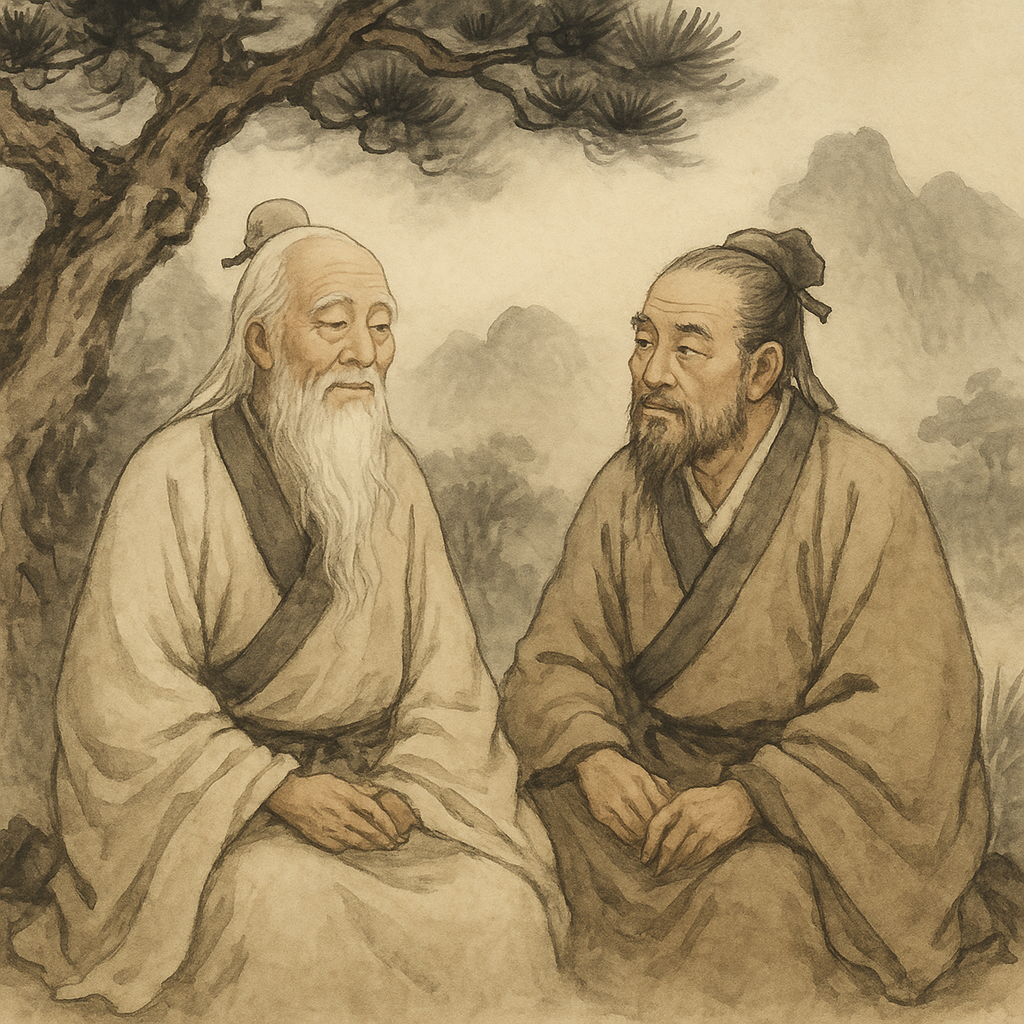
Following the Dao De Jing, additional texts appeared seeking to continue, interpret, and expand upon the ideas of Laozi. One of the primary among them is the Wenzi (文子), a work attributed to a disciple of Laozi, though most scholars view it as a later creation, compiled during the Warring States period or early in the Han dynasty.
The uniqueness of the Wenzi lies in its taking the abstract ideas of the Dao De Jing and connecting them to practical questions of governance, society, and daily life. If the Dao De Jing is a cosmic, almost poetic text, the Wenzi is more earthly: speaking on how a ruler should conduct himself, how an individual should act, and how a society can maintain balance.
Similar to the Dao De Jing, the emphasis here is also on action arising from harmony rather than compulsion, but in the Wenzi this takes the form of direct advice to leaders and the populace. It offers a way to apply the Dao within the political and social system, rather than solely as a philosophical or spiritual framework.
One might say that the Wenzi serves as the bridge between the evocative language of Laozi and the practical language of later teachers. It preserves the spirit of the Dao while attempting to render it practical, as a system of management tools, daily ethics, and insight into human-world relationships.
The uniqueness of the Wenzi lies not only in its direct continuation of the Dao De Jing, but also in the bridge it constructs toward Confucianism. If Laozi spoke of returning to nature, non-action, and the internal flow of the world, Confucianism places emphasis on social order, rituals, duties, and human morality. The Wenzi succeeds in integrating the two: on one hand preserving the principle of harmony with the Dao, and on the other speaking in a language familiar to Confucian society, a language of responsibility, proper governance, and human ethics. In doing so, it demonstrates that there is no necessary contradiction between the Way and order, but rather a possibility to unite the natural spirit of the Dao with the social framework of humanity.
The bridge between Daoism and Confucianism did not remain purely conceptual. As early as the Han dynasty (206 BCE - 220 CE), a reality formed wherein both schools coexisted side by side, influencing governance. Emperors utilized Confucian language to shape family structure, social morality, education, and discipline, yet in the background adopted Daoist ideas of balance with nature, moderation, and non-coercion. Thus a dual model of governance took shape: on one hand clear hierarchy and law, and on the other a recognition that law alone is insufficient, and that one must align with the grand course of things, with the Dao (道).
In this sense, the Wenzi was a seminal text: granting legitimacy to politicians, scholars, and officials to view themselves not merely as executors of duties and customs, but also as individuals connected to a broader universal principle. This allowed a bridging between two traditions that at first glance appeared opposing: one striving toward the natural and unrefined, the other emphasizing discipline and rituals.
On a personal level, the synthesis of Daoism and Confucianism creates a balanced way of life. Confucianism teaches social responsibility: filial piety, loyalty, rituals, order, and stability. Daoism serves as a reminder not to become trapped in formalism alone, but to listen to the flow of things, to breathe, release, and find the space where action arises naturally without coercion.
A person living solely by Confucian rules risks being overly harsh with themselves to the point of rigidity; a person living solely by Daoism risks distancing themselves from society and withdrawing. The integration enables a person to function within a community, fulfilling all duties and human connections, while remaining free in an internal sense: unattached, unforced, flowing. One could describe this as a dual bridge: in the political realm creating balance between strong governance and changing reality, and in personal life enabling balance between responsibility to family and society and faithfulness to deep inner selfhood.
Wenzi (文子) - The Cosmic Dimension - The Dao, Genesis of Things, Principles of Nature
The Dao as a Cosmic Principle
The Dao (道), as described by the Wenzi, is not a tangible entity, but the cosmic source preceding all form and residing beyond definition. It is a merged and complete entity, preceding the creation of Heaven and Earth, still, quiet, and soundless: an eternal void from which all things originate. Because it cannot be grasped, measured, or described in words, it was given the name the Way (道). A large portion of the Wenzi relies upon the wisdom and sayings of the pathfinder, Laozi, and the book as a whole is filled with quotes attributed to him.
"The Way (道) is so exalted its heights cannot be measured, so deep its bottom cannot be probed. It
envelops Heaven and Earth, receiving into itself all that is formless. Its source flows unceasingly,
surging without overfilling. When turbid, out of stillness it clears; when activated, its influence is
infinite. It knows no morning and no evening.
When one seeks to grasp it, it does not fill even a single palm; it is contracted yet capable of
expanding, hidden yet capable of illuminating, soft yet capable of being hard. It contains Yin and gives
birth to Yang, and through its power the three lights (sun, moon, stars) are made manifest. Mountains
rise from it, depths deepen through it, beasts run by its strength, birds fly through its aid, the Qilin
wanders within it, the Phoenix hovers within it, and the stars move in their orbits by its power."
(Wenzi, Chapter 1)
Thus, the Dao is not merely an abstract concept, but the force sustaining the world and nature's cyclical laws: the sun and moon, the seasons, the birth of creatures, and their continued existence. Its movement is consistently described as flowing, ceaseless, granting every thing its place without interfering in what transpires. It is an entity dwelling in an eternal void, observing what occurs while permitting the transformation of things, yet simultaneously all things spring from and rely upon it to be born, to exist, and to die.
"The Dao cannot be heard: if you think you have heard it, that is not it.
The Dao cannot be seen: if you think you have seen it, that is not it.
The Dao cannot be expressed in words: if you think you have described it, that is not it.
Who can truly comprehend the essence of the invisible, the form that has no form?
Therefore it is said:
When everyone knows what good is, it is no longer good.
One who truly knows does not speak,
And one who speaks does not know."
(Wenzi, Chapter 5)
This theme serves to describe the differences between the perception of Heaven and Earth, and the gaps between an earthly, intellectual, practical perception and an intuitive, sensory perception; yet the Dao (道) remains the concept residing beyond any spiritual-heavenly or earthly-practical approach, the unity balancing opposites and creating all that exists.
"It balances Yin and Yang, arranges the four seasons, harmonizes the Five Elements, waters plants, and penetrates metals and stones. Animals grow large and strong, their coats lustrous; birds' eggs are not spoiled, animal fetuses are not miscarried; fathers do not worry about losing their sons, brothers do not weep over the death of their brothers, children are not orphaned, women are not left widowed. No rainbow is seen (a sign of separation between Heaven and Earth), no thieves or robbers walk the roads: this is the fruit of manifestation in virtue."
(Wenzi, Chapter 1)
All the echoes of these statements establish the boundary of knowledge: the true sage is one who understands that non-knowing is itself the beginning of the path to knowing. Instead of attempting to define or directly grasp the Dao, the sage imitates its course: learning from Heaven and Earth, recognizing cyclicality, conducting himself with simplicity rather than excess.
"The sage does not force things,
But prepares the conditions:
He who wants fish directs water into the channel;
He who wants birds plants trees;
Water collects, fish arrive,
Trees grow, birds are drawn.
There is no need to drag the fish into the depths
Nor need to carry the monkey upon his trunk;
One simply allows creatures to follow their inclination.
Water becomes clear when it is still,
Clarity brings alignment,
Alignment brings simplicity,
And simplicity reveals the form of things.
When success arrives, the sage should withdraw.
Such is the Way of Heaven."
(Wenzi, Chapter 4)
The Balance Between Yin and Yang, the Four Seasons, and the Five Elements - Nature's Order as the Embodiment of the Dao
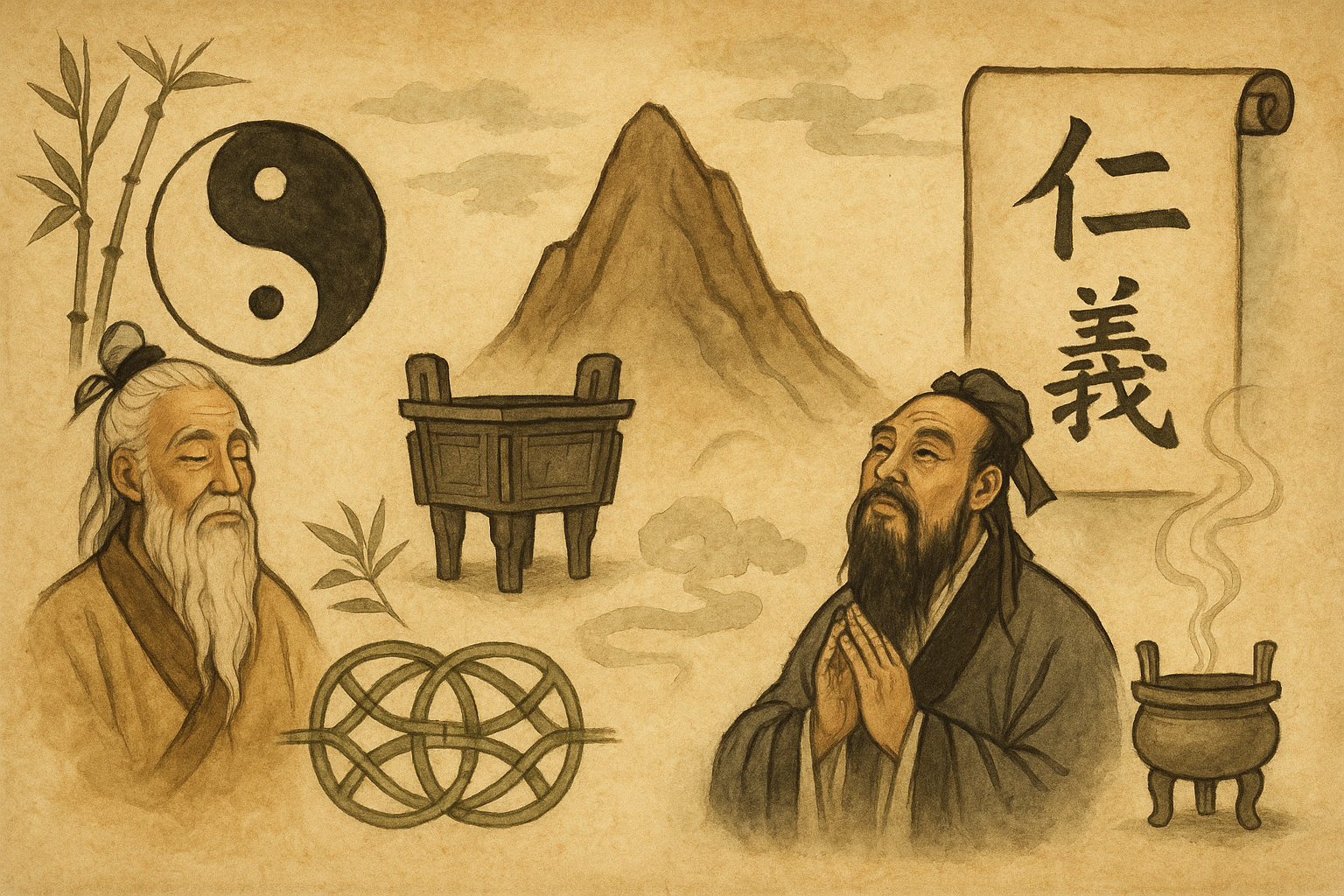
The Wenzi (文子) presents the Dao not merely as a primordial, abstract source, but as a principle ordering and manifesting itself through natural laws: Yin and Yang, the seasons, the Five Elements, and even human life cycles.
"Before Heaven and Earth were formed, all was deep, mysterious, indistinct, quiet, and clear.
The heavy, turbid matter became Earth,
The delicate, pure matter became Heaven.
From this the four seasons were born, and from this Yin and Yang divided.
Refined energy created man,
Coarse energy created insects.
Hard and soft balance one another, and thus all things were created."
(Wenzi, Chapter 3)
From this it becomes clear that the balance between Heaven and Earth, between softness and hardness, between refined energy and coarse, dense matter, is what enables the emergence of all things: everything is created from a union of spirit and matter. Man stands between Heaven and Earth, investigating his immediate, visible world to survive within it, yet his head remains raised toward Heaven, for there lies the delicate.
"When heavenly energy descends and earthly energy ascends, Yin and Yang meet, and all things dwell in
harmony. Then the noble person (Junzi) rises, and the petty person (Xiaoren) fades: such is the Way of
Heaven and Earth.
The Way of Heaven is to subtract from the full and add to the lacking;
The Way of Earth is to lower the high and elevate the low;
The way of spirits and gods is to humble the arrogant and exalt the modest;
The way of man is not to take from one who has much, but to grant to one who lacks.
The way of the sage is to place himself in the lowest position, where no one can surpass him."
(Wenzi, Chapter 4)
"Like the cycle of the twelve months, all revolves in a circle, returning and repeating,
Neither starting nor ending.
The five powers - Water, Wood, Fire, Earth, Metal - appear to oppose one another, yet in truth they
depend upon one another.
The Dao shall give birth to all things,
Its principles arranged within Yin and Yang,
Embodied in the four seasons,
And interpreted through the Five Elements,
So that each finds its place
And all moves in harmony with time.
Therefore, though the Dao does nothing,
All is done of itself."
(Wenzi, Chapter 6)
"When the body coalesces, the five organs take shape:
The Liver governs the eyes, the Kidneys the ears, the Spleen the tongue, the Lungs the nose, and the
Gallbladder the mouth.
The round head mirrors Heaven, the square feet mirror Earth.
Just as Heaven encompasses four seasons, five elements, nine divisions, and three hundred sixty
days,
So in man: four limbs, five internal organs, nine orifices, and three hundred sixty joints.
Man corresponds to Heaven and Earth, and the Heart is their master."
(Wenzi, Chapter 3)
Wu Wei (無為, Non-Action) as a Human Practice - Living in Harmony with Order
The Wenzi (文子) describes Wu Wei (無為, non-action) as one of the central insights of the Dao. Yet it is important to emphasize: this does not imply laziness or passivity, but action that forces nothing, action carried out in harmony with the order already present in nature.
"What is called non-action does not mean that if pulled you do not come, or if pushed you do not go...
it does not mean being frozen or closed. Its meaning is:
That personal desire does not intrude upon the public way,
That passions do not govern the paths of justice,
That deeds are performed according to natural principles,
And actions arise from opportunities already present."
(Wenzi, Chapter 6)
"The sage flows with the direction of what already operates, rather than attempting to impose artificial
order.
When something occurs, he does not cling.
When an action succeeds, he does not boast.
When a name is established, he does not hold fast to it.
All is done according to what already exists, not through compulsion, but through alignment.
The sage is not ashamed if his status is low,
He merely regrets if the Way (道) is not implemented.
He maintains inner emptiness
And true Wu Wei."
(Wenzi, Chapter 6)
"The supreme ruler (Dizhe) is called by name, yet no one knows his essence.
The supreme ruler is exalted by virtue of his De (德),
The ordinary king relies upon righteousness (Yi 義),
And the coercive ruler relies upon force (Li 理).
One who governs by scheme and cunning finds his heart troubled and confused.
One who governs by punishment and harsh laws is hated by the people.
And one who multiplies oversight and judgment causes the people to pretend goodness,
While corruption multiplies beneath the surface.
Therefore, the sage observes Heaven and Earth
And aligns himself with the changes of nature."
(Wenzi, Chapter 6)
"The great bell rings aloud, thereby wearing itself away.
The candle illuminates its path, yet melts in its own heat.
Stripes on the tiger's and leopard's skin are what draw hunters to aim their arrows.
Therefore:
One who relies on courage and firmness finds death.
One who boasts of wisdom and debate skills is bound to fail.
Intellect may be used to know;
Yet intellect cannot be used to know that you do not know."
(Wenzi, Chapter 4)
Wenzi (文子) - The Social-Political Dimension - Leadership According to the Dao
Degrees of Governance and the Distinction Between Types of Rulers
Wenzi opens his political discussion with a classification of four types of rulers, an order demonstrating degrees of leadership from the highest to the lowest.
"There are four modes of governance:
The Emperor (Dizhe) unites himself with the Taiyi (the Great Unity).
The King (Wangzhe) acts according to the laws of Yin and Yang.
The Hegemon (Bazhe) relies upon the cycles of the four seasons.
The Ordinary Ruler (Junzhe) relies upon the six regulations (a rigid system of laws)."
(Wenzi, Chapter 7)
The true emperor, united with the Taiyi (the Great Unity), requires virtually no external mechanism of control: he reflects the Dao itself in his body and actions, and leadership springs from him naturally. The king, lower in rank, maintains the balance between Yin and Yang. The hegemon imitates the seasons: possessing order, yet relying on external timing rather than inner harmony. At the lowest level sits the ordinary ruler, relying upon a system of rigid laws and regulations.
Corruption and the Decline of the Dao
"In ages of decline, when rulers have lost the Way,
They excavate mountains and rocks, extracting gold and diamonds,
Mining pearls and precious stones, taxing copper and iron,
Yet the world fails to prosper.
They cut open wombs and sacrifice fetuses, burning ancient sacrificial fields,
Destroying nests and breaking eggs, until even the Phoenix flies no more.
Yet all this destabilizes the cosmic order:
Yin and Yang are disrupted, the seasons confused."
(Wenzi, Chapter 10.6)
"In times of such crisis, sages and saints suddenly arise:
They bear the Dao, strengthening humanity and righteousness, uniting the near and distant.
They unite the entire land,
Establishing a new order, expelling the wicked and informers,
Eliminating cruel laws, abolishing unnecessary decrees.
They turn their path back toward nature:
Seeking simplicity, eliminating luxury, quelling cunning.
The sage does not create the moment, but knows how to recognize it
And does not miss it."
(Wenzi 10.7)
The Role of Ministers and Relationships with the Ruler
"The Way of Ministers (Chendao): when deliberating matters, they should be the first to propose
solutions, preserving their post and distinguishing spheres of authority, thereby achieving genuine
success.
For this reason, if ruler and ministers walk different paths, there is order.
If they walk the same path, there is confusion and chaos.
Each must know his place and act within his domain."
(Wenzi, Chapter 9)
The Position of the Ruler
"Like a whale stranded out of water, controlled even by ants,
So a ruler who relinquishes his position and post, intervening in the struggles of his officials,
Ends up controlled by his assistants and officials.
Like a simple carpenter attempting the work of a master craftsman, he rarely avoids injuring his
hands.
Yet if he mounts the carriage and allows one who understands horses to drive,
He arrives a thousand li without effort.
So with a wise ruler: utilizing the talent of others,
He goes far without wearing himself out."
(Wenzi, Chapter 8)
Wenzi (文子) - The Ethical-Practical Dimension - Balance Between Humility, Proper Measure, Self-Control
Self-Control and Proper Measure - The Sage as a Model for Inner Balance
"The Way of Heaven: when it reaches the extreme, it returns. When full, it diminishes.
The sage accordingly contracts himself daily, not daring to fill his spirit.
Human nature constantly strives toward the opposite:
Seeking the high and hating the low.
Seeking possession and fearing loss.
Therefore the sage imitates Heaven:
Without doing, he fulfills.
Without grasping, he attains.
He shares human emotions, yet walks a different path, and therefore endures long."
(Wenzi, Chapter 3)
"Heaven loves pure essence (Jing 精),
Earth loves balance (Ping 平),
Man loves his emotional nature (Qing 情).
Therefore when man closes the four gates (the senses)
And halts the five paths (the five routes of desire and perception),
He absorbs into the Dao and merges with it.
This is called the True Person (Zhenren 真人)."
(Wenzi, Chapter 7)
Corruption, Decline, and Social-Political Crisis
"Rituals and laws (Li 禮) shape and sculpt human nature,
Bending emotions and compressing character.
The eye may desire something, yet the law forbids looking upon it;
The heart may rejoice, yet rituals limit its joy.
If you cause people to fear the law, perhaps they will refrain from stealing,
Yet far better is to deepen within them so that in their hearts no desire to steal exists.
The root of disaster is always in desire."
(Wenzi, Chapter 10)
The Proper Way of Kingship - Governance in Harmony with the Dao
"Since ancient times, no person has ever succeeded in being perfect in deeds.
Therefore, a wise person (Junzi) does not demand perfection from others.
He is precise yet not cutting, modest yet not wounding, upright yet not rigid,
Broad-minded yet not despising others.
The sage integrates the Way, morality, power, and compassion:
He does not compel people by force, but rectifies himself."
(Wenzi, Chapter 9)
"Of all the breaths of Heaven and Earth,
None is greater than harmony.
Therefore the way of the sage is such:
He is broad yet resolute,
Meticulous yet compassionate,
Soft yet upright,
Vigorous yet full of mercy.
For one who is overly harsh breaks,
And one who is overly soft is crushed.
The proper Way lies in the middle:
Between harshness and softness, between firmness and flexibility."
(Wenzi, Chapter 8)
"When there is balance between movement and quiet, trouble does not penetrate.
When there is balance between taking and giving, guilt does not accumulate.
When there is proper measure between love and hatred, worry does not draw near.
When there is harmony in joy and anger, hostility does not touch you.
The sage lives in moderation:
Possessing enough to eat,
Enough to wear,
Enough warmth to preserve his body,
Requiring nothing beyond."
(Wenzi, Chapter 7)
Wenzi on the Connection to Confucianism
Within the thought space of classical China, a fundamental debate developed lasting centuries: how best to lead person and society. At its center stood two primary schools: Daoism and Confucianism. Confucianism viewed man as an incomplete creature to be shaped through education, rituals (Li 禮), social morality (Ren 仁), righteousness (Yi 義), and laws (Fa 法). Daoism emphasized returning to the source, to the Dao, recognizing that true harmony is not created through external compulsion, but from nature itself.
Wenzi emerges as a unique intermediate voice. He does not reject Confucianism entirely: recognizing the importance of values like Ren (仁, humanity) and Yi (義, righteousness), and even comprehending the place of laws and rituals in ordering social life. Yet he places them as secondary, derived from the Dao. Rituals and laws are valid so long as they remain connected to their root; when severed from the Dao, they become empty and distort human nature.
Morality and Ren (仁) - Love of Humanity as a Basis for Governance
"When strict laws of judgment and punishment are enacted, the people become resentful.
The sage acts differently:
He ensures wellbeing and security before distress approaches,
And foresees distant dangers before they arrive.
Therefore:
There is no greater Ren (仁) than loving human beings,
And no greater wisdom than knowing human nature.
When there is love of humanity, there is no need for punishment.
When there is understanding of human beings, there is no need for harsh and cruel rule."
(Wenzi, Chapter 5)
Laws and Rituals - Flexibility Versus Rigidity
"Are there truly fixed laws of governance in the world?
In the distant past, the three ancient emperors issued no decrees and introduced no laws, yet the people
willingly obeyed.
In the Xia dynasty, a promise sufficed.
In the Yin (Shang) dynasty, oaths were required.
In the Zhou dynasty, written covenants were already required.
One who clings too rigidly to laws cannot lead far-reaching changes,
And one bound to rituals and formality is incapable of responding to changing reality."
(Wenzi, Chapter 9)
Righteousness (Yi) and Law (Fa) - The Root of Order
"Laws (Fa) are born of righteousness (Yi).
Righteousness is born of aligning affairs with the common will, and this alignment rests upon what
connects with human nature and the heart.
Law is not sent from Heaven, nor does it spring from Earth: it arises from human society itself, based
upon each person rectifying himself first.
If the ruler himself bypasses the law,
Then the law is no law.
The principle is equal:
One who is honored and of high status receives no leniency.
One who is low and poor is not excessively punished."
(Wenzi, Chapter 9)
Wenzi establishes himself as a unique voice within the Daoist tradition: not content with cosmological contemplation of Yin and Yang or Wu Wei, but seeking to apply these principles to the life of the individual, society, and the state. On one hand, touching the heart of Daoist thought: natural harmony, inner emptiness, balance, and non-coercion; on the other hand, conversing with Confucianism, speaking of morality, righteousness, education, and law, yet offering them a different interpretation: not as external rituals sculpting man, but as ways to return to the root, to the Dao.
Thus it becomes clear that the profound message of the Wenzi is a call for balance: between governance and freedom, between law and nature, between morality and spontaneity, between framework and emptiness. It offers a model wherein person and ruler alike do not attempt to invent an artificial order, but live listening to the existing order, the rhythm of Heaven and Earth. In this sense, the Wenzi is not merely a commentator on the Dao, but formulates a bridge: between philosophy and governance, between individual life and social order, between the Dao and Ren-Yi (仁義, humanity and righteousness). A bridge continuing to remind us, people of this age, that true wisdom lies not in rigid laws or momentary schemes, but in the capacity to remain open to emptiness, balance, and the natural flow of things.