An Article on Chinese Medicine: Security - Reality or Illusion?
The central topic occupying most human beings is the desire and aspiration to be happy. But the concept of "happiness" varies according to a person's perspective, making happiness a subjective concept: spiritually, happiness depends upon the person oneself rather than external factors, thereby resting upon the degree of self-acquaintance, inner state of mind, belief system, education, and the culture in which one grew up and was shaped.
True happiness does not necessarily stem from abundant action, nor from the splendor of external success, but rather from the ability to set a simple and profound goal: to truly accept oneself and live as such, day after day. To bring one's selfhood into a balanced consciousness that recognizes in advance the existence of two poles, the ebb and flow, light and shadow, containing them as they are, much like the interaction of Yin and Yang.
In Chinese thought, the perception that man is a microcosm of the entire universe created a tradition of attuning to the flow and harmony with what surrounds us. In the spirit of Daoism, man is invited to contemplate what exists, recognize cyclicality, and work with the natural movement of Qi through the seasons, time, climate, and transformation. What is called: being in the flow. Emerging from coordinated action of Qi movement: whether in the clinic, practice, ritual, nutrition, speech, or demeanor. This enables connection to that which transpires above (Heaven), reflecting it below (man and Earth), leading to a deeper balance in body and consciousness, which is assimilation. This perception extends beyond personal health, affecting broader systems: education, governance, agriculture, economy, and family are all influenced by our ability to flow with cosmic order, rather than attempting to dictate terms to it or act against it.
Ancient Culture
As ancient Chinese culture developed, according to the period and imperial dynasties that ruled it, ideas and approaches underwent various variations, and the connection between above and below, between man and divinity, strengthened or weakened according to the spirit of the times. In the traditional structure, the emperor was the earthly representation of the divine position. His role was to mediate connection with Heaven through systems of laws, rituals, and values designed to preserve harmony with above. This is a value not merely to be believed in, but lived in alignment with. When this connection was alive and present, it was meant to manifest in reality itself: days of peace and quiet, abundance of crops, available resources, and an absence of natural disasters. Conversely, when this harmony was disrupted, periods of war, floods, droughts, conflict, or suffering appeared, serving as an expression of a disrupted connection with the celestial.
Ritual occupied a central and profound place in daily life, emphasizing the importance of the external framework of ritual, intention, and synchronization with time and place. Yet within that very ritualism existed a movement of fear, apprehension of celestial punishment or straying from the path. This was what Daoists sought to deconstruct. They opposed an approach based on effort, flattering Heaven, or action performed out of fear. For them, celestial cyclicality is natural, neutral, and requires no forced attunement. High and low tides, rise and fall, do not represent good and bad, but that which occurs of itself. Connection with Heaven, in their view, should be simple, authentic, devoid of effort, arising from the very essence of living existence.
Yet over the years, as man distanced himself from direct connection with the celestial, an emptying of content began. Concepts of time and seasons gradually lost their meaning. This can be clearly seen in our time: clothing stores no longer depend on seasons, nutrition has become artificial, and one can eat an avocado or an apple in any month, irrespective of nature's cycles. The desire for celestial connection transformed into a desire to accumulate: money, property, status, prestige. Thus, the material world took the place of God. Instead of living in harmony with the cosmos, man moved to live in an urban, detached, demanding space, wherein virtually no trace of alignment with Heaven remains, only a pursuit of control over that which was never meant to be controlled.
Yearning for Stability and Security
While some believe the starting point for life is freedom, lack of attachment, and an open identity, for many human beings, security and stability are fundamental conditions, solid ground from which processes begin and build. Man requires a framework, definition, and clear location: not only to avoid getting physically lost, but to avoid becoming lost consciously and losing oneself. Consequently, vast energy, perhaps primary, is directed toward repeatedly checking our degree of security, stability, and grounding within physical reality. Human beings examine their condition time and again, not only in relation to themselves, but also in relation to others. How successful are we? How stable are we? How secure are we? When difficulty arises and reality presses, we are required to reposition ourselves: marking ourselves and those around us in space. Not out of serene observation, but as part of a survival navigation software, for reality, in its essence, lacks a firm hold. The world changes constantly, always moving. It does not ask us before it shifts.
And so the question arises: what is this security for which we yearn so deeply? Is it truly an expression of stability, or perhaps an illusion designed to soothe fear?
The need for security is often a reaction to the fear of uncertainty: a need to stop the trembling. Yet trembling is an integral part of existence. The desire to be secure is, frequently, a desire to resolve fear, not life. But life itself cannot be resolved. It changes. The results we achieve, success, targets, all decay. The moment a person attains something, the value attributed to it dissolves, and one immediately yearns for the next thing. This is a cycle of suffering, for consciousness becomes outcome-oriented. Every goal generates another goal. Every attainment spawns further hunger. This is not fulfillment, but a perpetual hunger for replenishment. Conversely, when security rests upon clear self-knowledge, patience, listening, and acceptance, rest becomes possible. An inner ground upon which one can lean is enabled. Not because it is objectively stable, but because the person is connected to oneself.
Awareness strives to accept. Not the outcome, but the being. Who you are right now. Not as a process requiring repair, but as a selfhood that already possesses validity. This demands knowledge beyond definitions, beyond time, beyond space. It is a state wherein a single continuum exists between the "I" and the divine, and there, within that continuum, definition is unnecessary.
Love for selfhood is not indulgence or comfort; it is the knowledge that the "I" is already complete in its source. Gaps between us and this perfection arise only from thoughts, fears, habits, and mistaken perceptions. These impose conditions, limit love, and drain the experience of life. But when the seeker unites with the knower, the passion to truly know is born. To truly strive. To move from within oneself, not from without.
Still, it is important to remember: man lives in a body. Physical, temporary, material, limited. He is required to realize his spiritual choice within contradictory structures, inside a world containing pain, boundaries, and complexity. Therefore, internal balancing work is not merely a spiritual concept, but an embodiment of connection between Heaven and Earth, for even if everything is consciousness, the body is the vessel. If the vessel falls apart, consciousness too risks losing its anchors.
The universe moves in cycles of peak and trough, and uncertainty is precisely what drives processes forward. Can a human being truly claim complete security and assert stability? Or do thoughts of insecurity creep into everyone, threatening to collapse the social facade constructed with such great effort? And if complete security indeed exists, why do people preoccupy themselves with this subject constantly?
Chinese Thought on Security
When a person identifies this Shen within oneself, living by its light and drawing from it, true security begins there. In Chinese thought, the sense of security consists of at least two components: a forceful element and an emotional element. This is a delicate tapestry wherein fear and force, emotion and movement exist side by side. At the base of the feeling almost always lies fear. This is an emotion originating in the Water element, so any process involving emotion carries some fear in its foundation: of the unknown, loss, dissolution, or loss of control. It is a quiet, subterranean force, yet it is what drives man to seek, change, hold on, and advance.
To cope with fear, the force element is activated. Movement. Push. Action. This is the Wood element. It brings outward that which Water attempted to conceal inward. As in all things in life, the sense of security is multi-layered. Every person, according to one's level of self-awareness, will choose to operate from the layer most comfortable: some choose to lean on the layer of action, force, ability to function; others discover courage and turn directly into the emotional layer, the uncomfortable one requiring recognition of fear.
When the sense of security rests solely upon force, it becomes illusory. The modern world provides countless examples of external security, neatly packaged, concealing an internal void, slight tremors that require only a moment of shaking to expose. Security founded on constant movement, forward drive, control over details, achievement, yet all occurring without truly recognizing the fear beneath. This is security devoid of truth.
Conversely, when a person is willing to look at fear, admitting weakness and discovering emotion within, only then can force (Wood) awaken out of truth. In such a state, action does not ignore emotion, but emerges from within it. It stems from it. Wood emerges from Water. Movement is born from contemplation.
This is a subtle movement: Water nourishes Wood, Wood controls Earth, and Earth controls Water. A complex cycle wherein no element dominates another, but complements it. Only when a genuine connection exists between emotion and action, between recognition of fear and forward drive, can a person be said to act out of true security. Therefore, security is neither external quiet nor artificial stability. Nor is it an outcome. True security is knowing. Self-knowledge. It is a deep conscious anchor recognizing the tools of consciousness (sensation, emotion, thought) and knowing how to move them together in the same direction. This is a security based not only on Earth, but also on Heaven. It exists out of connection to the Shen, that supreme aspect of the soul residing beyond the physical plane, eternal, unified, unchanging.
The Theory of the Five Elements
Observing through the principles of the Five Elements, the concept of security can be mapped across three primary forces: Water, Wood, and Earth. Three elements, three trends, three movements, each reflecting a different aspect of what we term "a sense of security."
Emotion originates in the Water element: it is fear, hesitation, the need to check and investigate prior to action. It is connection to depth, internal history, memory, and the unknown. Force stems from the Wood element: this is forward movement, drive, realization, the capacity to break boundaries and initiate despite fear, bringing potential into actualization. Stability comes from the Earth element: it holds everything, seeks routine, strives to preserve the state, connecting to ground, responsibility, and quiet; it is that which holds all.
These three elements create among themselves a complex system of interactions. Water nourishes Wood, Wood controls Earth, and Earth controls Water. This is not merely a cycle, but an insoluble triangle of relationships, for each requires the other, and each can disrupt the balance of the other.
And this is precisely what makes security such a complex concept: for Water to nourish Wood, it must be strong, yet not flood. For Wood to control Earth, it must drive forward, yet not push excessively. For Earth to balance Water, it requires stability, yet not fixation. This is an existential paradox. Every movement requires its counterpart. Every stability requires movement. Every fear requires courage. Every such relationship carries within it contradiction, tension, and a riddle lacking a singular resolution.
Therefore, according to the theory of the Five Elements, one cannot reach absolute security or fixed stability. Security is not a finished state, but a dynamic system of changing relationships, and the capacity to live within this system, without demanding permanence or perfection, is itself the key to balance.
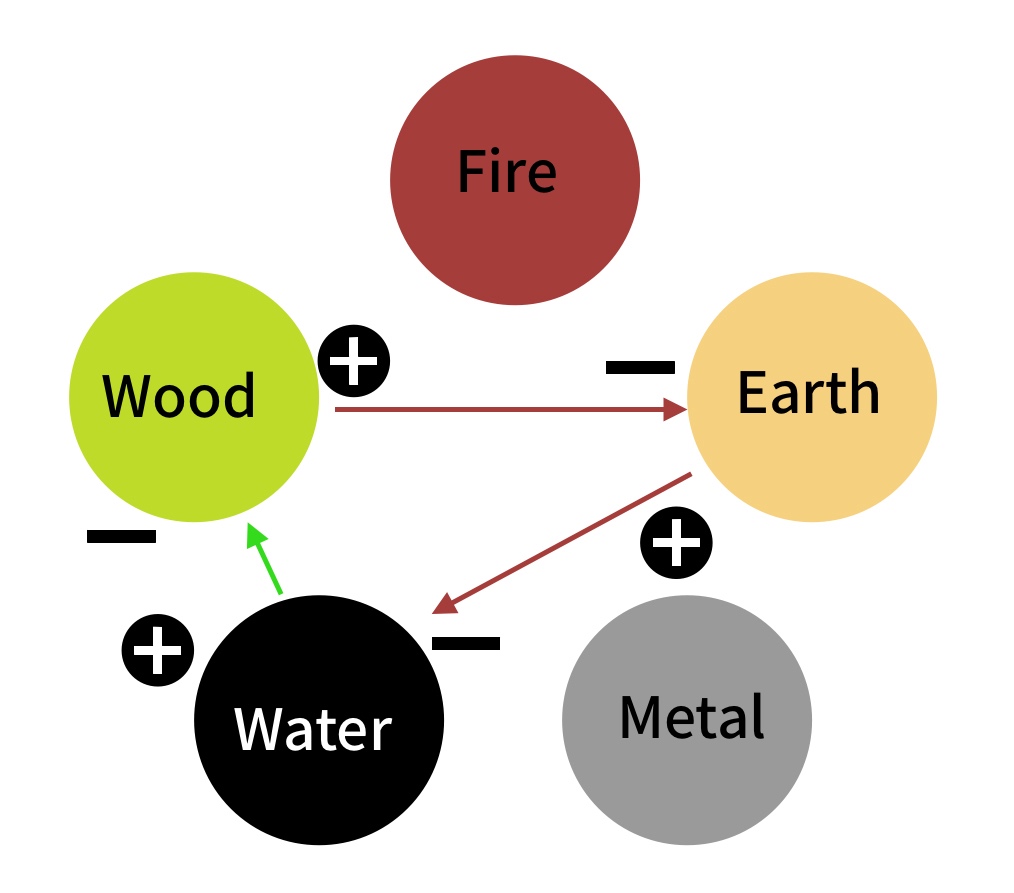
The Cycle of Relationships Between Water, Wood, and Earth
The Water element nourishes the Wood element in the Generating Cycle, for every action in the world begins with emotion, will, a quiet passion pulsing from within seeking to burst outward. Water, representing will and fear, the inner world, the root of consciousness, is the force from which the primary drive for action springs.
When the Wood element acts, it brings potential into actualization: initiating, planning, pushing forward. But for this push to truly exist, it must be nourished by genuine emotion, deep desire, rather than a forced or detached place. When a person suppresses emotion, one also suppresses the desire driving action, and thus action itself. Emotion is not a delay; it is the foundation. And Water, as long as it is not flooded, is a powerful, consistent, and enduring source.
When action begins in the Wood element, it naturally strives to reach its peak, Fire, where fulfillment, warmth, and expression reside. But for our understanding here, let us set Fire aside for a moment. What is important is to understand what happens in the process itself: how direction is maintained, how one remains connected to the ground while in movement. Here Earth enters.
Earth is that which brakes vertigo, grounds, balances, and stabilizes. It allows action to be not merely vigorous, but measured. For one can run fast, but without stable ground, falling is inevitable. Good Earth stabilizes Wood. However, when Earth is overly strong, when the need for stability becomes paramount, it can halt movement entirely. Then, instead of stabilizing, it suffocates.
Therefore, energetic hierarchy is required: Wood (movement) needs to be at higher intensity than Earth (stability) according to the Controlling Cycle, so that action remains alive and breathing, rather than stuck in over-preservation.
Earth, as controller of Water in the Controlling Cycle, directs emotion toward purpose. It prevents Water from sinking into itself, carried away in cycles of doubt, fear, or procrastination. It uses thought (Yi) as a conscious tool anchoring emotion and directing it. It creates boundaries not to limit, but to contain the self within. When emotions rise, one after another, unsettling stability, Earth offers a counterweight. It does not deny emotion, but helps it assimilate into a complete, stable, and active system of life. Water naturally disperses, that is the nature of emotion. Earth does not block, but holds Water within it.
What Is Seen in the Clinic?
When examining the topic of security in a person's life, the initial perspective, both of patient and at times practitioner, will identify security as a derivative of the Earth element: stability, routine, belonging, familiar circles. Indeed, Earth is the ground, providing shelter to the entire inner structure. Yet if we go deeper, we discover that true security resides not in Earth itself, but springs from the depths of Water.
The Water element, with its profound depths, holds the sense of inner knowing. Only a person acquainted with oneself, having investigated one's fears, conscious patterns, and inner truth beyond definitions, can feel true security. Not security resulting from "arranging life" externally, but inner quiet from contact with the root.
Therefore, in the clinic, it is insufficient to strengthen Water in a technical or symptomatic manner. One does not "strengthen Water" like adding Qi or matching pulse rate. Patient self-awareness is an integral part of the process. Dialogue, inquiry, questions arising in the room, mode of observation, agreement to meet emotion, are no less important than needles or herbs. Many practitioners emphasize dietary changes or treating physical issues, but is self-contemplation not the heart of the healing process? Is Chinese medicine truly just a system moving Qi from place to place, or is it the art of balance, listening, and gentle inquiry into a changing relationship between conflicting life forces?
To illustrate how a sense of security or its absence is reflected in the clinical encounter, I present several cases: birth charts and basic data alone, without entering excessive detail regarding acupuncture points or the course of the treatment itself. The reason is simple: every therapeutic process is personal and depends upon the patient's personality structure, pace, main element, and pulse, which is the decisive factor in any clinical decision because it is the parameter reflecting reality.
However, there are guidelines I try to adhere to: if within three to four treatments (about two weeks to a month and a half) there is no significant change on a sensory, conscious, or physical level, the diagnosis must be re-evaluated. Not because the process failed, but because something might not have been apprehended correctly, targeted precisely, or matched to the stage in which the patient currently exists. Chinese medicine is not an abstract theory; it is an encounter with time, the season, the body in this moment, and the capacity of the person facing me.
Case Study
Woman, schoolteacher, chief complaint: fibromyalgia.
She describes severe fatigue, weakness, general pain moving from place to place, coming and going without clear lawfulness. But beneath all this, she articulated herself in a single sentence clarifying much: "I cannot rely on my body. I have no strength, and I feel my security has been shaken."
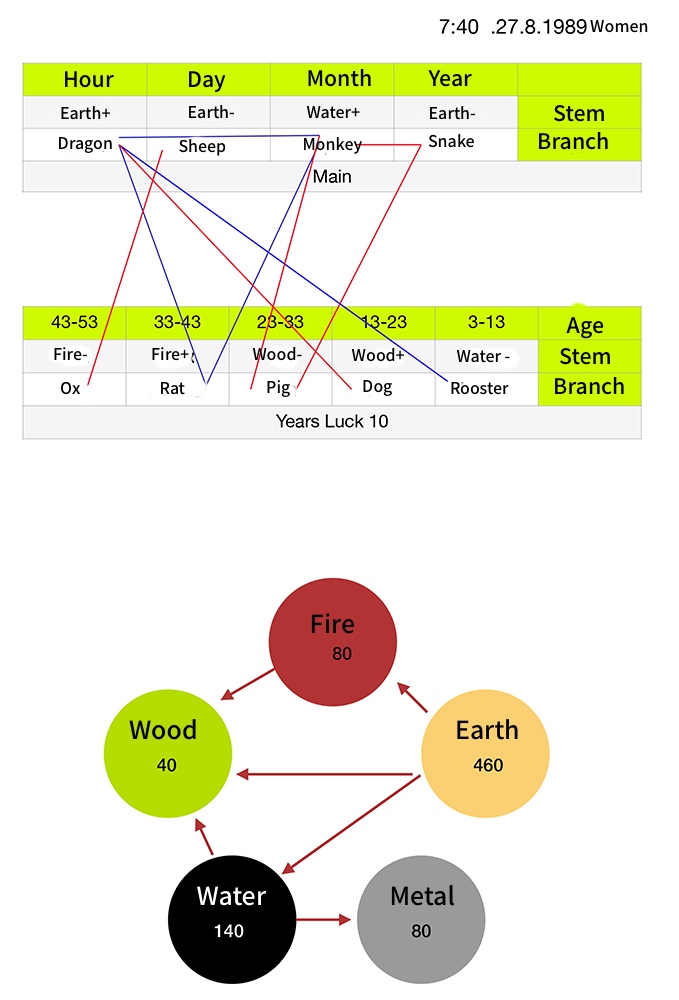
The root here is not merely pain, but a shaking of internal security. Losing the ability to rely on bodily sensations, not knowing when it will "function" and when not, creates a gap, detachment, hidden anxiety, and lack of trust. This is not a complaint of pain alone, but an existential experience of slipping ground.
In terms of elements: there is weakness in Water, harm to the deep anchor enabling a sense of inner stability, and a lack of Earth support: the ability to ground, contain, and bear daily life. Often, when Water and Earth do not nourish one another, a cycle occurs wherein will weakens, the sense of strength "running out" persists, and sense of self becomes clouded.
In this case, therapeutic work touched not only the body, but also the structure of self-sense, on the question: what can one lean on when strength is absent? And the first response was: to begin hearing the body without thinking of it as "disappointing," but as one requesting gentler listening.
The Earth Element as a Central Axis
In her Four Pillars of Destiny chart, the Earth element appears as the strongest element: the Day Master is Yin Earth. This is an organizing, supervising, mediating element, though not necessarily functional or operational. Yin Earth as a primary structure points to a person operating from deep emotional responsibility, frequently out of an inherent imbalance between receiving and giving.
In practice, this is a woman driven by the need to give and meet expectations, not because she possesses strength, but because she feels it is her duty. "The more tired and pained I am, I have no desire. But I continue. Because one must."
This feeling, that responsibility is what holds her, exhausts her from within. There is an ongoing emotional burden leading ultimately to emptiness. Although she receives love and recognition from her surroundings, her internal feeling is one of continuous lack, lack of fulfillment, lack of satisfaction, and above all, fear that one day she will no longer be able to function, resulting in loss of livelihood and meaning.
She holds an action perspective of "giving maximum all the time" and being responsible for everything continuously, even when unsuited to her physical or mental state. This is not merely an approach to life; it is a survival strategy. For her, responsibility is proof of existence. If she is not responsible, she has no right to exist in the workplace.
And this is precisely the trap. Every decline in energy, every retreat of Qi, translates immediately into pressure and anxiety. There is no stopping, no re-evaluating the mechanism of action. She does not stop to examine herself, for she is busy holding on. On a physical level too, the mechanism is clear: constant pain, fatigue, feeling at the end of her strength. The only action she still succeeds in performing is within work, and there she burns her entire energetic stock. In the afternoon? Collapse. Lying on the sofa. Emptiness.
Clinically, there is a clear need to move Qi, disperse wind, release stagnation, and drain dampness. But without a change in self-perception, any energetic "filling" we treat will find its way to depletion. The problem lies not merely in muscles or meridians, but in the internal belief that her identity stems from the capacity to give.
The conclusion here is sharp: fibromyalgia is not merely a "disease," but a physical expression of a deep conscious state. It is the way the body tells a story: "I do not know how to stop, so the body stops me."
The Relationship Between Elements
When the Yin Earth element appears as a primary element, an internal system of relationships emerges that strives not necessarily toward action, but toward organization, control, oversight, and deep emotional involvement in space. But as we have seen, this is an excess of Earth managing the system, while its resource, the Fire element, is lacking.
Theoretically, one could say Fire should be strengthened to "fuel" Earth. But in practice, this is a therapeutic trap. Continuous strengthening of Fire will further strengthen Earth, which is already in excess, increasing fixation, emotional burden, and the sense of obligation that prevents real change. This Earth "yearns for Fire" merely to continue holding the old world. In other words: any strengthening of Fire will be translated by it into further drive to continue in precisely the same manner.
The next nine years: Yang Fire - Rat (Water). She is currently entering a 9-year period (ages 33-43) with Yang Fire in the Stem and Rat in the Branch, wherein her primary encounter will be between Water and Fire. These are two poles: Water invites inner inquiry, quiet, depth, while Fire pulls outward: toward recognition, appreciation, success, achievement, and attention. And what factor mediates between them? The Wood element.
Wood is the axis. It is nourished by Water and nourishes Fire. Therefore, if she can connect to her Wood, she can create change: moving from the desire to shelter under a constant sense of responsibility to the capacity to identify true personal desire. If she can see herself not merely as a mediator, organizer, one "without whom everything collapses," but as a complete person whose developmental process includes releasing control, allowing others to act, participating without leading, perhaps something deep will shift. For in truth, the greatest fear she lives with is: "If I do not give my all, people will stop wanting me." This is not merely fear of function; it is fear of rejection.
If we look at the element chart, we clearly see the dynamics: excess Earth, deficient Water, trapped Wood, and Fire weakening and draining. If we translate this into an image: she lives inside a swamp, metaphorically and emotionally. Earth sinks into itself, blocks Water, harms Wood movement, creating fixation disguised as responsibility. The only way out of this swamp is to turn the concept of responsibility around: from responsibility over others to responsibility toward oneself, from holding the world to listening to desire. And here the concept of security returns. Her security currently rests upon fixation, not flow. It is not the product of internal recognition of Water, but the product of attempting to hold a crumbling structure. As long as there is no connection to Water: to desire, depth, quiet, root, security will remain illusory.
Second Case Study
Another case from the clinic: a man, age 42, main complaint: anxiety and insomnia.
Of course there are additional symptoms, pulse findings, and further diagnoses, but let us set those aside to focus on the central question he raises: he seeks emotional relief and a sense of security. He feels unsettled, not only recently but throughout most of his life, across all levels: physical, emotional, and conscious.
In this case too, the full clinical picture is not analyzed deeply here, neither pulse, acupuncture points, nor treatment plan, for the goal is to present a different perspective on the concept of 'security' derived from clinical experience. The emphasis is not only on what the patient describes, but primarily on what he seeks to feel: an inner anchor, basic stability, and recognition that he is not condemned to live in continuous anxiety.
Security Resting Upon Control
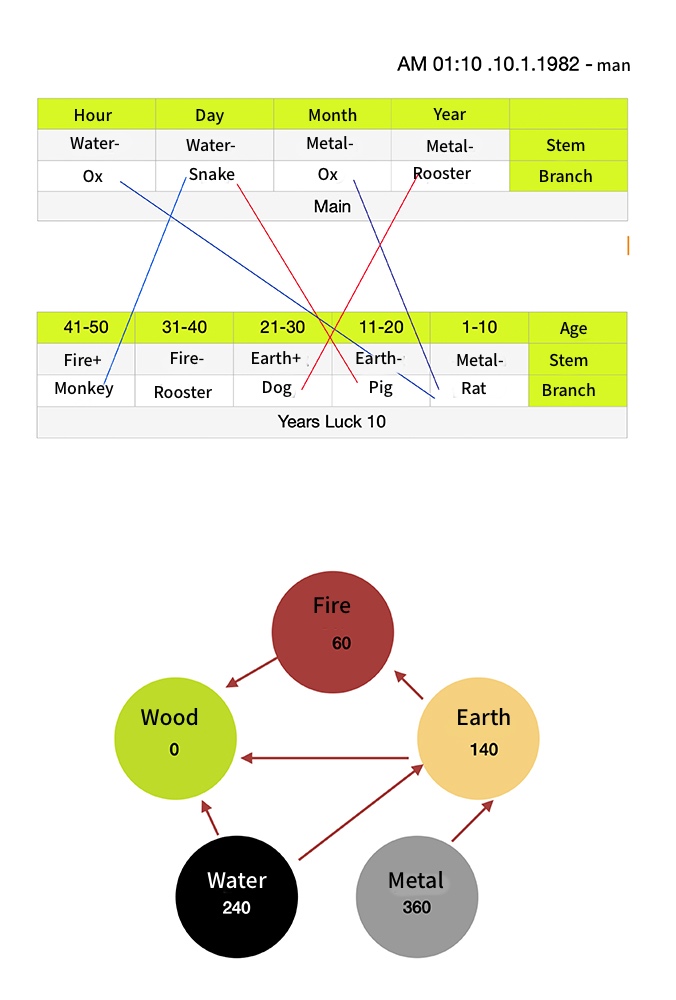
In general, the man belongs to the Yin Water element, evident in both his external appearance and communication style. He is hidden, quiet, keeping to himself. Communication with him does not occur easily: he is diffuse, very closed, yet as he gains trust, words open, and the little said expresses deep sensitivity, vulnerability, and rare honesty.
Most of his energy, meaning how he perceives reality, is concentrated in the Metal element and Water element. These two elements are characterized by traits of closedness, restraint, withdrawal, and a perspective of control. When Yin Water, the deepest element, receives strong support from Metal, the result is the construction of a system of control: self-discipline, intellectual walls, adherence to facts and logical patterns, all aiming to generate a sense of security through control.
Throughout most of his life, guidance received from his environment, education, therapies undergone, and even medications, was to suppress emotion. The indirect (and sometimes direct) message was: emotion is a threat. Therefore, he learned to invest heavily in developing an intellectual consciousness, building a "smart system" capable of explaining, analyzing, and critiquing every sensation. High intellect, logical precision, rejection of anything inexplicable. This was the primary path he chose. Yet he turned to Chinese medicine and an alternative approach because he understood that this path, despite consistency and control, brings no true relief.
And the vast intellectual effort invested, the attempt to grasp, articulate, and control everything, only intensified internal struggle. As long as he rejected emotion as unreliable, a "problematic" factor, he pushed it into an unprocessed depth. But emotion did not disappear; it accumulated and overflowed. Thus appeared anxiety, conscious disruption, sleep difficulties, and loss of the sense of security.
This is a classic case where security is perceived as an attempt to control: he appears strong, acting thoughtfully, yet has constructed a rigorous Metal infrastructure designed to block emotional flow. He analyzes failures and disappointments, planning prevention mechanisms so as not to "fall again," building a rational protective wall. The problem is that this is not merely fear of exposure, but primarily fear of loss of control, which is the core of mental tension.
Insecurity and the Struggle Between Intellect and Emotion
As noted at the beginning of the article, when emotion is not driven to action, it manifests as insecurity. This is a state where a person feels much, yet does not act. Emotion remains trapped inside, and action is blocked. Insecurity and the desire for control are like oil and water: insecurity is the result of deficient emotion, while the desire to control is excess intellect. Their combination, rather than creating balance, perpetuates the struggle between intellect and emotion, testifying to a deep conflict in consciousness.
In the case of the patient described, the Water element (emotion) is not connected to the Wood element (acting force). In other words: a rich inner world exists, emotional, full of ideas and images, yet lacking the capacity to translate them into action. Emotion retreats into itself, and excess Metal controls Wood, meaning intellectual thought denies any possibility of action in advance: "It is unsafe," "It will not succeed," "It is not worthwhile," "It will only cause me further suffering." Thus intellect paralyzes will, and the person finds oneself wallowing in fears, doubts, and a sense of disruption.
Returning for a moment to the three central elements composing the sense of security (Water, Wood, Earth): excess Water (emotion), deficient Wood (action), deficient Earth (stability). This is an unbalanced triangle: the person experiences emotional abundance, yet lacks drive to express emotion outward (lack of Wood), and lacks an inner anchor or grounding (lack of Earth). Thus he lives within relentless emotional fluctuations: swings, waves, storms, moments of quiet, like the vast sea.
Inner emotional content: fears, doubt, tension, mental illusions, sense of insecurity, constant experience of threat. All this leads to an increasing need for control, as if one could control emotion and neutralize it through order and logic. But Water does not operate thus. Emotion indeed needs to be managed, yet not through control, but through self-awareness. This is the subtle yet decisive difference: control seeks to eliminate emotion; awareness allows containing it, understanding it, and giving it place.
The Process of Progress, Regressions, and Security
In this case, a process occurs where he seeks clarity and security, yet fails to see that the solution he found for himself over the years may have enabled survival, but is unsuited to his personality structure. Ostensibly, the basic therapeutic approach in such a case is to strengthen Wood and Earth, to move, stabilize, and calm the mind, teaching him to channel emotions in a more balanced manner. But in practice, it is more complex.
Today, at ages 41-50, he enters a Yang Fire period with a Monkey (Metal) Stem, these being two elements weakening both Earth and Wood; thus the challenge in this period is great: his supporting forces are weak, while forces of criticism and control strengthen.
In treatment, he experienced a rapid drop in anxiety levels, yet precisely upon feeling relief, he returned instinctively to his old survival pattern: excess control, extreme systematicity, attempting to "hold" the situation stable through intellectual effort. When this effort failed to hold, anxiety reignited. This is a recurring pattern.
But the very understanding that anxiety depends upon how he observes himself and conducts himself with himself is the heart of the process. Insights surface, retreat, appear again, and this process is frustrating, not simple, but real. The process is measured not merely by the disappearance of symptoms, but by the patient's level of self-awareness, his capacity to identify his patterns himself, and to move between periods of difficulty and periods of understanding and breakthrough. True security lies neither in control over emotion nor in its suppression, but in the capacity to accept all parts of oneself, even the vulnerable, frightened, those preferring to hide, uniting them into a sense of complete self-love. This is a process of inner conscious unification. And there, within that unification, lies the true foundation of security.
Security as a Process
The concept of "security" is perhaps one of the most common terms in human language, yet far from self-evident. Throughout the article, we attempted to deconstruct this idea, not as an illusion, but as a dynamic, changing, complex process filled with opposites, centered upon a person's capacity to truly know oneself. Not through achievement, not through maintaining an external image, not through control, but through quiet, soft listening to the self.
Clinical examples show that security is not necessarily a product of stability; sometimes excess stability preserves deep insecurity, and conversely, inner movement, search, and inquiry can generate an anchor, even if not "cast concrete."
In Chinese medicine, every process of change is part of a cycle. The search for security is also a cyclical movement among emotion, desire, and stability, among Water, Wood, and Earth. Balance arrives not through suppression of one component, but through recognition of their interactions, and continuous attunement toward the center. This center, the quiet point, is a place lacking a single answer, yet possessing possibility.
A possibility to meet ourselves without demanding to be different. A possibility to know that perfection does not exist, but truth does. And a possibility to live, not according to fear, but according to the inner knowledge that our Heart knows the way.