The Earth Element in Chinese Medicine
Earth is home. It is the place one returns to, where one rests, plants, builds, and nourishes. It is the substance that contains life and allows it to stabilize, grow, and organize around stability. Earth is not a sharp movement or a forward thrust, but a broad, patient, observant plateau. It is the heart that listens and considers, the responsible adult, the one who pauses for a moment to evaluate what is truly important.
The Earth element represents the peak of summer, yet it also symbolizes the transitional periods, those 18 days preceding the start of every season. It is a balancing element, a midpoint, whose unique role is to regulate the movement among the other four elements. During sharp transitions between seasons, such as from the introverted winter to the bursting spring, a regulating movement is required to allow adaptation. Therefore, in the traditional diagrams of the Five Elements, Earth stands in the center while the other elements revolve around it; only in later stages of the system's development was it positioned as the fifth element.
The Earth element strives for wellbeing, quiet, peace, and security. It wishes to give and support: to others, to the family, to the community. This is the capacity to listen, contain, mediate between sides, step into a charged situation, and reflect the correct state for the benefit of all parties, through a mindset that declares we are all together in unity. It does not choose a side but offers understanding, seeking mediation and compromise while ensuring safety.
What drives Earth is the desire for security: not necessarily power or status, but consensus, a stable ground. This can manifest as a defined economic need, an organized family life, or a fixed and familiar daily routine. It is a primary choice of stability as a core value that prioritizes preservation over adventure. A person driven by the Earth element will act over time to fortify this ground, and will not necessarily rush to change, even when it is clear that change is needed, because stability precedes movement, security precedes action, and responsibility precedes daring.
The central dilemma of Earth is this: how does one make a change without risking stability? This is the question that every person with dominant (or lacking) Earth carries with them. Their state of balance depends on the proportions and relationships with the other elements.
The Earth Type - The Person
The Earth element is driven by the need for economic and emotional security. This security is expressed in every action taken. There is an observation of external processes from an internal space that weighs risks, possibilities, and relationships with the environment. They always prefer to preserve what exists as a condition to ensure that the required change will not be too dramatic. They do not like change; they love routine, the constant and the unchanging.
The Earth type's ability to maintain stability and balance on the ground allows them to help others out of genuine care and empathy. They possess the ability to mediate, bridge, balance, and listen to the needs of every individual. They can step into the center of a conflict, reflect each side's position, and lead them safely beyond the boundaries of the dispute while safeguarding the best interests of all parties. Their goal is not the "justice of the matter" but the preservation of a unified structure over time.
Yet herein also lies the paradox: the internal security of Earth is bound to the choices of the other. They tie their fate to the fate of the family, the community, all of us together, and therefore "my security is your security." Thus, any external fluctuation seemingly threatens their internal balance. Therefore, this is a unique and singular element that is entirely dependent upon the decisions of those surrounding it, their moods, and their choices. The Earth type finds themselves in the role of the compromiser, the responder, the mediator, and at times, this comes at their own expense.
A central mechanism of Earth is the pursuit of fullness. The Chinese Spleen pushes for an experience of fullness, because the experience of existential lack is burdensome. This manifests in frequent eating, a constant need for the other, and the building of conditions and habits in order to preserve the experience of fullness. To mingle, to meet, to fill, and repeat. Like a family gathering on a particular holiday: meeting, rejoicing, eating, and drinking, feeling a fullness that is an expression of abundance pushing for more and more refilling, because this is the desired feeling of Earth: to be fertile.
Earth people struggle with self-development, yet at the same time, they are open, willing, and yearning to listen. They live at the center of the occurrence but act as a satellite around which the planets revolve, taking on the balancing role, the one whose task is to balance others within changing situations. They help, give, and dedicate themselves to others. They investigate, check, and inquire about the other's state of mind, leaning on the other's experience and being impressed by it as if they are responsible for the other's happiness and wholeness, their stability and balance. And thus, in essence, the person's understanding of their own boundaries is lost, of what is or is not within their control.
Yang Earth
Stable, practical, active in daily operations. They live responsibility not as a sacrifice but as a natural choice, and consequently apply their skills with proficiency and stability, sometimes even quietly and simply, without flaunting their contribution or seeking recognition. They do not tend toward internal probing, but focus on what requires attention. They tend to place themselves in positions that demand the ability to coordinate, manage, and regulate large movements. They are the responsible one, the director, the executor, though not necessarily the initiator or the visionary: they are the operator, the one who does the work and exerts the effort.
Yin Earth
Much more introverted and sensitive, and in many cases carries a sense of victimhood, melancholy, and a deep feeling of injustice. Due to over-giving and excessive effort, they may repeatedly encounter the feeling of a broken trough, where they give their all but do not receive an equal return. They struggle to separate their personal wellbeing from the welfare of the other, between what is in their control and what is not, and therefore tend to confuse genuine giving with an investment that demands an emotional return. The feelings that guide them are guilt and conscience, not out of weakness, but because they absorb what is around them. Yin Earth profoundly needs rest, tranquility, permanence, and minimal external stimuli, as these tend to pull them out of their delicate and vulnerable center.
Relationships Between the Elements
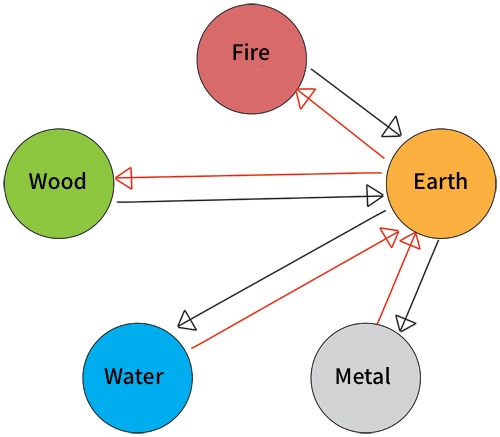
Fire Nourishes Earth - The Generating Cycle
The nourishment from the Fire element is essential to the Earth element. Without it, Earth might freeze and remain motionless. Fire produces the heat required to sustain digestive processes, both in the physical sense and no less in the mental sense, and to create the appropriate atmosphere for expressing the emotional relating, compassion, and care that characterize the Earth element.
When Fire is active and balanced, it ignites within Earth the ability to feel a part of, to be a vessel for others, to act out of a sense of mission and belonging. This is the ground upon which human brotherhood grows: extending a hand, giving, containing, and understanding, not out of sacrifice but out of a sense of value and purpose. Fire does not merely warm; it opens gates and moves Earth away from its tendency toward fixation. In an emotional-conscious transformation that occurs from within, it knows how to cross boundaries and bring with it an experience that fertilizes Earth and encourages it to grow, dare, and expand. To step out of the pattern that seeks to preserve, because balance must be momentary and not fixed. Maintaining a fixed balance is stagnation because it does not allow for change.
Fire nourishes awareness within Earth, the passion to experience, the fusion and interpersonal connection, and the empathetic ability to experience the other directly.
Earth Destroys Fire - The Destructive Cycle
When the Earth element is stronger than the Fire element, a lack will immediately be felt. A fading sense of warmth, an unanswered need for love, and even a feeling of rejection: "I am not loved." Emotions such as guilt, insecurity, and a sense of victimhood rise to the surface. Natural giving is replaced by resistance, because there is truly nothing left to give; the reservoir of passion and warmth is depleted. Worries multiply and become a continuous, oppressive tension.
The security of Earth, which becomes a primary and central need, expands until it exceeds personal boundaries: Earth's security depends not only on itself, but on the wellbeing of its children, its spouse, their choices, and the level of risk they take. In such a state, choices are not made out of accepting what is, but out of security considerations. A spouse, a job, belonging, a place of residence, all these are chosen based on the likelihood they will enable stable preservation over time. When the heat fades, movement stops, and the person becomes slow and heavy. They move through life out of responsibility but wear themselves out internally, clinging to what is not nourished by love but out of constraint.
Earth Nourishes Metal - The Generating Cycle
The Earth element grants the Metal element a framework of belonging: familial, communal, social, in order to allow Metal to establish itself upon foundations of grip when it turns to its internal world for the purpose of measuring, discerning perfection, and processing values. It is an earthy part that remains active and present, responsible, functioning, volunteering, and it prevents Metal from disconnecting, from moving too far away without the ability to return. It is a connection that keeps Metal human, connected, understanding the need of others: a choice. This is a sense of belonging that allows Metal to find uniqueness within fixed and recurring life situations. It is an emotional and human anchor that does not let Metal fixate solely on what is perceived as logical. It compels Metal to expand the form.
Metal Destroys Earth - The Destructive Cycle
When the Metal element is in excess, it crumbles the consensus, the sense of togetherness, the basic definitions of the family or society, and prefers to detach in order to protect its boundaries, its internal laws, the righteousness of its path, and its separate existence. The person removes themselves from the collective, not out of arrogance, but out of an essential need to redefine themselves in a clear, logical way that will express clean hands or perfection of form.
The Earth element does not understand how a person can cast off responsibility and let go of the connection. It binds its life within the web of connections it has created and nurtured, and when the web tears, it experiences collapse and a sense of personal failure. The gap between them is not only in approach but in the perception of identity: the Earth element says, "I am you, therefore I care." The Metal element says, "I am me, and therefore only I am responsible for myself"; in a state of excess Metal, this is a crushing phrase that strikes the heart of Earth.
Wood Controls Earth - The Controlling Cycle
The Earth element has a natural tendency toward fixation, stemming from its desire to live in certainty. The world is perceived as a field that must be organized, stabilized, and maintained, and any deviation or unexpected movement may be interpreted as a threat to the sense of security. The Wood element in the Controlling Cycle comes to move Earth, to awaken it from its slumber, to extricate it toward action and movement. Just as the Liver Qi (LIV) moves the Stomach Qi (ST), so too does the movement of Wood encourage digestion, processing, and maneuvering between what exists and what is required. It points to possibilities of free choice, entrepreneurship, and risk-taking, and does not allow Earth to sink into worry and the repetitive checking of its emotional and economic security state, sinking into a worry that nullifies any possibility for change and movement.
Earth Insults Wood - The Insulting Cycle
In a state where Earth is in excess, the need for stability overrides the need for freedom. The movement of Wood is halted: courage, initiative, and breaking forth are replaced by a quiet, slow, and cumbersome maintenance of the status quo. The more dominant Earth is, the more Wood operates under limitations that become a social, emotional, and cultural imperative. The person loses the ability to initiate, make decisions, locate opportunities, move, and initiate, and they tend to sink into an existing routine. Stability that contains no movement is not stability, but stagnation.
Earth Controls Water - The Controlling Cycle
Earth without Water is cracked and dry. Yet Water without Earth, without a boundary, is devoid of direction. Earth is the edges of the lake, the vessel holding the water in a container. It defines boundaries for that elusive diffusivity of Water and creates a framework for it, a belonging. It bridges philosophy and belonging, idea and reality, bringing them into the here and now. Through this connection, it manages to awaken within Water a sense of shared responsibility and belonging, to make them be present, not merely think. To feel, not just explain. Water has a fundamental problem with communication and responsibility, and if this responsibility translates into raising children, the Water element is obligated to maintain a continuous, responsible, and practical connection, which does not allow for detachment or a floating philosophical stance whose purpose is to conceal the fact that it is afraid of what is not in its control. Earth tells it through the Controlling Cycle that this stability is a maintenance job built on persistence, on maintaining the edges of the lake and preserving what exists through the ability to maintain stability even in moments of storm.
Water Insults Earth - The Insulting Cycle
When an Insulting Cycle occurs in which Water is in excess, withdrawal appears. Distance. Emotional detachment. The person sinks into their interiority, retreating into a worldview disconnected from the collective. Observation becomes too deep until it denies the need for the other. Then that language of detachment awakens: "I do not want children in such a world," "The world is bad, so why should I connect to it?" This is not necessarily a moral stance, but a symptom of deep emotional detachment. Of water washing over the earth and leaving it unstable. The person no longer belongs, but watches from the side, afraid of friction, of the burden, of responsibility. It threatens their inner being, the survival experience, and the desire to sustain and protect themselves from invasion. And therefore it is easier for Water to connect to groups, movements, methods, through which they can change the world or experience a different perception where their spiritual-emotional ideas are realized even if they are far from accepted reality.