The Cosmos, Time, and Yin and Yang in Chinese Thought
1: The Cosmos, Emperor Yao (堯), and the Establishment of Cultural and Spiritual Time
A. The Concept of the Cosmos, Continuity, and Change in Chinese Thought
In contrast to Western thought, Chinese mythology and philosophy do not view the world in terms of creation out of nothingness or an absolute end point, but rather in terms of evolution, circular flow, and perpetual, cyclical change. At the core of the cosmological concept stands Qi, operating as energy through the dynamic interaction between two complementary forces: Yin and Yang. Within this framework, death is not perceived as the destruction of existence, but as a change of form within an eternal process of transformation, and as part of a broad, natural cyclicality in which the soul and the human being, as well as the social and hierarchical structure in which they live, continue to exist in the realm of spirits and ancestors.
Within this cosmic tapestry, legendary emperors and wise kings do not appear in Chinese mythology and historical texts merely as political rulers, but as exemplary cultural and spiritual figures endowed with extraordinary abilities. They embodied the direct connection between Heaven (Tian), Earth (Di), and Man (Ren), bringing humanity its first technologies, agricultural skills, writing, and rituals. These legendary kings established an unbroken continuum extending from the dawn of Chinese civilization to the present day, making present the idea that social and moral order must be anchored in the laws of nature and the rhythm of cosmic Qi.
B. Emperor Yao (堯) and the Invention of Time as a Cosmic Rhythm
The legendary Emperor Yao (堯) is preserved in Chinese tradition as the archetype of the sage-king: a moral, noble, wise, and humble ruler who lived in complete harmony with Heaven and nature. In the Confucian tradition, Yao received immense praise;
In Chapter 8 of the Analects, Confucius is quoted saying of Yao:
"How grand was Yao as a ruler! How vast is the greatness of Heaven, and Yao alone matched it. So sublime were his achievements, and they established the patterns of culture."
The central and foundational contribution of Emperor Yao was the invention of the Chinese calendar and the transformation of time from an "abstract" or random concept into a living, organizing, and beneficial system of existence. According to accounts in classical sources, Yao dispatched his officials to the four corners of Heaven to precisely observe the sun, moon, and stars, measure the length of days and nights, and calculate the orbits of celestial bodies. The purpose of these observations was to identify the succession of seasons and assign to each season its natural energetic quality.
- Spring: Sprouting, growth, and awakening.
- Summer: Blossoming, the peak of Yang, and expansion.
- Autumn: Harvesting, decline, and the ripening of fruit.
- Winter: Gathering inward, the peak of Yin, and storing strength.
Thanks to these observations, a cyclical and circular model of time was created, a concept entirely different from the prevailing Western linear perspective. Time in China became a living force expressing the dynamic balance between Heaven and Earth, allowing human beings to integrate into the cosmic rhythm by aligning their actions with the cyclicality of cosmic Qi.
C. Sun, Moon, and Stars
The calendar established by Emperor Yao was based on a harmonious and sophisticated integration of three primary celestial bodies:
- The Sun (Yang): Served as the measure for the yearly cycle and seasons. The agricultural calendar (later known as the "Xia Dynasty Calendar" - Xia Li) was determined according to solar movement to ensure the timing of sowing and harvesting.
- The Moon (Yin): Served as the measure for months. The lunar phases (from full moon to full moon) expressed the internal, alternating, and cyclical rhythm of time.
- The Stars and Constellations: Served as a system of celestial signs (Tianwen) guiding the human community and the emperor regarding cosmic and climatic changes and the organization of subsequent rituals.
This luni-solar structure created a direct connection between the great cosmic movement and human daily life. It granted human beings the ability to know when it is right to act and go outward (a Yang action) and when it is right to gather inward and exercise restraint (a Yin action), when to sow and when to harvest, when to perform a ritual and when to retire for rest, thus aligning human movement with the movement of Heaven.
D. The Connection Between Time, Ritual (Li), and Morality
Emperor Yao did not merely create an astronomical or agricultural tool; he founded the cultural, ritual, and moral time of China. According to this concept, if the king and the people do not act in accordance with the seasons and the natural rhythm, a violation of cosmic harmony occurs, which may bring drought, floods, disease, and social disorder.
A key concept arising from this connection is "opportune timing" (Shi - 時). In Chinese thought (both Confucian and Daoist), a person of noble consciousness (Junzi or sage) does not act merely according to rigid rules, but out of a profound sensitivity to cosmic and contextual timing.
- Holidays and Observances (Spring festivals, rain rituals, thanksgiving to ancestors): Became a means of directing human consciousness toward the cosmic order.
- Medicine and Health: Blood and energy cycles in the human body were perceived as a microcosm reflecting the macrocosm; adapting one's lifestyle to the seasons was considered the foundation of longevity and health.
- Leadership and Politics: The mandate to rule (Tianming) was granted to a ruler who knows how to "hold fast to the center" and manage the calendar and rituals with integrity and compassion.
- In Chapter 20 of the Analects, Yao is quoted as he passes governance to his successor Shun with the words: "Lo! The numbers and calculations of Heaven's calendar fall upon your person - hold fast to their center."
The concept established by Emperor Yao regarding time and the cosmos forms the shared foundation upon which the two deep currents of Chinese thought would later emerge:
- The Confucian Perspective: Viewed the calendar and rituals (Li) as a primary tool for stabilizing social order, shaping morality, and cultivating rectified human relationships that operate in harmony with the will of Heaven (Tian).
- The Daoist Perspective: Viewed natural cyclicality as proof that the cosmos operates spontaneously (Ziran) and through non-forced action (Wuwei). Time does not require struggle, but rather flow and alignment with the cosmic Way (Dao).
The mythical life work of Emperor Yao inextricably linked Heaven, nature, ritual, and human morality, a connection that continues to echo in the calendar, holidays, and structure of Chinese consciousness to this day.
2: The Yellow Emperor (黃帝) - Founder of Culture, Medicine, and Cosmic Kingship
A. The Yellow Emperor (黃帝) as the Archetype of Enlightened Kingship
If Emperor Yao (堯) represents in Chinese tradition moral order, opportune timing, and royal humility, the Yellow Emperor (黃帝, Huang Di) is perceived as the mythical archetype of all Chinese civilization. He is remembered in history not merely as the head of a dynasty or a warrior who defeated rival tribes, but as a cosmic ruler, an exemplary figure of a wise sovereign acting out of deep observation of natural laws, the heavens, and the cosmic order.
In Chinese tradition, the Yellow Emperor embodies the transition from the original, wild, unorganized, and chaotic state (Hundun) to an era of culture, technology, social order, and discipline. However, Huang Di's uniqueness lies in the fact that his conquests and technological innovations were not achieved through forceful coercion, but through a deep understanding of the Dao and the alignment of human action with the internal lawfulness of nature.
B. Cultural Innovations: Transforming Speech into Memory and Matter into Consciousness
Mythological and historical tradition attributes to the Yellow Emperor and his officials a series of foundational inventions that laid the material and spiritual groundwork of Chinese culture:
- Development of Ancient Chinese Writing: Attributed to Cangjie, an official of the Yellow Emperor, who observed the tracks of animals and birds and based the first characters upon them. Through writing, fleeting speech became eternal historical memory, and spoken culture crystallized into preserved written knowledge.
- Material and Technological Mastery: Invention of the wheel, the boat, ceramics, the loom, the bow and arrow, and the early compass. These innovations expressed human ability to influence the environment through observing world structure: the floating of a boat on water, the cyclical motion of the wheel, and calculating the cardinal directions.
- Organization of Social and Political Structure: Division of the land into administrative units, establishment of weights and measures, and fixing rituals that organize human relationships.
C. The Yellow Emperor and the Foundation of Chinese Medicine: The "Huangdi Neijing" (黃帝內經)
The Yellow Emperor's most influential and profound contribution to human culture is the foundation of the theory and practice of Chinese medicine. According to tradition, the Yellow Emperor engaged in deep conversations and medical-philosophical dialogues with his physician and personal advisor, Qibo (岐伯). These dialogues were compiled in the foundational classical text "Huangdi Neijing" (黃帝內經 - The Yellow Emperor's Inner Canon).
The book established a revolutionary concept of preventive and holistic medicine based on the close relationship between the macrocosm (universe and nature) and the microcosm (the human body):
- Balancing Yin and Yang: Health is perceived as part of the dynamic balance between Yin and Yang forces in the body. Disease is not merely an external enemy, but a result of violating internal balance.
- Flow of Qi and Channels (Meridians): The body is understood as an energetic system through which the vitality of Qi flows. Blockage, excess, or deficiency of Qi directly impacts physical and mental function.
- Alignment with Seasons and Cosmic Time (Yang Sheng): Body organ function and human physiology are directly linked to seasonal cycles. Medicine calls upon human beings to direct their lifestyle, nutrition, rest, and breathing according to the rhythm of the seasons: awakening, acting, gathering, and storing in accordance with the energetic quality of each season.
In doing so, the Yellow Emperor established a concept in which medicine is not merely a technique for curing symptoms, but the art of nourishing life (Yang Sheng), linking body, mind, consciousness, time, and nature.
D. Astronomy, Movement of Celestial Bodies, and Cosmic Language
Beyond his material and medical contributions, the Yellow Emperor is also perceived as an astronomy researcher who studied the structure of the heavens. In his era, the understanding crystallized that the movement of the sun, moon, planets, and constellations (Tianwen) is not merely physical randomness, but a symbolic celestial language.
Through the movement of night and day, constellations, and seasons, Heaven "speaks" with Earth and expresses the harmony of the Dao. A violation of moral or natural heritage in the human world was perceived as echoing cosmically, while conversely, observing the stars aided human beings in establishing a calendar, guiding rituals, and understanding their place within the great cosmic tapestry.
E. Imperial Myth and the Huang-Lao Tradition: The Emperor as Cosmic Mediator
Understanding Heaven and nature led to the crystallization of a new political-spiritual role for the ruler: the Emperor as "Son of Heaven" (Tianzi) and cosmic mediator. The Emperor is not merely a mortal ruler imposing laws by force, but a figure carrying the Mandate of Heaven (Tianming). His role is to stand at the center of the axis between Heaven (Tian), Earth (Di), and Man (Ren), preserving harmony among them.
During the Warring States period and the early Han Dynasty, a central political-philosophical school developed called the Huang-Lao tradition (Huang-Lao - 黄老), named after the Yellow Emperor (Huang-Di) and Laozi (father of Daoism). This school, whose writings were rediscovered in the famous archaeological finds at Mawangdui, offered a fascinating synthesis:
- It drew from Daoism the concept of flowing with natural order, non-forced action (Wuwei), and spontaneity (Ziran).
- It drew from Legalism and public administration the need for clear laws, standards, and objective criteria (Fa and Xing-Ming).
- It joined them into a doctrine of cosmic leadership: the Emperor rules through a quiet path, devoid of ego or arbitrary intervention, operating state laws in accordance with the laws of nature and the cosmos.
Thus a model was created wherein the sage-king operates as a mediator activating the system; he represents the spirits of ancestors and gods before the people, while making present the will of Heaven and nature within social and political reality.
The figure of the Yellow Emperor forms the mythical and conceptual bridge between establishing material civilization and deepening cosmological theory in China. His deeds and writings attributed to him demonstrated that:
- Technology and culture are not separate from nature, but arise from understanding its laws.
- The human body and mind are a microcosm of time, Qi, and seasons.
- Leadership and governance are not arbitrary power, but a moral and spiritual responsibility to represent cosmic order.
This comprehensive concept of human-nature-heaven relationships laid the foundations for the crystallization of more complex cosmological models: Yin and Yang, the Five Elements (Wuxing), and the Eight Trigrams (Bagua), which would become the shared language of Daoism, Confucianism, and the Book of Changes (I Ching).
3: Early Development - The Enigma of Time, Writing, and the Cosmological Shift from Shang to Zhou
A. The Shang Dynasty (1600-1050 BCE): Oracle Bones (Jiaguwen) and Writing
The cultural and spiritual roots of China are planted deep in pre-history, yet the beginning of documented and written development appears during the Shang Dynasty (Shang). In this era, explicit textual evidence appears for the first time, not as law books or daily administrative records, but as a window into deep religious and cosmological ritual.
The primary artifacts from this era are oracle bones (Jiaguwen - 甲骨文): ox scapulae and turtle plastrons upon which kings and priests carved questions addressed to Di (Shangdi - the Supreme Deity), nature spirits, and deceased royal ancestors.
The divination process involved a complex ritual series:
- Carving the question or statement of intent upon the bone or shell.
- Creating hollows and applying controlled heat using hot metal rods.
- Deciphering the celestial cracks opened in the bone due to intense heat, which were perceived as the revelation of the command and will of gods and spirits.
Uniqueness of ancient Chinese writing: Chinese writing was not born as a secular tool for commerce or bureaucracy, but as sacred semiotics and a ritual medium intended to bridge the earthly living world and the world of spirits and ancestors. In the Shang Dynasty worldview, a continuum of existence (Continuity) exists between the living human world and the world of the dead and spirits; writing served as a tool for communication, channeling, inquiry, and direct contact with the forces guiding the cosmos. In the late Shang Dynasty, the king himself deciphered the cracks, thereby strengthening the legitimacy of his rule as one holding spiritual authority and direct communication with ancient ancestors.
B. The Triangular Connection: Writing, Time, and Sacred Ritual
Even at this early stage of Chinese civilization, one can see how writing, the concept of time, and spiritual practice were inextricably linked:
- Writing as a Medium of Cosmic Dialogue: Writing developed out of the human need to ask, understand, and interpret the will of Heaven and ancestors, ranging from dates for going to war to sowing and harvest times, weather forecasting, and royal health.
- Time as a Divine and Cyclical Rhythm: Time was not perceived as a measured linear resource, but as a cyclical system sensitive to movements of celestial bodies, solar and lunar eclipses, and seasonal changes.
- Ritual Timing: Every ritual and royal action received its validity and meaning solely when it occurred at the "sacred time" and proper moment, as defined by signs of nature and stars.
C. The Zhou Dynasty (1050-256 BCE): The Cosmological Revolution and the "Mandate of Heaven"
With the fall of the Shang Dynasty and the rise of the Zhou Dynasty (Zhou), the transition occurred from tribal ritual myth to a structured, coded cosmological and philosophical system. Zhou rulers understood that the validity of their rule could not rely solely on military force or single tribal ancestor worship, but on a comprehensive moral and cosmic justification.
At this stage, fundamental concepts of political-spiritual thought in China crystallized:
- Heaven (Tian) and the Concept of the "Mandate of Heaven" (Tianming): Heaven shed its image as a tribal deity and became a mystical, moral, universal, and impartial cosmic order. The ruler was called "Son of Heaven" (Tianzi), and the right to rule was granted to him solely on the condition that he act with morality, justice, and mercy toward the people, serving as a living example.
- Institutionalization of Rituals (Li) and Laws: The connection between man and Heaven was translated into a structured system of laws, fixed dates for agricultural rituals, prayers, sacrifices, and seasonal transition festivals. Ritual (Li) became a means of shaping human emotions, restraining impulses, and establishing social harmony through alignment with cosmic order.
D. Coding Knowledge: From Ritual Divination to Cosmic Science (Yin-Yang and the Book of Changes)
During the Zhou period, a foundational shift occurred: ancient knowledge transitioned from oral tradition and local divination practices to a written and coded system. Writing ceased to serve merely as a means for addressing spirits, becoming a profound method for understanding reality, managing the state, and guiding spiritual philosophy.
At the center of this crystallization stands the Book of Changes (Yijing) - the central classical text of Chinese culture:
- Principles of Yin and Yang: Reality is perceived as a dynamic arena of interaction between Yang force (active, illuminating, expanding) and Yin force (passive, shaded, gathering).
- Trigrams and the Eight Signs (Bagua): Solid lines (Yang) and broken lines (Yin) combined into eight trigrams and 64 hexagrams, representing all states of change and possibilities in the cosmos and human life.
- The Cosmic Triangle - Heaven, Earth, and Man (Tian Di Ren): Man is positioned as the mediating link between forces of Heaven and Earth, whose role is to act out of harmony and internal and external balance.
The development that occurred between the Shang and Zhou Dynasties laid deep foundations for Chinese consciousness:
- Time as a Realm of Transformation (Bian / Hua): Time does not pass casually, but constitutes an open realm of perpetual cyclical change, wherein every extreme eventually becomes its opposite (the peak of Yang gives birth to Yin, and the peak of Yin gives birth to Yang).
- Writing as Organizer of the Cosmos: Chinese writing transformed from a language of divination and cracks into a language coding the laws of nature, governance, and morality.
- Man as Cosmic Mediator: Man, and specifically the enlightened ruler or sage (Junzi), is not a passive subject of reality, but an active, mediating entity who knows how to read the seasons of time, perform proper rituals, and preserve harmony between Heaven and Earth.
4: The Bagua, the Book of Changes (I Ching), and the Cosmic Continuum of Chinese Myth
A. The Two Foundational Templates of the Bagua
In Chinese cosmological tradition, two foundational templates of the Eight Trigrams (Bagua - 八卦) exist:
- The Early Heaven Bagua (Xian Tian Bagua): Attributed to the legendary Emperor Fu Xi, presenting an eternal, symmetrical, and static cosmic order of perfect opposites (Heaven opposite Earth, Fire opposite Water).
- The Later Heaven Bagua (Hou Tian Bagua - 後天八卦): Attributed to the father of the Zhou Dynasty, King Wen (周文王, Wen Wang).
Both maps are discussed in detail in chapters 7 and 8.
B. The Book of Changes (I Ching / Yijing - 易經): From Divination Practice to Consciousness System
Out of observation of natural cycles and the attempt to coordinate celestial movement with earthly occurrence, the Book of Changes crystallized, the "I Ching" (Yì Jīng - 易經). The book developed out of the ancient system of the Zhou Dynasty (Zhouyi), becoming the central and most influential text in the history of Chinese philosophy and culture.
The "I Ching" combines the eight trigrams to create 64 hexagrams - complex patterns of six lines (solid lines representing Yang, or broken lines representing Yin). Each hexagram represents a dynamic state of existence, a moment in time, or conflict and potential within reality.
The I Ching does not present a predetermined fate, but a doctrine of cyclical change, continuity, and connection:
- Change (Bian - 變): Reality is in constant flow; there is no fixed state or stagnation.
- Continuity and Connection (Tong - 通): Change is not random or chaotic, but operates according to harmonious and cyclical patterns. When a phenomenon reaches its peak, it turns into its opposite.
- Symbolic Reading of Consciousness: The book grants human beings a tool for inner observation and deciphering "opportune timing" (Shi), allowing action in harmony with currents of reality rather than struggling against them.
C. The Contribution of Confucianism and the "Ten Wings" (Shiyi): Transforming Divination into Moral Philosophy
Confucius in the tradition of Chinese thought is linked deeply to the study of the "I Ching". In Chapter 7 of the Analects (Lunyu), his famous statement is brought:
"If a few more years were granted to me, at age fifty I would study the Book of Changes, and I would not fall into grave errors."
According to tradition, Confucius and his disciples composed the "Ten Wings" (Shiyi - 十翼), a series of philosophical essays and commentaries on the Book of Changes, chief among them "The Great Commentary" (Dazhuan / Xici). This commentary sparked a revolution in consciousness:
- Transformation of Divination into Morality: The "I Ching" ceased to serve merely as a simple fortune-telling tool, becoming a moral and philosophical guidebook for the noble person (Junzi).
- Human Responsibility and Autonomy: The book does not determine human future deterministically, but clarifies the conditions of the situation, leaving the moral choice of how to act in human hands.
- Linking Cosmology to Ethics: Confucian commentary demonstrated that the laws governing the cosmos (balancing Yin and Yang) are the same laws that should guide human relationships: compassion, integrity, ritual, and sensitivity to proper and just timing.
5: Daoist Thought, the Six Confucian Classics, and the Philosophical Tension Between Currents
A. Daoist Thought (Daoism): Flow Within Wholeness and Return to Simplicity
Daoism (Daojia) emerged in ancient China not as a rigid dogma or a set of civil laws, but as a way of life, philosophy, and conscious practice striving for complete harmony with the universe through observing the principle of the Dao (道). The Dao is defined as the source of the universe and its organizing force, yet it is perceived as a metaphysical entity impossible to grasp conceptually or define exhaustively in words; as the Daodejing opens: "The Way that can be spoken of is not the eternal Way." The Dao is not a personal deity, but the natural and internal rhythm operating in every cosmic process and change.
At the center of Daoist philosophy stand two interconnected core principles:
- Ziran (自然): Meaning literally "so of itself", spontaneity, or internal naturalness. Daoism calls upon human beings to observe nature and see how seasons, water, and plants operate of themselves without artificial effort.
In Chapter 25 of the Daodejing it is written: "Man models himself after Earth, Earth after Heaven, Heaven after the Dao, and the Dao models itself after its own naturalness (Ziran)."
- Wu Wei (無為): Often translated as "non-action", but its precise meaning is not passivity or apathy, but non-forced action (Non-coercive action) and natural flow without egocentric intervention. Wu Wei is the ability to act out of harmony with reality, akin to water flowing around obstacles and overcoming the hard and rigid out of softness.
Exemplary thinkers and classical texts:
- Laozi: Offers in his book Daodejing a lucid, minimalist, and political-spiritual approach, calling upon rulers and human beings to return to original simplicity (Pu - uncarved wood) and govern without draconian interference.
- Zhuangzi: Leads Daoism into realms of inner freedom, humor, philosophical skepticism, and wondrous poetry. Zhuangzi invites human beings to "free wandering" (Xiaoyaoyou), transcending rigid distinctions of "good" and "bad" or "right" and "wrong" (Shi/Fei), practicing "forgetting the self" (Zuowang) and "fasting of the heart" (Xinzhai) to break free from the shackles of artificial consciousness.
- Expansion of Classical Daoist Tradition (Heguanzi and Wenzi): Extended Daoist texts such as the Heguanzi and the Wenzi, alongside chapters of the Neiye (Inner Cultivation) in the Guanzi, deepen the doctrine of nourishing life (Yang Sheng), preserving Qi, and regulating consciousness, showing how inner quiet enables a spontaneous and precise response to shifts in time and environment.
B. The Confucian Classics (The Six Classics - Liu Jing) and the Establishment of Moral Order
In contrast to the Daoist aspiration for integration with the uncarved natural state, Confucianism (Rujia) placed at its center the construction of the moral human being (Junzi) and a rectified society out of social responsibility, education, and self-discipline. Confucius did not rely on random flow, believing rather that the human being is an entity to be shaped, cultivated, and rooted in virtues.
To establish this moral and cultural order, a series of six classical texts was anchored in Confucian tradition (Liu Jing), serving as the sole basis for education, public administration, and imperial service examinations:
- Book of Changes (I Ching / Yijing): Cosmology of transformations and a moral code for the noble person.
- Book of Rites (Liji): Comprehensive breakdown of rules of conduct, rituals, and family and state structure.
- Book of Odes (Shijing): Collection of classical poetry for refining emotions, consciousness, and verbal expression.
- Book of Music (Yuejing): (A text partially lost) that emphasized the power of music in harmonizing the human soul and society.
- Spring and Autumn Annals (Chunqiu): Historical chronicle teaching moral judgment and political lessons.
- Book of Documents (Shujing): Speeches and administrative documents of ancient kings and sages.
Core principles of Confucian practice:
- Ritual and Protocol (Li): Not mere external etiquette, but a primary tool for shaping character, restraining desires, and translating inner humanity (Ren) into practical implementation.
- Filial Piety (Xiao): Perceived as the root of morality and social integration; human beings learn respect, compassion, and responsibility first within the family unit, extending outward to the state and world.
- The Five Relationships (Wulun) and Moral Hierarchy: Ruler-subject, father-son, husband-wife, elder brother-younger brother, and friend-friend. This hierarchy is not arbitrary, but a system of mutual obligations ensuring harmony and stability.
- Rectification of Names (Zhengming): The demand that language and social roles match moral reality, that the king act as king, father as father, and son as son.
C. The Philosophical Tension: Daoism Versus Confucianism
Throughout Chinese history, a fascinating philosophical dialogue and tension existed between the two schools. While both emerged from the same cosmological source and accepted the principle of Yin and Yang and the idea that the world operates through complementary opposites, they derived opposing worldviews regarding human beings, society, and the state.
This existential difference begins first and foremost in the perception of human nature and the purpose of life. The Confucian approach (Rujia) views human beings as incomplete by nature, requiring constant education, polishing, correction, and moral shaping. Its primary goal is rectifying society, stabilizing social order, and establishing a moral and proper state.
Conversely, the Daoist approach (Daojia) believes that human beings are born good, whole, and harmonious by nature (Ziran), and that artificial education and laws are merely a coercive system spoiling original innocence. The central aspiration of the Daoist approach is not rectifying the state, but achieving inner freedom, cosmic balance, and harmonious blending of the individual with the flow of nature.
From these opposing aspirations, the two schools derived entirely different means for achieving harmony. Confucianism relies on structural tools: rituals (Li), self-discipline, diligent study of classics, preserving social hierarchy, and practicing filial piety (Xiao). Daoism, on the other hand, rejects structural effort and advocates the principle of Wu Wei - non-forced action, shedding artificial distinctions, returning to simplicity (Pu), and listening attentively to natural rhythm.
This shift is also reflected in the attitude toward external morality. For Confucianism, morality (Ren and Yi) is human essence and a supreme celestial imperative without which social existence cannot occur. For Daoism, by contrast, formal morality was born only when the natural Way (Dao) was lost; in its view, any rigid moral system is an artificial and arrogant attempt to control what cannot be controlled.
The deep difference between the approaches is well summarized in their foundational metaphors:
- Confucianism likens the human being to a gemstone or a carved statue, raw material that must be cut, filed, and polished with great effort to bring it to the height of moral and aesthetic revelation.
- Daoism likens the human being to uncarved wood, a raw and whole trunk standing in nature, where every cut, carving, or polishing damages its original and pure wholeness.
In practice, Chinese tradition did not decide absolutely between the two schools nor negate one before the other, but created between them a complementary synthesis of Yin and Yang.
Confucianism served as the philosophy of "Yang" - the public realm, state administration, civic duty, morality, and family. Daoism served as the philosophy of "Yin" - the private realm, art, poetry, meditation, and liberation from the shackles of social convention.
Thus was born the famous Chinese proverb: "Act as a Confucian on the outside, and as a Daoist on the inside." The combination between moral duty and Confucian order and Daoist flow, spontaneity, and freedom is what granted Chinese consciousness its richness, flexibility, and spiritual resilience across millennia.
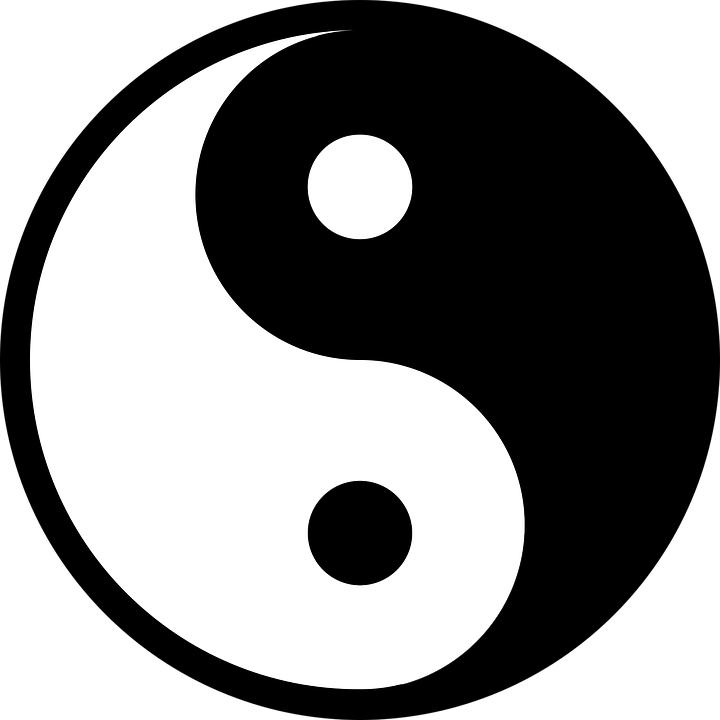
6: The School of Yin and Yang - Characters, Time Cycles, and Application in Chinese Medicine
A. Zou Yan and the Systematization of the School of Yin and Yang (Yinyangjia)
In the third century BCE, during the Warring States period (Warring States), the School of Yin and Yang crystallized in China (also known as the "School of Naturalists" - Yinyangjia). The school grew out of deep analysis of cosmic phenomena and the tradition of the Book of Changes (I Ching), but the person who turned it into a systematic, ordered, and coded framework was the great scholar Zou Yan (鄒衍, 305-240 BCE), who operated at the famous Jixia Academy.
Zou Yan was the first to holistically connect the two central cosmological theories in China:
- The Dual Polarity Dynamic Mechanism: The interaction between Yin and Yang.
- The Five Elements/Phases Theory (Wuxing): Wood, Fire, Earth, Metal, and Water.
In doing so, Zou Yan provided a comprehensive scientific-metaphysical infrastructure that served from then on as the shared language of political philosophy, Chinese medicine, astronomy, Daoism, and Confucianism.
B. Archaeology of the Characters
The literal and calligraphic origin of the concepts Yin and Yang is rooted in direct observation of the natural landscape and Chinese geography:
- The Character Yang (陽): Originally represents the slope of the mountain facing the sun - the southern, sun-drenched side. From here its meaning expanded to the celestial, warm, bright, summery dimension, the element of fire and wind, and the active and creative potential.
- The Character Yin (陰): Originally represents the shaded slope of the mountain - the northern, hidden, and cold side. From here its meaning expanded to the earthly, shaded, wintry dimension, the element of water and matter, and the passive and gathering potential.
These two forces are not separate entities, but a dynamic duality moving time and matter: day becomes night, night becomes day, and summer becomes winter. They constitute complementary opposites across all strata of existence - heaven and earth, matters of spirit and matter, rising and falling, left and right, abstract planning and material construction.
C. Yin and Yang as Dynamic, Relative, and Complementary Forces
Yin and Yang are not solid "elements" holding a fixed status or separate substances, but rather movements, energetic qualities, and relative states of cosmic vitality - Qi.
The duality concept of the school is founded upon several core principles:
- Absolute Relativity: Yin and Yang are not absolute concepts. Nothing is "Yin alone" or "Yang alone"; every phenomenon is measured solely in relation to its counterpart and within a specific context of time, season, hour, or internal and external state.
- Complementary Opposites (Complementarity):
- Yang: Originally assigned to the bright, sunlit side of the mountain, representing light, heat, movement, expansion, ascent, activity, and the masculine aspect.
- Yin: Assigned to the shaded side of the mountain, representing darkness, cold, quiet, gathering, decline, reflexivity, and the feminine aspect. Neither force exists in a war of destruction, but rather they nourish, balance, and depend upon one another inextricably.
- Man as Microcosm: This concept holds that man is not separate from nature, but constitutes a microcosm reflecting the cosmic macrocosm. Just as clouds, wind, water, and plants are subject to the dynamic lawfulness of Yin and Yang, so the human body, blood circulation, breathing, and consciousness operate according to the same energetic cycles.
For example, water is considered a distinctly Yin element (cold, flowing downward, gathering). Yet when water is heated, hot water is considered relatively Yang compared to cold water. The heat, steam, and energy rising from the water show how Yang grows out of Yin. The intensification of Yang and heat eventually brings evaporation and decline, out of which Yin is born anew.
D. The Principle of Reversal at the Peak (Reversal of Polarities) and Cyclical Movement
One of the central laws of the School of Yin and Yang and Daoist thought is the law of change at the peak (Extreme leads to Reversal):
- When a phenomenon or force reaches the peak of its cosmic expansion, it does not freeze, but gives birth within itself to the seed of the opposing force, bringing about a shift.
- Yang at its peak gives birth to Yin, and Yin at its peak gives birth to Yang.
From this arises the perception that reality does not move in straight (linear) lines, but in cyclical, circular, and breathing movement.
The clearest and most daily example of this cyclicality is the 24-hour daily cycle, presenting a continuous and permeating transition wherein no stage is detached from the preceding one:
- Dawn: Yang force awakens beneath the surface and begins to rise out of the Yin of the night.
- Noon (Peak Yang): The sun at the center of the sky; light, heat, and movement reach their peak.
- Sunset and Evening: Out of the peak of Yang gathering begins; Yin force returns, grows, and intensifies.
- Midnight (Peak Yin): Darkness, cold, and quiet reach their peak.
- Pre-dawn: In the heart of the darkness of peak Yin, the new Yang seed is formed, and the cycle begins anew.
E. The Yearly Cycle: Seasonal Movement of Time and Cosmic Rhythm
Just as in the daily cycle, the seasons of the year also move in a precise circular wave of Yin and Yang:
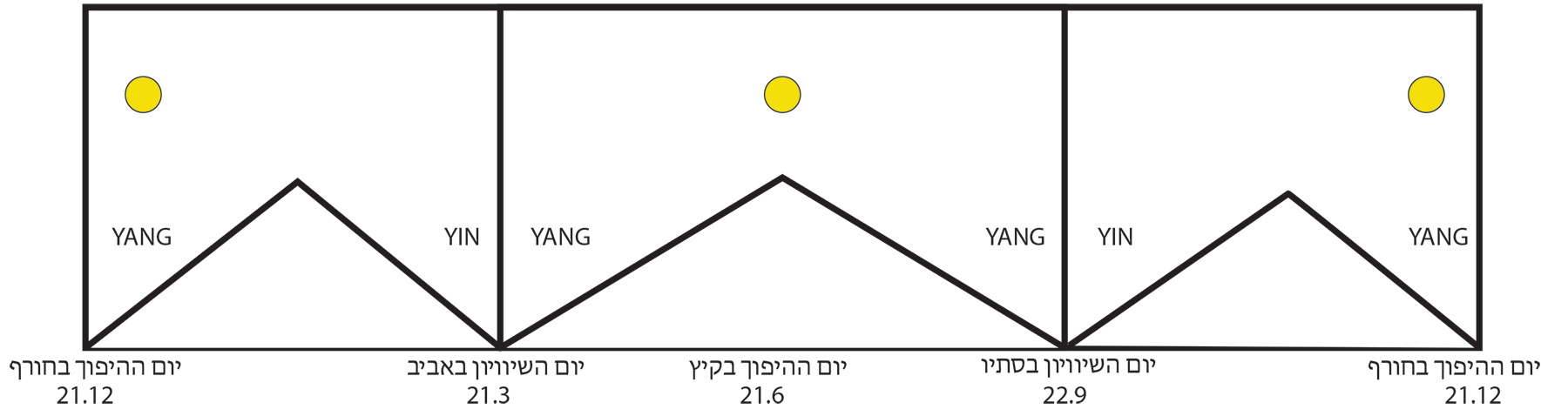
- December 21 (Winter Solstice - Peak Yin): The longest night of the year. Cold, darkness, and gathering inward reach their peak. Yet precisely at this extreme point the cosmic shift occurs: Yang begins to awaken, days begin to lengthen, and light returns gradually.
- March 21 (Spring Equinox): Yin and Yang exist in momentary balance. The rise of Yang brings sprouting, blossoming, renewal, and growth drive in nature and man.
- June 21 (Summer Solstice - Peak Yang): The longest day of the year. Sun, heat, and expansion reach their peak. Precisely from this point begins the gradual decline of Yang, as Yin force begins to return and strengthen.
- September 22 (Autumn Equinox): Another momentary balance. Yin rises out of Yang, movement gathers inward, days shorten, crops are harvested, and cold returns.
- Return to Peak Yin (December 21): The cycle is completed and repeats in a living, breathing, and eternal circle.
The School of Yin and Yang provides a philosophical and practical reading for human life: man is not required to control nature or struggle against changes, but to learn to identify his location within the grand movement.
Adapting lifestyle, nutrition, activity, and rest to the cyclical rhythm of the 24-hour day and seasons allows human beings to maintain physical and spiritual balance, prevent disease, and live in complete harmony with the laws of the universe.
F. Clinical Application: Yin and Yang in Chinese Medicine
In Chinese medicine, health is defined as a dynamic balance between Yin and Yang in the body, and disease is perceived as a violation of this balance. The therapeutic principle derived from this analysis is that a Yin or Yang quality does not operate in isolation:
- Diagnosing Yin Deficiency: When a patient suffers from Yin deficiency, a shallow approach would aim solely at nourishing Yin. However, Chinese medicine teaches that it is insufficient to strengthen Yin alone; one must also address Yang - encouraging, circulating, and moving it, so that it can support and generate Yin from within.
- Interrelationship and Preventing Extremes: A Yang that is overly strong and raging may burn and weaken Yin further; conversely, a Yin that is too weak is incapable of anchoring and braking the expansion of Yang.
These forces move in internal and external cyclicality influenced by the rhythm of the day, seasons, life stages, and personality and environmental structure.
G. The Connection to Han Dynasty Confucianism: Yin and Yang as Moral Law and Discipline
In the second century BCE, under the rule of Emperor Wu of the Han Dynasty, the Confucian scholar Dong Zhongshu sparked a conceptual revolution when he fully integrated the theory of Yin and Yang and the Five Elements into Confucianism.
This adoption translated the laws of nature into the moral and political world of man:
- Universal Moral Order: Yin and Yang relationships served as a compass for understanding harmony or disharmony in society and the state, defining moral categories of right and wrong, duty and responsibility.
- Self-Rectification and Discipline (Gongfu): Han Confucianism rejected reliance on passive flow alone. Man is required to perform self-work, subjecting himself to rules, rituals (Li), and discipline to achieve moral unity and perfection.
This principle is summarized in the well-known Chinese proverb: "It is easy to change the courses of mountains and rivers - but difficult to change the nature of a person." The human rectification requires conscious effort, study, and continuous training.
H. Philosophical and Therapeutic Bridge: The I Ching as Unifier of Law and Flow
In the world of therapy and practice, many practitioners are naturally drawn to the Daoist approach - soft, flowing, advocating non-effort (Wuwei) and connection to nature. However, in practice, therapeutic and clinical practice also demands rigid discipline, precise diagnosis, technique, and setting boundaries - qualities assigned to the Confucian tradition.
Here the decisive importance of the Book of Changes (I Ching) is revealed:
- Confucius himself devoted many years to interpreting the "I Ching" (through the "Ten Wings").
- The "I Ching" serves as a bridge unifying both schools: it consolidates order and transformation, fixed law and dynamic flow, Heaven force (Qian) and Earth reception (Kun).
Yin and Yang are not merely theory, but a language bridging man and nature, internal existence and cosmic laws, teacher and path.
I. From a Single Line to a Trigram: The Early Heaven Map (Xian Tian) and Eternal Essence
Symbolically and ritually, the flow of Yin and Yang is represented from a single mark to the composition of trigrams and hexagrams:
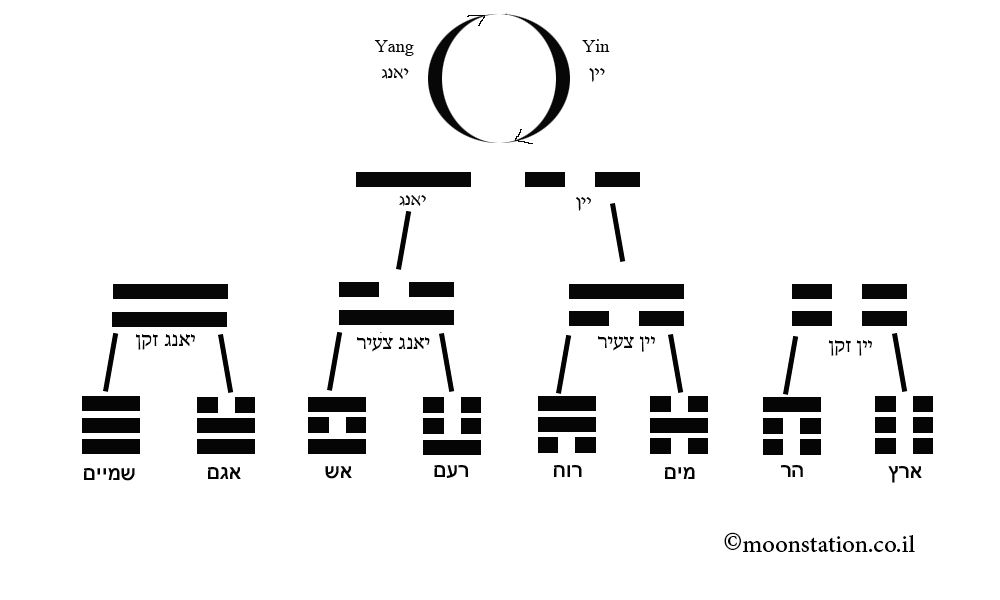
- Yang (on the left): Represented by a solid line ( ______ ).
- Yin (on the right): Represented by a broken line ( __ __ ).
When returning to the original and metaphysical concept of Yin and Yang - as expressed in the Early Heaven map (Xian Tian Bagua) of Fu Xi - these forces are not measured by time, earthly result, or human scale. They are perceived as eternal potential forces, existing beyond linear time.
7: Fu Xi (伏羲), the Early Heaven Map (Xian Tian Bagua), and Anatomical-Energetic Parallelism in Chinese Medicine
A. Fu Xi (伏羲) - Father of Cosmic Order and Discoverer of Eternal Patterns
If Emperors Yao and the Yellow Emperor represent the establishment of cultural time, technology, and human medicine in the world of phenomena, the mythical Emperor Fu Xi (伏羲) stands at the origin of the axis as founder of metaphysical essence and cosmic order. Fu Xi is portrayed in Chinese tradition as an enigmatic, visionary, and mystical figure, possessing direct celestial consciousness.
According to "The Great Commentary" of the "I Ching" (Dazhuan / Xici), Fu Xi did not invent order out of his personal will, but deciphered it out of pure observation of reality:
- He observed above at the tables of Heaven, the movement of stars and constellations (Tianwen).
- He observed below at the patterns of Earth, the structure of mountains and rivers (Dili).
- He observed the signs on animal bodies and on the human body itself.
Out of this observation, Fu Xi discovered the internal lawfulness organizing the cosmos: the division of undifferentiated Qi into two foundational forces - Yin and Yang. In the system Fu Xi established, Yin and Yang are not perceived as products of historical or linear time; they were always there as eternal potential, as built-in capacity, and as a matrix of coordinated opposites, fertilizing and balancing one another.
Fu Xi's contribution to humanity was in providing the first rules for a life of alignment with nature: he taught human beings to fish with nets, write in ancient symbols, play stringed instruments and flutes, and domesticate animals - not out of violent compulsion upon nature, but out of flow and integration into its existential rhythm.
B. The Early Heaven Map (Xian Tian Bagua, 先天八卦) - Cosmology of Essence and Eternal Order
Unlike the Later Heaven map (Hou Tian) of King Wen - dealing with living time, seasons, change, and the dynamics of the world of phenomena - the Early Heaven map (Xian Tian Bagua) established by Fu Xi presents a static, metaphysical, and eternal cosmology.
In this map, the motif of linear time is irrelevant; the question is not when things occur, but how they are built in their internal essence. The eight trigrams are located in a structure of absolute symmetry and polarity, wherein each trigram stands opposite its perfect contrast, together presenting reflection, balance, and eternal connectivity.
C. The Four Cosmic Axes
The cosmology of Early Heaven does not remain solely in the abstract symbolic plane; in Traditional Chinese Medicine (TCM), the four axes of the Xian Tian map constitute the structural map of the six primary channels (Liu Jing) and extraordinary vessels (Qi Jing Ba Mai), which manage human physiology, movement, and consciousness:
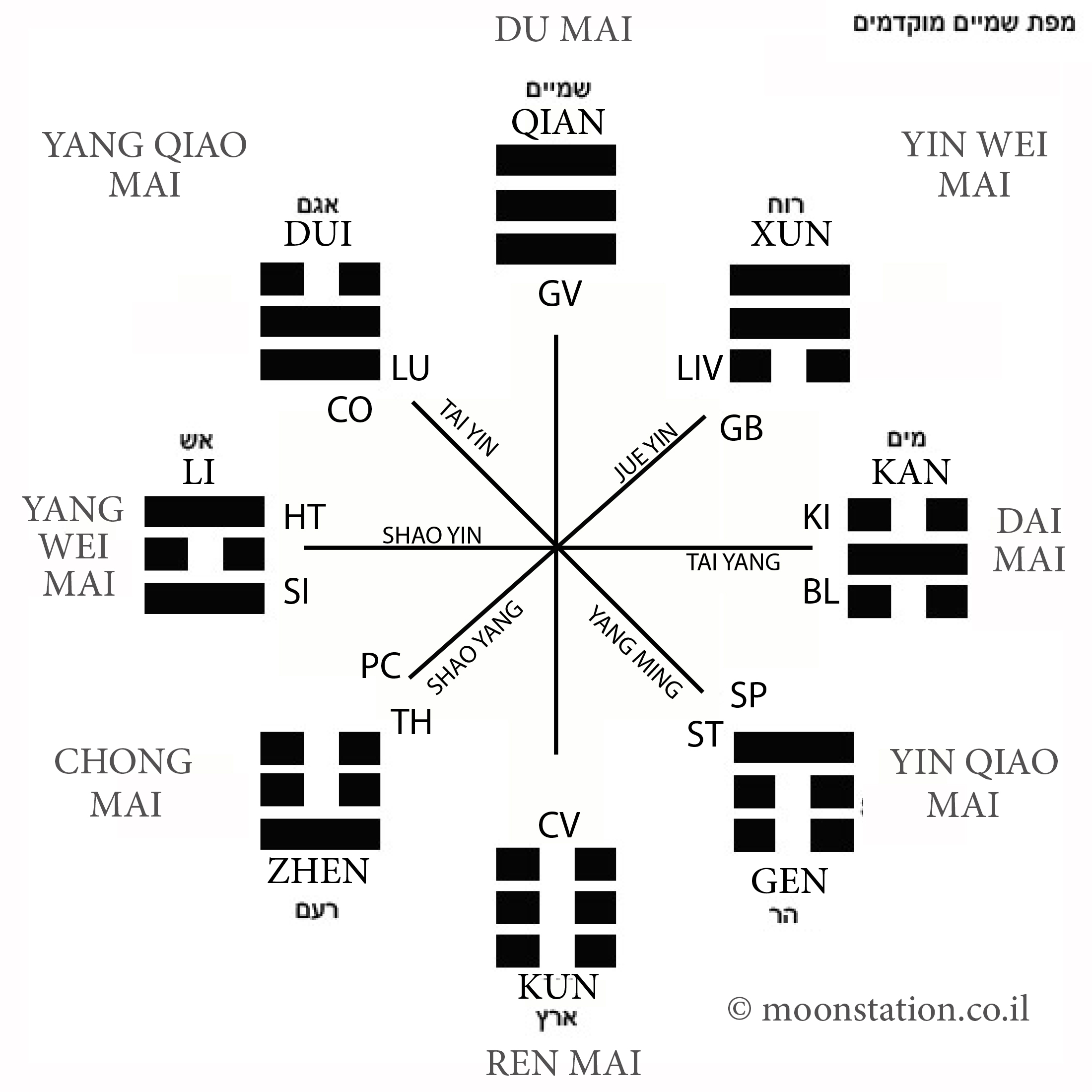
1. Heaven-Earth Axis: QIAN (乾) Opposite KUN (坤) - The Central Axis of Existence
- Cosmic Symbolism: In the South stands the Qian trigram - three solid lines, absolute Yang, Heaven, the creative energy. In the North stands the Kun trigram - three broken lines, absolute Yin, Earth, the receptive and nourishing energy. This is the central vertical axis: Yang at its peak in the South, Yin at its peak in the North, with a cyclical flow of nourishment and realization taking place between them.
- Anatomical and Clinical Parallelism: This is the axis of the central extraordinary vessels, Ren Mai and Du Mai:
- Du Mai (Governing Vessel): Represents Qian, the sea of Yang channels, the ascending movement in the back, spine, and brain - the source of inspiration, will, and supreme consciousness.
- Ren Mai (Conception Vessel): Represents Kun, the sea of Yin channels, the descending movement in the front of the body, abdomen, and chest - the source of nourishment, emotion, and material realization. This axis expresses the internal connection between celestial potential and earthly realization in the human body.
2. Thunder-Wind Axis: ZHEN (震) Opposite XUN (巽) - The Dynamics of Movement and Vibration
- Cosmic Symbolism: In the Northeast stands Zhen (Thunder) - a bottom Yang line beneath two Yin lines; a sharp, sudden, bursting outbreak. In the Southwest stands Xun (Wind) - a bottom Yin line beneath two Yang lines; a gentle, permeating, vibrating, and unpredictable movement.
- Anatomical and Clinical Parallelism: This is the axis of Shao Yang opposite Jue Yin:
- Shao Yang (GB / TH - Gallbladder and Triple Burner): Represents Thunder (Zhen) - Yang bursting out of Yin, the force of decision, breakthrough, and lateral movement.
- Jue Yin (PC / LIV - Pericardium and Liver): Represents Wind (Xun) - Yin rising out of Yang, regulation of smooth Qi movement and the diaphragm, and protection of consciousness from friction and emotional storms.
3. Fire-Water Axis: LI (離) Opposite KAN (坎) - Light and Instinctive Depth
- Cosmic Symbolism: In the East stands Li (Fire) - an inner Yin line surrounded by two Yang lines; clarity, light, heat, and expansion. In the West stands Kan (Water) - an inner Yang line surrounded by two Yin lines; abyss, depth, danger, darkness, and a hidden spring.
- Anatomical and Clinical Parallelism: This is the core axis of Shao Yin opposite Tai Yang:
- Shao Yin (HT / KI - Heart and Kidneys): The illuminating and conscious Heart fire (Shen) opposite Kidney water storing eternal essence (Jing). The interaction between Heart fire and Kidney water is the foundation for vitality and sanity.
- Tai Yang (SI / BL - Small Intestine and Urinary Bladder): The external envelope protecting the body, enabling expansion and separation between the pure and turbid.
4. Lake-Mountain Axis: DUI (兌) Opposite GEN (艮) - Release and Stability
- Cosmic Symbolism: In the Southeast stands Dui (Lake) - a top Yin line above two Yang lines; openness, joy, grace, gentleness, and quiet open to change. In the Northwest stands Gen (Mountain) - a top Yang line above two Yin lines; stability, deep roots, halting, contemplation, and deep quiet.
- Anatomical and Clinical Parallelism: This is the axis of Yang Ming opposite Tai Yin:
- Yang Ming (ST / LI - Stomach and Large Intestine): Represents the Lake (Dui) - transformation, decomposition, digestion, and openness to receiving food from the external world.
- Tai Yin (LU / SP - Lungs and Spleen): Represents the Mountain (Gen) - harvesting, inner respiration, gathering of Qi, and creating a rooted foundation for body stability. The mountain and lake reflect one another: inner stability enables external flow and openness.
The mythical teachings of Fu Xi and the Early Heaven map grant Chinese medicine and human consciousness a deep insight: prior to the commencement of movement in time and prior to the creation of disease or change, an archetypal, fixed grid of cosmic balance exists.
When the practitioner or student observes the human body through the Early Heaven map, they see not merely fleeting symptoms or seasonal dynamics of time, but the essential and eternal structure of energetic axes. Understanding Fu Xi's map allows returning body and mind out of the disharmony of the world of phenomena to the point of balance, quiet, and original harmony.
8: The Later Heaven Map (Hou Tian Bagua), King Wen, and Entry into the Dimension of Time and Humanity
A. The Foundational Transition from Xian Tian to Hou Tian: From Eternal Potential to Realization in Time
In Chinese cosmological tradition, the transition from the Early Heaven map (Xian Tian Bagua) of Fu Xi to the Later Heaven map (Hou Tian Bagua) - assigned according to tradition to King Wen (周文王, Wen Wang), father of the Zhou Dynasty - represents one of the deepest conceptual steps: the transition from the metaphysical sphere to the world of phenomena, time, and living human existence.
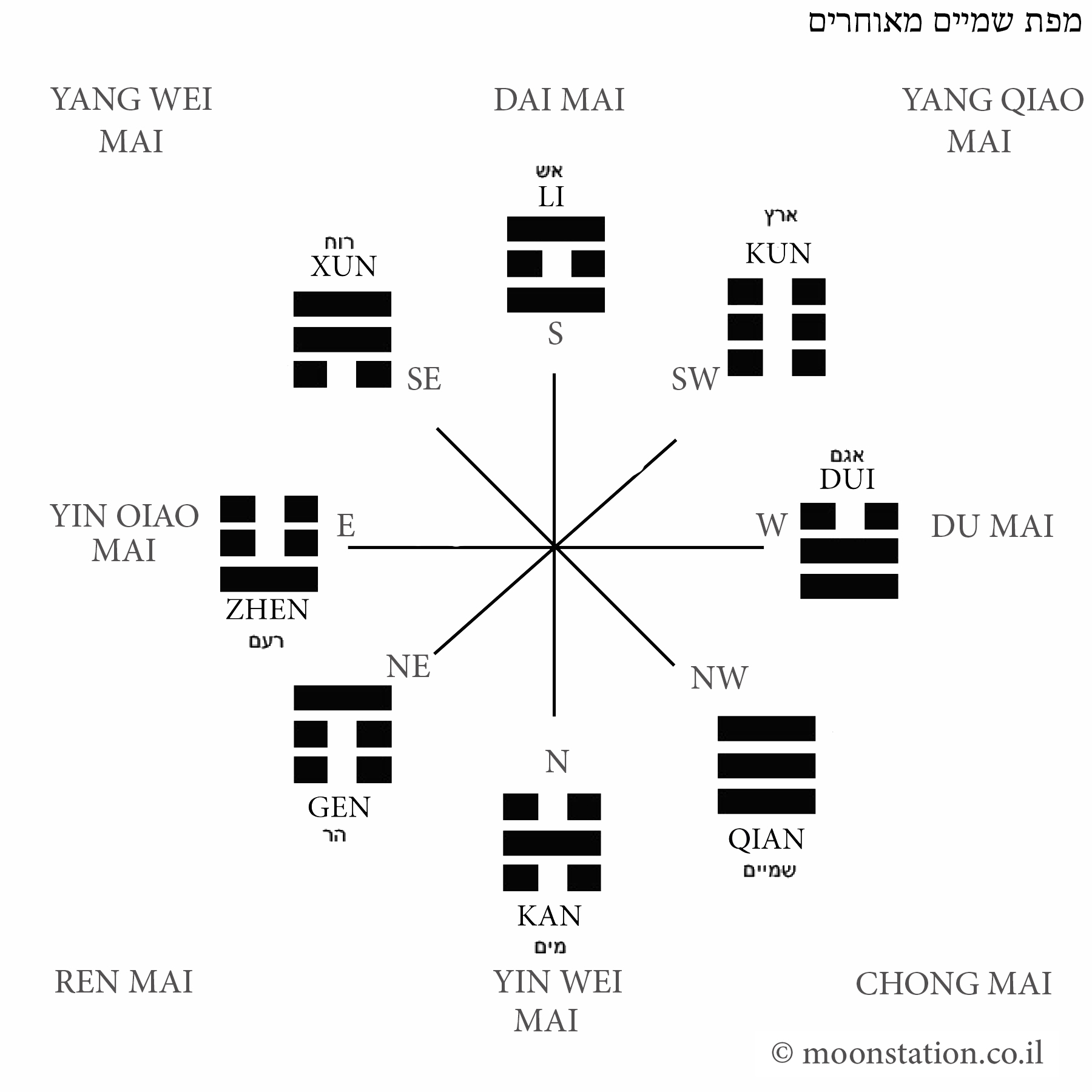
- Early Heaven (Xian Tian): Represents the pre-natal state (Pre-Natal), the early cosmic template, absolute potential, and eternal order beyond the dimension of time.
- Later Heaven (Hou Tian): Represents the post-natal state (Post-Natal), material manifestation, the soul's entry into body limitations, and the flow of Qi within the dimension of time and space.
The Later Bagua does not present absolute and static opposition, but a map of movement and transformation. It deals with how cosmic Qi manifests in the macrocosm (seasons, directions of heaven, and climate) and reflects in the microcosm - within the human body, its internal organs, and states of consciousness.
B. The Eight Forces: Directions of Heaven and the Seasonal Cycle
In the Later Bagua, the eight cosmic forces are located according to directions of heaven and the seasonal cycle:
- Heaven (Qian - 乾): The creative and active energy of Yang.
- Earth (Kun - 坤): The receptive and nourishing energy of Yin.
- Thunder (Zhen - 震): The force of awakening and sprouting (assigned to the East and early Spring).
- Wind/Wood (Xun - 巽): The force of expansion and gentle penetration.
- Water (Kan - 坎): Abyss, flow, depth, and danger (assigned to the North and Winter).
- Fire (Li - 離): Light, clarity, and expansion (assigned to the South and peak Summer).
- Mountain (Gen - 艮): Quiet, halting, stability, and inward gathering.
- Lake (Dui - 兌): Joy, fertility, and harvest (assigned to the West and Autumn).
This arrangement is not merely an abstract system of symbols, but a practical roadmap for understanding the dynamics of reality. It demonstrates how these forces do not stand in stagnation, but act upon one another in constant cyclicality, wherein every state contains the seed of the next.
C. Birth as Entry into the Energetic Grid: The Seal of Time and Cosmic DNA
At the moment of birth, a person steps out from the potential, unlimited field of Early Heaven and enters a fixed, measured energetic system in time and space:
- Circumstances of the Moment: Hour of birth, day, month, season, position of the stars, weather, and environmental Qi quality.
- The Energetic Seal: These initial conditions imprint a unique energetic picture upon a person - a sort of "cosmic-energetic DNA" of innate Yin and Yang tendencies, innate polarity, climatic sensitivity, and emotional and mental response patterns.
This innate seal accompanies a person throughout the journey of life. Every external change - seasonal shift, weather fluctuation, or time transition - does not meet a neutral canvas, but encounters a specific internal field, evoking in each person a unique and distinct response.
D. The Later Bagua as Blueprint of Social and Family Order and Confucian Morality
One of the central features of the Later Heaven map is the embedding of Confucian values and structures into the cosmological grid. Unlike Fu Xi's map, which deals with pure forces of nature, King Wen's map organizes the eight trigrams in a structure reflecting human hierarchy, family, and social order:
- Qian Trigram (Heaven): Located in the Northwest, symbolizing the father, ruler, and guiding authority.
- Kun Trigram (Earth): Located in the Southwest, symbolizing the mother, nourishment, and family support.
- The Six Additional Trigrams: Mapped as the six sons and daughters (eldest son, middle son, youngest son; eldest daughter, middle daughter, youngest daughter).
In doing so, the laws of Heaven were brought down to Earth and directed into the family and political unit. The map is not merely a reflection of astronomy, but a moral-social code (Li) anchoring filial piety (Xiao), social hierarchy, and self-discipline within the cosmic order as a whole.
E. Historical Background: The Transition from Shang to Zhou and the Establishment of Time as the Basis for Governance
The crystallization of the Later Heaven map and the Book of Changes (Zhouyi / I Ching) occurred against the backdrop of one of the most turbulent periods in Chinese history - the fall of the Shang Dynasty and the rise of the Zhou Dynasty.
This era was characterized by political chaos, wars, and a severe legitimacy crisis. Rulers understood that governance could no longer be based solely on tribal ancestor worship or military force. An urgent need arose for a new value system and an objective moral and cosmic justification, the concept of the "Mandate of Heaven".
To establish order in society, it was necessary first of all to coordinate and map time:
- Anchoring Calendar and Observances: Precise calendar determination, linking rituals to seasons and directions, and subjecting human activity to the cosmic rhythm.
- Canonical Texts: Later in the Zhou period, alongside the crystallization of the "I Ching", the Confucian classics were compiled and edited - Book of Rites (Liji), Book of Documents (Shujing), Spring and Autumn Annals (Chunqiu) and the Book of Music. These texts were designed to introduce order and moral consciousness at the level of the individual, family, and public governance.
F. Clinical Application in Chinese Medicine: Diagnosis as Movement in Time
In Chinese medicine, the Later Heaven map and understanding the seal of time constitute a primary clinical and diagnostic foundation: time is not merely environmental context, but an essential part of diagnosis and prognosis.
1. Dynamics in Cycles of Life and Time
The interaction between Yin and Yang changes constantly across different cycles of time: the 24-hour day, seasons of the year, and broader cosmic cycles (10-year, 60-year, and 180-year cycles).
However, the practitioner is required to observe the patient's innate baseline tendency and examine how it responds to dynamic shifts in time:
- A naturally Yin person: Characterized by slowness, heaviness, internal cold, and difficulty bringing into action (lack of Yang or excess Yin), may blossom and experience a breakthrough specifically during the summer season. The powerful environmental Yang of summer infuses heat and movement into them, balancing their innate tendency.
- A naturally Yang person: Tending toward heat, restlessness, and extroversion, may experience worsening symptoms at peak summer, requiring specifically the gathering and Yin nourishment of winter.
2. Diagnosis as Process Rather Than Static Condition
Chinese medicine does not view the symptom as a static finding or an isolated constant, but as a possible movement in time.
The goal of diagnosis is to locate the internal process the patient is undergoing at any given moment, and adapt a precise response (in acupuncture, herbal medicine, nutrition, and lifestyle) operating in harmony with time, space, individual structure, and changing essence.
King Wen's Later Heaven map grants Chinese consciousness and the world of therapy the complete connection among three strata of existence:
- The Cosmic Stratum: Understanding the dynamics and constant change of Qi, Yin, and Yang in space and time.
- The Moral-Social Stratum: Translating natural laws into a moral, stable, and harmonious social and family structure.
- The Individual-Clinical Stratum: The ability to decipher the energetic seal of a person, returning them to dynamic balance through listening to the rhythm of time and life.
Conclusion: Hold Fast to the Center
The journey this article has taken begins in Heaven and ends in the human body. Fu Xi observed above and below and discovered the template. The Yellow Emperor asked Qibo how the body reflects Heaven. Yao dispatched his officials to the four corners of Heaven to learn the rhythm of the seasons. King Wen rearranged the trigrams so they would describe living time and not merely eternal essence. Each of them, in his way, performed the same deed: first observing, and only then ordering.
This is perhaps the deepest insight that Chinese tradition passes on to us: time is not an empty framework inside of which things occur, but a quality. Every hour, every season, and every moment of birth has its own character, and one who knows how to read it also knows when to act and when to wait, when to sow and when to harvest.
Hence also the difference between the two maps. Early Heaven serves as a reminder that at the core of every human being lies a whole and balanced structure, a template that does not erode. Later Heaven serves as a reminder that this template lives within time, encountering seasons, illness, crisis, and transitions, and responding to them in its unique way. Health is not a fixed condition achieved once, but the ability to move with time without losing the center.
The practitioner of Chinese medicine stands, in a sense, in the place of those ancient kings. He does not force order upon the patient from the outside, but observes: pulse, tongue, season, hour, the seal that the person carries from the moment of birth, attempting to identify where the patient stands within the great movement. This is Confucian work in its precision and discipline, and Daoist in its listening and humility. And in between stands the Book of Changes, reminding us that every state, no matter how heavy, already contains the seed of the next.
"Hold fast to the center", said Yao to Shun as he handed over Heaven's calendar to him. This is perhaps the simplest instruction this tradition leaves in our hands, for practitioner and patient alike: not to stop time nor struggle against it, but to find within it the point of balance, time and again.