The Five Elements - Wu Xing
The Five Elements are a harmonious framework and method for observing existence and reality itself. They operate within a balanced system of coordinated, polar forces that nourish and weaken, control and are controlled. Each element can sustain itself relative to its relationship with the other elements, thus creating movement or stillness, strengthening or weakening, which maintains the force of each element in relation to the others. This is a system that consciously explains how dependent we are on external forces, elements, and influences, and how profoundly our existence as human beings relies on our conduct within external relationships and internal responses.
The ancient Chinese perceived the human being as a microcosm of the surrounding universe. Thousands of years of observing the heavens and the movements of the stars birthed a wondrous, orderly system capable of explaining world order and balance, which man projects onto himself and his environment. The Five Elements represent processes of constant change, wherein every earthly or cosmic process finds its place and integrates into the existing movement.
The Five Elements are: Water, Wood, Fire, Earth, Metal.
The Five Elements operate within a system of supportive and controlled cycles because existing reality can never be entirely whole and perfect, otherwise, where would the lesson lie? Thus, an excess will always exist in one system at the expense of another, just as water recedes in summer when fire reaches its peak, reflecting internally within the distribution of elements inside the human being, within the soul, emotions, and movement.
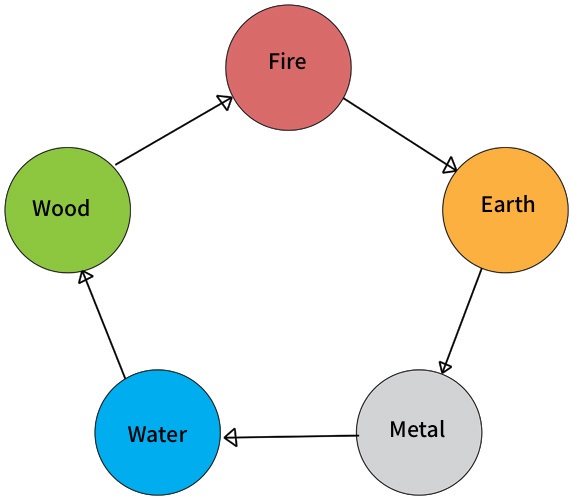
The first and most primary cycle among the Five Elements is The Generating Cycle, which describes a relationship of nourishment, a seamless system of harmonious flow.
The Generating Cycle
The Water Element
The process of human conception within the mother's womb is represented by the Water element, the element from which all things originate. It embodies a Yin aspect, the winter season, and the color black. This is an inward movement striving toward the primordial, initial state, like a seed buried in the earth, developing and waiting for the right moment to burst forth. It is a foundational process allowing the soul to consolidate itself for life through ideas, emotions, and thoughts about reality. This state is safe, as the movement of Water is supported and floats within the amniotic fluid, awaiting the opportune moment to emerge. It is a period where the prevailing cold outside symbolizes a static state of inactivity, wherein life exists beneath the surface, a hidden, unseen process, akin to an idea that has surfaced in a person's consciousness but has not yet manifested, remaining purely a concept.
The Water element nourishes the Wood element: Water waters Wood, and this is the secret of its existence.
The Wood Element
The Wood element represents birth, breaking forth with strength and determination to enable life and shape reality. The newborn is tender and vulnerable, yet carries an immense Yang energy, a willpower and drive toward growth and development. This upward movement is associated with the spring season and the color green. The Wood element guides the child, or the sprouting plant, toward maturity, clarifying desires, shaping personality, and building structure. This process continues until reaching the peak of maturity, which is represented by the Fire element.
Returning for a moment to the idea that appeared out of nowhere within the Water element, the moment an initial action is taken to realize it, bringing it from potential into actuality, it relies on the momentum, breakthrough, and realization capacity of the Wood element. The process of realization may be long and fraught with obstacles, or swift and precise, yet in either case, it requires one to face challenge, willpower, inspiration, planning, breakthrough capability, and goal-setting, all of which characterize the Wood element.
The Fire Element
The peak process of creation corresponds to the Fire element. The child has matured and reached full bloom; the seed sprouted, grew, and is now at the height of its blossoming. The idea born in the Water element materialized through Wood, and now reaches its destination, its fruit: fulfillment and satisfaction. This is the Fire element, dependent upon the driving force and action of the Wood element, for the strength of Fire depends on the burning of Wood.
The Fire element is a melting pot in which all systems function at their peak, guiding the individual toward internalization and knowing, a full consciousness whose sparks we experience as satisfaction, achievement, fulfillment, love, and passion. This movement expands outward to the sides, allowing an experience of expansion beyond confining boundaries.
The Earth Element
This is the state of peak Yang, typically a brief phase. For when a person reaches the apex of maturity, a process of decline begins. When a plant reaches full bloom and yields fruit, a decline begins. When an idea is born and fulfilled, it enters a decline that starts immediately after the climax of the Fire element. This is the period of the Earth element, whose purpose is to preserve the realized achievements as much as possible, to sustain the flower at its peak, the youth at his height, and the outcome of the realized idea as an enduring result. It is a process of containment, preservation, and ripening, as desires for stability, balance, and moderation arise.
The Metal Element
The Earth element resides at the end of the Yang process, reaching the height of internalizing what transpired, signaling the start of the Yin phase. Inward gathering, contraction, and decay, much like any familiar process of aging, are represented by the Metal element, associated with the autumn season and the color white, bringing an inward-gathering movement. At the end, or in death, we return to our original state, a Yin state representing decline, which culminates in death and a new beginning: the Water element.
These processes unfold within us at every moment of our lives. For instance, during the stages of developing and maturing ideas and opinions, followed by decision-making and bursting forth toward their realization, turning spirit into matter. After realization, the idea loses its momentum and movement, beginning a descent toward letting go, paving the way for the ripening of a new process, the Water element.
The Generating Cycle in brief: Wood nourishes Fire (burning of wood), Fire nourishes Earth (ash), Earth nourishes Metal (formed in its depths), Metal nourishes Water (enriching its quality), Water waters Wood.
The Destructive Cycle
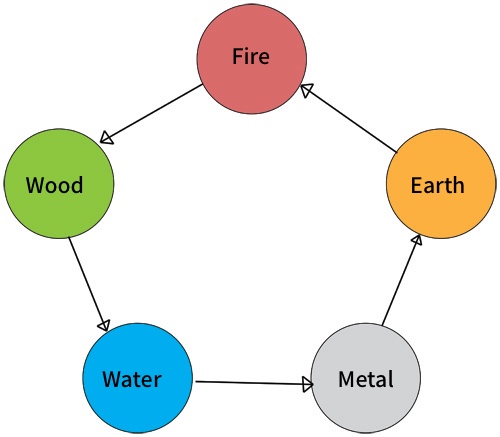
An inverted cycle in which the child element destroys the mother element, a situation where the power of the child exceeds that of the nourishing mother, preventing proper nourishment and giving rise to a reverse process of destruction.
Wood in Excess Destroys Water
Akin to trying to water a tree with a single drop during a drought. Dryness, loss of operational flexibility. A person leaping into action before an idea has crystallized. Rigidity, inflexibility, over-control, tyranny, anger, and tension frequently seeking release. An individual acting out of fear and anger, striving to reach a goal through aggressive and assertive force without regarding surroundings. This is an improvising person, driven by ego and control, feeding on extreme ideas that serve short-term goals but undermine long-term wellbeing.
Water in Excess Destroys Metal
The Metal element bestows focus, discernment, and precision upon the Water element, channeling diffuse Water into defined, organized methods. When Water destroys Metal, mental dispersion and an inability to focus ensue. A person scatters across numerous fields, withdraws inward, detaches, isolates, and avoids communication. Mental dispersion prevents a continuous thought process. In this state, the ability to refine and distill is impaired, and in compensation, the individual develops obsessions with minor matters while overlooking the essential. Principles and values dissolve, or boundaries collapse.
Metal in Excess Destroys Earth
Earth at its best provides Metal with a sense of belonging and security, offering a framework of family and an anchor. In the reverse process of destruction, a person stubbornly entrenches within their own world, developing alienation and distance, primarily engaging in rebellion, judgment, and criticism toward the community in which they live. Such a state perpetuates self-righteousness, judging every event or interaction from an individual standpoint that disregards others in favor of proving oneself right, thus ignoring the collective good.
Earth in Excess Destroys Fire
The Fire element gives the Earth element joy, generosity, warmth, empathy, and the ability to channel positive emotions into social structures. When Earth destroys Fire, a person entrenches inward, developing negative thinking fed by feelings of being unloved, unaccepted, unwanted, or unattached. They cast themselves as a victim in a cyclical process, shifting from leader to follower. Excessive security and stability principles preclude spontaneous expressions of warmth, love, and expansion. Over time, skepticism, bitterness, and fixation emerge. The heart cools and retreats, leaving the individual rigid and unsatisfied.
Fire in Excess Destroys Wood
The Wood element gives the Fire element the movement required to achieve goals, planning, speed, initiative, and courage. When Fire destroys Wood, it creates illusion. Goals become unclear, and a state of euphoria and delusion takes over, aimed solely at satisfying Fire's craving for fulfillment even if the surrounding world collapses. This manifests as addiction and the pursuit of stimulation and gratification, a desire to be loved and needed at all costs, without building true purpose or setting goals grounded in reality.
The Controlling Cycle
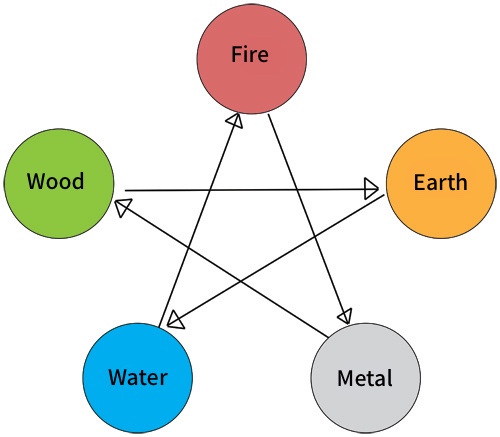
A polar cycle representing control and limitation, safeguarding the opposing element from soaring or exceeding functional boundaries. In Chinese thought, the controlling element is the source of strength and power for the element it controls.
Wood Controls Earth
Earth tends to conserve and establish itself, maintaining safety and scrutinizing any action requiring courage and innovation. The Wood element within the Controlling Cycle moves, pushes, and initiates, preventing Earth from stagnating or sinking into comfort zones. It points to possibilities of free choice, entrepreneurship, and risk-taking, preventing Earth from slipping into inertia, over-conserving the status quo, getting bogged down in routine, or remaining inactive amidst surrounding opportunities.
Earth Controls Water
By containing and gathering Water within its boundaries, a process of containment akin to a lake or vessel. This creates structure and belonging for the Water element, which tends to seek the depths, detach, and disperse. Earth allows Water to inhabit a realm of responsibility, vital communication, and emotional connection with loved ones. When such responsibility translates into raising children or sustaining a family, Water is obligated to maintain an ongoing, responsible, practical connection, leaving no room for detachment or a floating philosophical stance, a tendency Water naturally holds that bypasses responsibility or confrontation with deep-seated fears.
Water Controls Fire
Water controls the intensity of Fire. The dynamic of the Fire element is to break boundaries, drift, and expand; Water regulates the height of the flames. The depth, sensitivity, and quest for identity within Water prevent Fire from scattering, merging recklessly, and losing itself. Water imparts seriousness, perseverance, willpower, and diligence to Fire, qualities crucial for an element prone to superficiality. Water teaches Fire that satisfaction and realization stem from a process, not a momentary pursuit of stimulation. In other words, Water provides balance between vision and the passion to experience, between emotions and thought.
Fire Controls Metal
Fire controls Metal's density and strength through its ability to transform solid into liquid. The Metal element tends toward rigidity, meticulousness, and obsession with detail. The more solid Metal becomes, the more its rigid principles turn into an obstacle, inducing a sense of suffocation that precludes joy and spontaneity. The Fire element brings laughter to Metal, the ability to take things less seriously, and the recognition that applying principles depends on changing circumstances. Metal's mental rigidity, criticism, and judgment dissolve before the understanding that others have different needs and that righteousness is not absolute.
Metal Controls Wood
Metal governs and limits Wood's movement and growth, instituting order and discipline within the growth process, much like pruning a tree to preserve freshness and generate renewed vigor. The Wood element is a pioneering force that moves powerfully toward goals. The Metal element mandates order and self-discipline, outlining maps, warnings, and resolution points along the path, enforcing structure, shedding the superfluous, pruning the trivial, and helping Wood distill its definition prior to action.
The Insulting Cycle
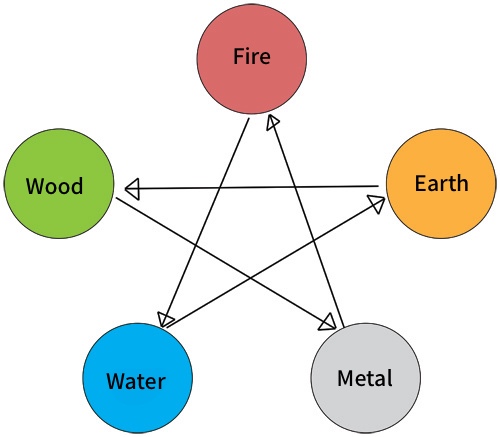
A cycle functioning in reverse to the Controlling Cycle: instead of the controlling element regulating and balancing, an excess arises in the controlled element, which weakens and impairs the function of the controlling element.
Earth Insults Wood
Instead of Wood controlling Earth, an excess of Earth exists relative to Wood, preventing Wood from mobilizing Earth into movement and action. Earth wallows in stagnation and inertia. Movement fades, and the need for security dominates. The individual loses the capacity to initiate, make decisions, or spot opportunities, tending to sink into established routine. Security overrides the need for freedom and action, causing the person to slow down and hesitantly weigh every step to avoid stumbling.
Water Insults Earth
The Earth element fails to contain Water, causing it to overflow. Inward retreat. Developing philosophical concepts that hinder family unity or group initiatives requiring commitment. Sanctification of the self and self-search. A tendency toward isolation, avoidance, and solitude, drifting from practical utility into abstract philosophy, seeking belonging within larger entities: organizations, workplaces, religions, or systems where Water can merge with an abstract idea rather than directly with people.
Wood Insults Metal
An overly dominant Wood dismantles Metal's ability to dictate principles and rules. This causes excessive assertiveness, outbursts, anger, an inability to accept criticism, and a failure to follow an organized plan. It challenges laws, order, and self-discipline, leading to extremism, forceful domination over others, stubbornness, and tyranny. Energy scatters rather than gathers, bursting forth in forceful pushes even where letting go is required.
Metal Insults Fire
When Metal is stronger than Fire, cold and rigid patterns extinguish Fire's spontaneity. Logic governs emotion or nullifies it in the name of justice or order. Movements become calculated and sharp, and the individual becomes critical and judgmental. Perfectionism yields immense self-control that prevents breaking out of rigidity, impeding the experience of spontaneity, love, or closeness. The Metal individual does not yield or allow merging with Fire's warmth, cooling it by guarding boundaries and self, insisting that the sole purpose is preserving structural integrity.