The Fire Element in Chinese Medicine
The Fire element represents the summer season, the time of blossoming and prosperity. This is a time when joy prevails everywhere, abundance is at its height, and a sense of satisfaction lingers in the air. It is an element of connection, of interaction between people and situations, maturity, renewal, and changes. It is responsible for socializing and recreation, living in terms of passion and charm, romance and hedonism. It represents a desire for unity and consciousness, the capacity to bring oneself and others toward transformation and perpetual change.
Fire is linked to the Heart and the capacity to feel, to be moved, to share, and to touch the other without a clear boundary, and consequently to be hurt as well. It seeks to resonate, to inspire, and to move, while simultaneously seeking an answer: does anyone see me? Feel me? Understand me? It is vibrant, yearning, yet also vulnerable. It provides warmth, but asks for resonance and attention.
Fire is a state of consciousness, a peak state that is the result of a process of sowing and growth. It is the blooming and fullness of a theoretical idea born in the Water element, whereas the practical phase of bringing potential into action belongs to the Wood element, and realization is the Fire, the fruit. In its spiritual aspect, the Fire element represents the wisdom of the Heart, the SHEN, that quality capable of uniting opposites, dissolving limitations, and opening the door to conscious transformation. This is the connection to the divine spark within us, to the spiritual purpose beyond the earthly roleplay, toward a perspective that perceives possibilities and selects from them that which will serve one's choice and destiny in the most beneficial and desired manner.
The Fire Type - The Person
The Fire type loves connection and touch, needing change within. They bore easily, seek challenges, and desire to be loved, warm, and inspiring. They readily expose feelings and emotions, share with others, confess, identify with the feelings, thoughts, and states of others, and place themselves at the center of the relationship and attention.
Fire loves to stand out, arriving at situations and among people with a full reservoir of energy and enthusiasm, tending to immediately become the main stage of occurrence. They know how to move others from one emotional state to another, to encourage, amuse, and promote positive states of joy and satisfaction. These are the classic teachers who inspire, expressing a vision and the manifestation of a better world: people who know how to enter into the situations of others, identify with them, and help them realize an inner transformation through enthusiasm, warmth, and fusion, sowing hope.
Their capacity to walk toward the emotional threshold causes them to move along boundlessly, far beyond their definition of self. The Fire element tends to lose the self in its merging with others; hence, the process is doubly crucial, as movement beyond boundaries creates a gap between enthusiasm and suppression.
The need to exist and function in states of enthusiasm, warmth, and inspiration brings the Fire type easily into exhaustion, anxiety, and restlessness. They require rest, yet often tend to refuel themselves through external, exciting means in order to sustain the path of warmth and passion. A tendency toward extreme emotional states is an integral part of their journey: they tend to move beyond boundaries, and there are situations in which they burn out, becoming extinguished and gloomy. In today's world, one can observe many Fire types whose gloominess is more characteristic than the path of joy when they have discharged their energy and charge, felt disappointed, been hurt, and remained so, drained and extinguished without the ability to find a new purpose to thrill them and reignite enthusiasm. This demonstrates how sensitive, vulnerable, volatile, and quick to move from peak to trough this element is through the need for drama and storms, which in turn exact their price.
At their best, the Fire type is a source of inspiration. They carry the optimistic gaze of the heart, bringing forth a vision of a better world, a true connection between human beings, hope, and the capacity to overcome obstacles: a connection to joy and love as a way of life.
Yang Fire
Seeking closeness and warmth, burning openly, extroverted, living on stage and within the crowd as the main attraction. The performance itself and life are the backdrop, as is the environment whose role is to cheer, encourage, and help promote the elevated and broad status sought: the capacity to influence, transform, hold status, and mutate energy and situations. For this, they are willing to throw themselves into the center of an emotional situation without engaging critical thought processes, but rather surrendering to the experience and merging, even at the cost of losing themselves.
Yin Fire
Far more closed and introverted, often appearing like the Metal type, reaching broad recognition and peak status through an intellectual, status-oriented path, typically associated with education. There is a natural caution, a fear of emotional exposure. The fear of being hurt leads to excessive restraint and tight self-control. The warmth does not disappear; it is simply translated, appearing as sharp intellect, precise expression, achievement, and professional prestige. Realization means being esteemed, echoing success, and securing a place in a world that values worth, not merely emotion.
Relationships Between the Elements
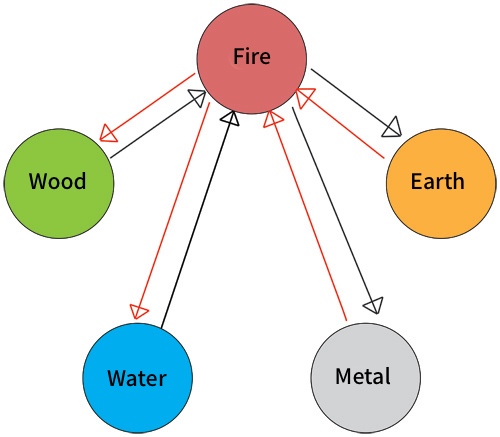
Wood Nourishes Fire - The Generating Cycle
The Fire element requires the momentum and strength of the Wood element. The burning of Wood is what ignites Fire: Wood is its fuel. It pushes Fire forward, beyond familiar boundaries, with a surge of daring, vision, planning, and courage.
When Wood does not nourish Fire, it resembles a bonfire without combustible material. Wood provides the stimulus that causes expansion and departure from boundaries. This stimulus can be a goal, an initiative, or another person's emotional need. In cases where Wood does not create appropriate movement, a person tends to develop forced drama or crisis, through which movement can be experienced; however, the bitter aftertaste remaining does not make the situation positive. On the contrary, it worsens the natural polarity ingrained in the Fire element: the shift from being of interest to a lack of interest, from enthusiasm to boredom, from a groundbreaking personality to a depressed one.
Fire Destroys Wood - The Destructive Cycle
When Fire grows excessively strong, it burns the fuel. Drive increases, need intensifies, and emotion strives for peaks. An emotional vertigo ensues, an addiction to feelings, excitement, and immediate gratification: an endless emotional pendulum seeking to conquer another moment, another experience, another thrill, a Fire seeking to burn, enthuse, share, and uplift the environment even when it is empty and devoid of meaning.
This is a cycle of self-exhaustion. The heart fills but does not settle. A confused consciousness, a tiring emotional wandering, jumping from thought to emotion to action without rest. At times, this manifests as anxiety, restlessness, and nervousness. The heart boils, yet lacks root. Then, when the fire goes out, fear arises: fear of what is absent, of what has ended, fear of losing love. And the person attempts to ignite it again, by any means, through external stimulation, another experience, another relationship, another emotion, when in fact they need the exact opposite: quiet, rest, turning inward, and ceasing to make such a grand affair of themselves.
Fire Nourishes Earth - The Generating Cycle
The Fire element nourishes the Earth element in the Generating Cycle. It grants it warmth, inspiration, and a sense of belonging. This touches the human heart and ignites within it a sense of care, from which action for the common good is born: recognizing the need of the other without turning the other into an object in one's own game. Empathy, consideration, and tenderness are all emotional contents Earth requires to know where to act, how to act, and above all, why. Thanks to Fire, Earth does not become merely ground, but fertile, considerate, connected ground that shares with others.
Earth Destroys Fire - The Destructive Cycle
When Earth becomes overly dominant, it exerts excessive weight on Fire, absorbing the heat and extinguishing the spark. The internal sensation is rejection, not necessarily actual rejection, but rejection as consciousness: the person feels unwanted, as if the world does not need them. Spontaneity disappears. The natural lightness of Fire is replaced by heaviness. Every initiative is halted; every drive turns into an exhausting internal debate. The heart, which was meant to drive, encounters walls of hesitation, doubt, and worry. Thus Fire becomes covered in overly thick ash, and the person gradually becomes a worried individual when stability is imposed that is not part of their natural traits.
Water Controls Fire - The Controlling Cycle
The Water element, which controls the Fire element in the Controlling Cycle, does not oppose it but balances it. It maintains boundaries, enabling discernment, separation, and self-definition. If Fire is drawn outward toward connection, experience, and expansion, Water strives inward toward authenticity, root, quiet, and self-knowledge. Without Water, Fire scatters, burns out, wears down, losing itself within the other, within excitement, within the theater. Water is what pulls back inward, placing a quiet hand on the heart and reminding: "You are not only what you feel right now. Within you lies a deep root, an inner presence, a memory of the self." Developing listening, observation, and ease is vital for the Fire element, because through them, it can experience its movement, goals, and initiatives as an empowering and supportive experience, understanding that without striving toward its own root, it will continue through life chasing the next thrill, whereas Water invites it to a different experience: a search for meaning.
Water Insults Fire - The Insulting Cycle
When the Water element acts in excess toward the Fire element, no fire will be created, or at the very least, it will have no expression. The light remains trapped. Emotional expression disappears. The difference between Water communication and Fire communication is fundamental: Fire stands on stage, speaks, lives the words, exciting because it is itself the subject, the beating heart of the moment. Water expresses things from behind a screen, keeping distance, sometimes as an anonymous writer, sometimes as a quiet speaker avoiding exposure. A person writes wise articles over years, and you know nothing about them: not their face, not their voice, not their personal story. This is an expression of excess Water building above Fire and smothering it, the dissolution of outer identity and the safeguarding of inner identity from intrusion.
Fire Controls Metal - The Controlling Cycle
The Fire element controls the Metal element, not to suppress it, but to soften it, allowing it to open. Fire is the abundance of Metal: definition, self-control, order, ritual. Metal binds Fire to a defined, sequential process, but Fire shows Metal how to reach a place of genuine identification through intuition rather than intellect alone, a place where transformation can be experienced through connection, relationships, and expression before others. However, if movement manifests in excess Fire without Metal order, the expression will be over-emotionality, mental and emotional disturbances, a breakdown of boundaries.
The interaction between Fire and the Metal element teaches Metal to understand: boundaries can be preserved, but also changed. Principles are important, but sometimes judgment must be suspended to listen to the heart. Compassion toward a human being, even when they err, is part of Metal's capacity to be human and not entrench solely in what is right, valuable, and moral. Fire shows Metal through the Controlling Cycle that it is worth loosening the tie, dancing, rejoicing, and enjoying life and existing reality. It says: do not be so severe with yourself.
Metal Insults Fire - The Insulting Cycle
When an excess of Metal occurs over the Fire element, it is no longer Fire melting Metal, but Metal solidifying into a rigid, unworkable substance. The heart cools. The inner burn is blocked behind rigid control mechanisms. In place of an open heart, there is cynicism; in place of intuitive compassion, intellectual interpretation. Emotion is no longer a flowing liquid, but solid, stuck, frozen. These are people who speak of feelings, yet do not express them, who analyze, yet do not open up or truly experience them. The person entrenches, becoming righteous, cynical, and distant from themselves and the world, perceiving it as unfair and unequal.
The Fire element is empathetic, highly sensitive, absorbing and sensing what others feel even when unsaid. This is a great gift, but also a burden. When unbalanced, when Fire is exposed to too much flowing emotional information, it burns out. Internal warmth becomes a blaze; excitement turns to anxiety. Thus, the balance between Fire and Metal is critical: Metal provides a boundary, yet must know when to let go; Fire ignites, but requires containment, needing a boundary so that the person does not lose themselves.