The Metal Element in Chinese Medicine
The Metal element represents autumn, the period of decline for all things. This is the time when plants wither, shed, fall to the ground, and decay in preparation for the start of a new cycle. It is a concluding energy that does not permit existing reality to continue on the same functional plane - it is the end of the road for that which grew and blossomed, a moment before gathering into the root of life.
The Metal type is driven by the need for perfection. This is fundamentally a spiritual element that prefers a heavenly perspective over an earthly one. Perfection is a potential and a soul's longing, giving rise to a process of refining, separating, and discarding superfluous elements. It knows how to separate the trivial from the essential and tends to anchor the essential with the nails of order and self-discipline.
The Metal type relies on abilities of discernment, focus, and concentration. They live within measured boundaries based on justice, morality, values, and strict self-discipline, striving to bring existing and desired reality into clear borders. This reflects a rigid, uncompromising, and at times inflexible personality concerned primarily with how they appear in the eyes of the world in terms of self-image.
The Metal Type - The Person
Metal people tend to rely on their mental capacities. They hoard knowledge, as this knowledge serves them as shelter, as well as objects of nostalgic value. The mental side tends to lead and dominate over the emotional side. Emotionally, they tend to be closed and introverted, sharing little and zealously guarding their inner boundaries against vulnerability, which leads to a serious and cynical personality.
The Metal type is endowed with precision and an ability to analyze situations from an observant stance they adopt for themselves. They judge processes according to what is correct and just, based on morality and values. This is an element centered on itself and its internal refining, shedding another layer on the path toward long-awaited perfection that grants a touch of aesthetics and beauty. They know how to appreciate order, for external order reflects an organized internal state, and an orderly, clear internal state imparts a sense of control over the situation.
The Metal element is drawn to unseen worlds: mystery, enigma, and mysticism. It appreciates tradition and is drawn to nostalgia, to the cosmic order that once was. These are naturally rebellious people who challenge the existing order, confident that they know how things ought to be organized, thereby entering frameworks and creating revolutions within them to refine and properly structure them. There is great rigidity in their approach, yet they are uncorruptible and faithful to their origins, for the desire to achieve the optimal can help them remain humble, while simultaneously carrying high anxiety regarding image and the wish to remain pure-handed.
This is an element that lives in perpetual self-reckoning, prone to melancholy, and struggling to cope with complex states of stress and pressure. The internal perception demanding self-control often causes them to remove themselves from the collective and isolate within a sense of injustice and non-belonging. Metal does not feel belonging: it views itself as an independent, individual territory engaged in perfection and self-advancement rather than as part of a greater whole. For many of them, life is a long survival struggle on the path to solving the formula that will grant their method victory or a clear advantage through exemplary order and organization.
The Metal element possesses the ability to break complex scenes down into small, clear, and defined components. This process of deconstruction helps it understand the situation thoroughly and master the details. Its organizational process is natural: an internal order projected outward through a systematic, known, and structured process of deconstruction, investigation, documentation, and reassembly in a more efficient and precise manner. One of the prominent drawbacks is that they cannot multitask. If a difficulty arises within a task, they will not proceed until the problem is solved, and this waiting sometimes delays overall development.
Metal people are not interested in what everyone sees, but in what no one sees. This is the unique gaze driving them toward the mystical, the hidden, the religious, and the symbolic: the desire to discern what no one else observes.
Yang Metal
Assertive, direct, sharp, and distinct. Operating according to principles of cutting, precision, and an uncompromising stance on law, order, value, and justice: this is the architect. Living responsibility as a natural choice, striving to mend and organize reality out of a sense of mission, because in their eyes only they know efficiency and order. Rebellion as a principle of life: not going with the flow or the beaten path, seeking to change patterns, actions, and habits, establishing in their place other patterns, actions, and habits, meaning that one must refine what is useful, summarize what is essential, and follow solely this essence. These can be principles of life, belief, or perception that express the desire to transcend toward the sublime: bringing functioning and actions to peak efficiency and continuing to sharpen, streamline, and order instructions until they are perfect. Their sanctuary is perfection of form.
Yin Metal
Softer, less rigid, operating out of a sensitive observation of conditions, contexts, and environment. This is the interior designer interested in small details, aesthetics, form, and harmony. At times, they prefer to nurture image, representation, and how things are perceived: the beauty of form, rather than necessarily their inner essence. Their need for perfection is not aggressive: it is delicate, vulnerable, preferring inner quiet and integration over external struggle, preferring comfortable conditions, status, and authority. They engage in utilizing their discernment to arrange life itself in an aesthetic way, one that is pleasant and bestows upon them an environment and atmosphere of beauty, order, and aesthetic cleanliness.
Relationships Between the Elements
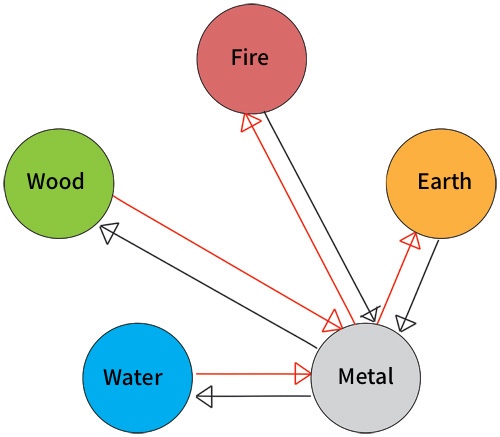
Earth Nourishes Metal - The Generating Cycle
The Metal element is an element whose eyes are raised upward toward the heavens, rather than at the earth beneath its feet. It requires an anchor. Here steps in the Earth element, which nourishes it in the Generating Cycle. Earth is the womb within which Metal is formed, granting it a sense of belonging, background, and framework that allows it to observe without collapsing. This compels Metal to accept what differs from itself, to accept forms of expression and behavior that do not always align with its ritualistic rules. The less Earth support Metal has, the more rituals and repetitions occur meant to provide security as a return to a known, familiar place. This expresses the need for control through an attempt to freeze reality rather than confront its inherent chaos. As Earth fulfills its function, it grants stability to Metal, which requires it. If Earth fails to support, doubt and cynicism increase within Metal: a conviction toward mental and intellectual detachment from what might harm or fail to conform to its worldview.
Metal Destroys Earth - The Destructive Cycle
When the Metal element is in excess, it removes itself from the collective, revokes belonging, judges itself and others with utmost strictness, and feels disappointment with the world. Metal is too sharp: it lacks flexibility, compassion, and a base upon which to lay its principles, leaving the person to entrench within their positions in the name of the justice of matters.
Here a persistent sense of lack is born: anger and frustration when reality fails to meet the standards the person set for themselves. The gap between individual need and social commitment creates a deep inner conflict: the person feels torn between a role assumed and the values established, because containment capacity and capability are low. Recurring, obsessive thoughts and a sense of failure emerge, all undermining the internal foundation. Thus, an imbalance in the Metal element leads to an inverted state of immorality, lack of values, and corruption, which is the exact opposite of what it believes, yet survival instinct prevailed upon discovering an unsupportive Earth.
Metal Nourishes Water - The Generating Cycle
The expression of Metal occurs through the Water element. When Water is nourished by Metal, it gathers refinement, precision, and values, giving them movement. Values do not remain abstract principles: they embark on a journey. Metal's search for perfection and justice translates, through Water, into a different question: "Who am I?" not within one's role, but in an authentic drive for identity. Thus a foundation for true conscious transformation is laid: from a judgmental gaze to an understanding, compassionate, learning perspective. Metal's advantages of discernment and refinement find Water thirsty for direction and definition, and this combination creates a blessed state of refined drive toward the root in search of the source of self-identity.
Water Destroys Metal - The Destructive Cycle
When the Water element acts in excess toward Metal, Water washes away Metal's boundaries. Principles and discipline cease to exist: only fragmented, raw, undiscriminating flow remains. Precision is lost, judgment blurs, and the person moves between extremes of thoughts, ideas, and emotions without direction, randomly. In such a state, we may see expressions of valuelessness, cynicism, and even corruption, because Metal's desire to solidify into a system of laws scatters within the inquiring Water, creating great difficulty in following instructions, decisions, or principles upon which the person chose to rely. Here we witness jumping from idea to idea, an inquiry lacking depth, a dissolution of boundaries, and a loss of form.
Fire Controls Metal - The Controlling Cycle
In the Controlling Cycle, the Fire element regulates Metal. It breaks the freeze, thaws the cold, and allows emotion to penetrate closed boundaries. Fire enables Metal to understand that sometimes it is better to think with sensitivity rather than merely hold fast to rigid principles. Boundaries, laws, and logic are indeed important, yet life requires flexibility, compassion, broad vision, and openness. The balance between intellect and emotion allows Metal to function in a high and refined manner, receiving messages through feelings rather than exclusively through data. This means that the path of thought connects with sensitivity and intuition, granting a different dimension to the intellectual, planned world of Metal thinking.
Excess Fire over Metal - The Insulting Cycle
When Metal is overly strong relative to Fire, it stiffens even further. Every emotion is frozen, the emotional system locks down, and functioning becomes automatic, cold, intellectual, and cynical. The person operates from a pre-set plan, driven by dread of emotional exposure and fear of being hurt. They choose to avoid any situation requiring self-exposure: in relationships, love, creation, or simple conversation. It is an internal freezing process that permits no renewal, love, or change: a constant sadness, a sense of detachment, a depression hidden behind efficient functioning that remains empty inside.
Metal Controls Wood - The Controlling Cycle
The Controlling Cycle exerted by Metal upon the Wood element allows it to impose rules and boundaries upon Wood's movement, slowing it down to enable precision, understanding, and meaning: to get organized. If Wood has a goal, it chooses the fastest route, whereas Metal examines the path, measures obstacles, and offers a strategic vision based on values and laws. Wood provides Metal with inspiration and imagination: a tangible playground wherein Metal tests its boundaries. Wood is Metal's ideal client: one whose lifestyle needs organizing and arranging, delving into details, and refining.
However, when Metal is overly strong, it can stymie execution. An excess of Metal leads to fear of failure, a need for perfection, and severe self-judgment. The result: blocking action or bogged down over-delving into minor details, losing the capacity to see the broad, big picture, the task itself. Nitpicking details frequently causes a loss of momentum, introducing considerable tension into Metal-Wood relationships, as both work intensely on control.