The Water Element in Chinese Medicine
The Water element seeks the purpose of life. This purpose can be philosophical or logical, aiming to reach self-definition due to the vast dispersion felt by the Water element. Within the Water element, one finds monastic aspects such as inward gathering, restraint, solitude, and mystery. It is the least communicative element, yet paradoxically the one striving for deep, essential communication that matches its internal pace and depth, pointing to the existing gap between its external world and its inner world.
Philosophy drives the Water element toward the search for the truth of life, the search for its personal self, the need to establish and know itself, and the establishment of a unified method for a chaotic life while finding mental solutions for emotional problems. Its approach to life: every problem and phenomenon has a cause, and in search of that cause, it is willing to go anywhere and listen to anyone willing to show it the truth or explain the process from which the problem was born. Life is a defensive journey in which one opens up to the world on one hand while fearing its inward invasion and defending oneself, marked by unclear boundaries.
The Water element is primordial and therefore constitutes the most crucial source. It contains within itself all the other elements, which are relatively extroverted and external in relation to it. Within this, in Western social reality, this acts as a delaying factor that is sometimes perceived as a weakness due to a vulnerable personality. One can identify watery traits such as suspicion, withdrawal, inward gathering, loneliness, solitude, and a tendency to build a wall and defense around oneself. Yet at the same time, these are individuals who choose to confront the topic of communication as a central theme, and for this, they are willing to speak, express, and find within themselves the source of their feeling that they wish to voice as truth.
As an analogy to a house: the Metal element is the texture and aesthetics, the architectural blueprint. The beauty is Fire. The spaces and garden are Wood. The walls and substance are Earth. And Water is what lies in between, as well as the basement of the house: that hidden, internal place where the most vital dialogue occurs. This is usually the place people fear most, the self. Water asks itself, who am I? And from here begins the search for self-definition, emotional probing, dealing with memories, the past, events, and identity: a drive toward the depths in an effort and desire to build a consolidated identity, which begins with knowing oneself.
The Water Type - The Person
The Water element investigates the secrets of life with great shrewdness, until it thoroughly comprehends the nature of its reality and that of its environment. Through its distant perspective, it succeeds in defining the problems and obstacles standing in its way, yet usually fails to find the path that will lead it through these obstacles to the truth because it does not always know how to define desire and boundaries precisely. It lives in a world of ideas and vision focused on its deepest interiority, a condition that may cause detachment from unfolding reality and a sense of dispersion. It is highly vulnerable and easily retreats into itself, and thus may periodically find itself indifferent, cold, lacking excitement, and devoid of willpower when it fails to identify a suitable purpose. In other words, it does not always find the reason for living because it expects itself to be driven, brimming with ideas, desires, and needs that will propel it toward its goals, yet these processes are not constant and are marked by many retreats.
The Water type engages with its fears and seeks to resolve them. When deficient, fears dominate, meaning that the fear of losing control is present and prominent in life as a permanent anxiety regarding what might go wrong or a fear of becoming lost. Deeper fears relate to the fear of emotional exposure that threatens its interiority, manifesting as an experience of invasion into its inner sanctuary, which is meant to be collected and protected. It is the holy of holies that not everyone can reach, and therefore Water's defense mechanisms operate powerfully precisely because there is a fundamental issue with defining boundaries.
The issue of money frequently connects with its fears. Water is a hoarding element, usually living with a sense of scarcity, even when possessing abundance. Financial security is an essential tool and a path meant to bring security, and their money usually comes from hard work, perseverance, and willpower, because it becomes a goal in itself. The perception of money is a survival perception carrying the magic that if the right, suitable mechanism is found, the survival experience will be pushed aside, and then the general threat or fears will decrease accordingly: this is the true motive, rather than the material itself.
The Water type finds it difficult to express emotions. Due to reliance on Earth, it possesses a need for closeness, family, or a framework, yet tends to distance itself. Family for it constitutes the containing vessel, and the wholeness of the family is more important to it than its own wholeness. Even within a family or framework, it tends to live in the position of a distant observer, hiding away or excessively guarding itself and its boundaries.
Water element people engage in and are interested in communication, if only because they are not naturally communicative. The emotional world is their source, but also the source of their vulnerability, and thus when a person tends to withdraw and turn inward, this lack magnetizes a regular practice of social communication. Therefore, Water people will testify about themselves that they are open and communicative, but this is a skill acquired throughout life rather than an innate personality trait as with Fire.
Water by nature disperses, and therefore requires definition. It receives the definition of boundaries from the Metal element, and does not naturally know where the boundaries of the self reside. It finds it difficult to separate its desire from the desire of those around it and to discern where it begins or ends, for Water is inherently diffuse. Past memories carry immense weight, and projecting past experience onto the future is the source of emotional hardship with which the Water element contends, forming the basis for the emergence of fear regarding what might transpire.
Yang Water
Diligent, dynamic, practical. Driven by a desire to act, work hard, and invest energy in large frameworks, provided an emotional connection, a sense of mission, or belonging to a broader structure exists there. Once such a connection exists, it is ready to surrender completely and work hard. It constructs an idea, analyzes it, searches for the logic at its base, and then turns to transform it into a replicable method, because it is Water: driving, disseminating, and wishing to influence, expand, and spread. Yet at times, out of a desire to accelerate processes, it may neglect critical stages along the path, such as order, discipline, and clear boundaries that protect the self.
Yin Water
The most fragile, soft, and deep. Possessing very high inner awareness, yet lacking the strength to bring itself into the light. A distinct altruist: giving without asking, helping without intervening, present without standing out. Its capacity for perception is extremely high, sensing the person opposite as if they were itself, yet it does not always know how to cope with this information. Prone to internal flooding when no clear boundary exists, representing the most boundlessly diffuse element, if only because its self-definition is entirely unclear. This is a deep element, endowed with fundamental wisdom, sensitivity, and a realm of sensations. Yin Water cannot operate through struggle; it requires comfort, quiet, and a gentle pace.
Relationships Between the Elements
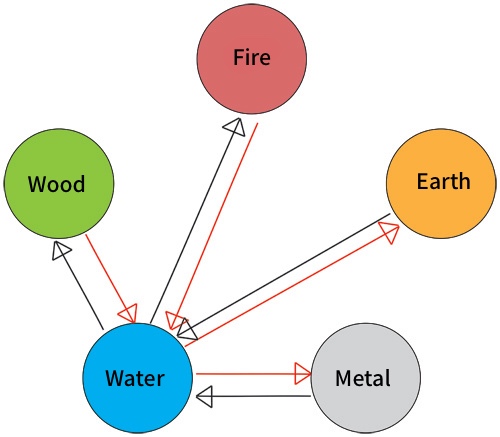
Metal Nourishes Water - The Generating Cycle
The Metal element nourishes the Water element and grants it focus. While the Water element moves, disperses, questions, and changes, Metal is what provides the backbone necessary for precision, filtering, and direction. This involves the ability to distinguish between the trivial and the essential, defining and framing. When Metal nourishes Water in proper balance, a person knows how to order their life and inner world. Desire becomes clear. Consciousness gathers, striving consistently toward the depth of understanding. If the Water element does not receive Metal's support, it experiences a lack of these values and develops an immense urge for self-control, typically accompanied by obsessive, ritualistic aspects loaded with self-criticism and a tendency to make decisions through logical comparison, as everything is conducted through mental programming and intellectual thought.
Excess Metal over Water - Imbalance
When the Metal element is overly strong, flow is halted. Water loses its nature. Consciousness becomes locked within templates, every thought examined solely through the categories of "correct" or "incorrect." The drive toward depth, which is the core of Water, vanishes and is replaced by a motionless stance before an unchangeable boundary. It is as if a person clings to a principle or law and cannot round, soften, or alter it. Metal imposes discipline upon Water even when this discipline cuts off the possibility to flow and feel.
Water Destroys Metal - The Destructive Cycle
When the Water element is overly strong and damages Metal, the capacity for organization, discernment, and focus dissolves. Without a clear definition of self, there is no way to know what belongs to oneself and what does not, what is right and what is foreign. The person drifts between ideas, feelings, and experiences, falling into a loss of control that stems not from freedom but from a lack of grip. In such a state, we may see expressions of valuelessness and cynicism, a dissolution of laws and guidelines: the person becomes an improviser rather than guided, spreading across all realms of life and relationships, slowly dismantling moral agreements that maintain a clear boundary.
Earth Controls Water - The Controlling Cycle
Earth provides Water with a pattern of belonging: family, community, emotional commitment. It creates the edges of the lake that contain Water, preventing it from overflowing and helping it stay connected with the world. Earth brings Water down to earth, into the here and now. Water struggles to understand the way the Earth element creates dependence: how can one constantly care for everyone? And perhaps it is better to observe from afar, not to intervene? And yet, Earth's control over Water is indispensable. It teaches Water what responsibility, dependence, connection, and mutuality are, showing Water that it does not live in isolation and that life itself is a living organism developing through emotions rather than withdrawal from the world.
Water Insults Earth - The Insulting Cycle
When Water surges in excess, it exceeds Earth: flooding, penetrating, and nullifying Earth's role. Connection loosens, the person retreats inward, separating from the world and beginning to deny the need to be part of it. A sense of alienation develops that can be directed toward family, organizations, responsibility, or society. Every external commitment is perceived as a threat to the internal journey. That language of detachment is born, a radical critique of the world and its conduct: "I do not want children in such a world," or "The world is bad, so why should I connect to it?" Hypotheses begin to arise regarding other possible life forms, not necessarily out of openness, but out of a survival need to protect the interior. This is not necessarily a moral stance, but a symptom. The person sinks into a freeze that is not a quiet observation, but a detachment. Sensitivity turns into vulnerability. They withdraw easily, becoming indifferent, cold, and struggling to function within a demanding environment of give-and-take relationships.
Water Nourishes Wood - The Generating Cycle
The Wood element is the expression of the Water element in the Generating Cycle. Water's ideas and inspirations turn into goals, actions, and planning. Wood receives strength from the depths of Water, and through it occurs the transition from the internal to the external, from potential to realization. This is an idea that becomes a drive, a drive propelling action. It rests upon Water's quiet determination, which, despite its natural diffusivity, knows how to concentrate force the moment it understands its desire, nourishing the Wood element by realizing the idea: the growth of Wood.
Water Controls Fire - The Controlling Cycle
The Water element controls the Fire element in the Controlling Cycle and governs its level of intensity. When the relationship is balanced, Fire expresses itself through the insights Water provides: quiet, listening, depth, and inner knowing that the internal nourishes the external: Fire is drawn outward toward connection, experience, and expansion; Water strives inward toward authenticity, root, quiet, and self-knowledge.
When the Water element is in excess, no fire will be created: communication will collapse, emotional expression will disappear, and the person will retreat into themselves. The dissolution of outer identity safeguards inner identity from intrusion, but at the cost of isolation. Fire requires interaction, friction with the world, with emotions and life situations, and does not function well under excessive restraint from Water, as it becomes extinguished. But under proper control, it illuminates, expresses, feels less need to entrench, and learns to balance emotional situations in life through sharing and moderation.
In excess Fire without Water, Fire scatters, burns out, and wears down, losing itself within the other, within the excitement of the experience while losing identity. Clarifying self-identity is vital for both these elements: the Water element confronts it through the question, who am I? while Fire confronts the question, how do I express or project myself to the world? The connection between these two elements is, in fact, self-awareness.