The Wood Element in Chinese Medicine
The Wood element represents breaking forth and birth, like a sprout bursting from the ground in a stubborn struggle against the forces of nature, striving to grow upward and reach as high as possible. It is an element associated with competition, achievement, upward aspiration, and the desire to reach the top and naturally rule at the summit.
The Wood element is an individualist prone to controlling others. It is a natural manager endowed with initiative, charisma, and decision-making capacity. Uninhibited and excelling at functioning under pressure and stress, it is willing to forgo comfort in order to realize its goals. It excels at mobilizing immense energy for time-bound tasks, appearing capable of stretching boundaries, acting, driving, pushing, accelerating, and operating aggressively, provided it accomplishes its mission. This is the classic manager, the entrepreneur, the marathoner: the living spirit that moves on the wings of vision, unsatisfied with standing still or following someone else who will provide achievement, abundance, or advantage; it wants and strives to attain it independently.
Balanced Wood grows tall, alive, perceiving and experiencing the space around it, developing adaptability to nature's conditions, competing on the way to the sun, and demonstrating flexibility that allows it to bend before the wind. This movement permits the examination of situations from shifting viewpoints, changing direction, swapping opinions, altering vision: nothing is sacred save for the essential need to direct drive toward the right goal. The Wood element inherently concerns the future; this gaze enables it to cultivate leadership qualities, harness the vision received from Water, and bring it into action while evaluating the changing possibilities within life's situations. It views life as a playground containing many obstacles over which, through wisdom and flexibility, it knows how to leap.
The Wood Type - The Person
The Wood element builds pressure in order to act, and this is part of its operating pattern. The gradually mounting tension helps it charge into projects, remaining slightly tense, sharp, and clear, but only for a short span of time after which it tends to lose interest. Without pressure, it loses the thrill. It will create several projects simultaneously and move through them, jumping from one thing to another, advancing each matter according to precise and firm timing, pushing and nudging the clock and time, accelerating its actions to reach its goals via the shortest path. In seeking shortcuts, it frequently skips essential stages, confronting reality and challenging rules and conventions. In retrospect, it will realize that the tension that brought movement and realization is the very factor derailing significant aspects from its life, such as ease and tranquility. This leads to a life alternating between periods of inactivity and periods fraught with tension, explosive fuel, and frustration, creating a fundamental imbalance when there is no possibility to spread goals over a longer, more moderate timeframe. This happens because perseverance is absent.
Anger appears when Wood perceives a limitation and delay. It wants things done its way, and when that does not happen, it becomes angry and frustrated. The root of anger lies deep within the Water element, in fear: in the awareness that the Wood element feels it lacks sufficient information about what is happening, making it difficult to maintain control.
The Wood element dislikes surprises and prefers a familiar, controlled environment; it wants to operate with certainty, plan several steps ahead, and remain in motion. Delays stemming from the limitations of others evoke harsh reactions and impatience, as the ability to achieve things rapidly is the core of its strength.
The Wood type is competitive and loves to win, and one can certainly deduce that it hates to lose. It operates within a relative space where it measures progress in comparison to others rather than to itself. It struggles to share with others, preferring to be the sole leader: the one who harnesses vision for the future, uses imagination to illuminate future possibilities, employs foresight, and builds the path for those who will follow. The strength of Wood stems from its flexibility: from its ability to move across vast spaces and explore unknown worlds with courage. It is an individual who loves adventures and challenges, willing to gamble and even fail occasionally to succeed and meet its goals, if only due to foresight emphasizing the possibility of reaching the destination, which is often a matter of persistence. Thus, one can clearly observe flexibility on one side and rigidity on the other, attributes of strength along with change and softening, both of which greatly heighten its creativity and turn it into a way of life.
Yang Wood
Practical, courageous, enterprising, grounded in the earth. Operating out of movement, push, and a breaking force. A natural leader who dislikes being managed and employs authoritative power to voice and express what they feel and think. These are people with a driving engine, who know how to push themselves, flex, but primarily persist on the goal as it is. These are individuals you like seeing in society because they are different. Their thinking is open, viewing life as a system of possibilities rather than a system of defenses. They will forgo comfort and constantly shift viewpoints, yet once locked onto something, it is extremely difficult to sway them from their opinion.
Yin Wood
Less practical, less enterprising, more connected to the heavens: to the realms of spirit, art, creativity, imagination, dreaming, and emotion. It is drawn to aesthetics and the display of uniqueness out of the belief that the great engine of Yang Wood is not in its possession, representing an entirely different aspect: more internal. It expresses more Yin or Blood rather than Yang. Therefore, its strength does not derive from a powerful, dominant, and aggressive movement, but from the capacity to move, touch, and create a soft yet striking presence. It is drawn to status, prestige, and managerial roles, but is less inclined toward large-scale entrepreneurship due to an inability to push and advance matters over time. Owing to high sensitivity, it tends to avoid confronting direct emotional tension, preferring comfortable conditions which themselves serve as a goal.
Relationships Between the Elements
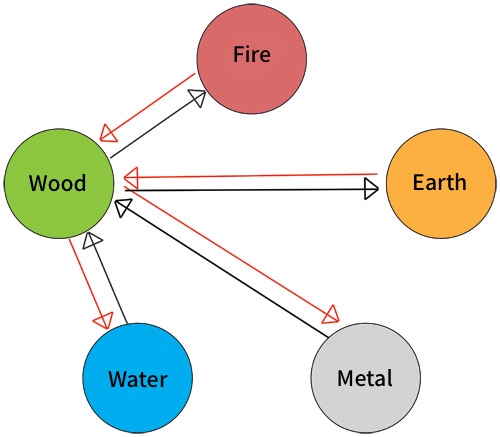
Water Nourishes Wood - The Generating Cycle
Wood needs Water to grow: it needs an idea and a vision. Ideas and visions take shape within the world of Water, in the depths of consciousness, in the invisible subterranean space. They awaken out of an inner drive to materialize; hence, the execution phase constitutes a natural transition between the Water phase and the Wood phase. The depth of Water, its power, and the quality of will all awaken within Wood the drive toward realization. This is a profound connection between the vague identity of the Water element and the bold self-definition of the Wood element: the connection between vision and action, between the idea and the daring and courage to express it and bring it to light as it is.
In the Wood element functioning at its best, pure intelligence exists that is not subservient to memories, unlike the Water element, where the past rules the present through replication: copying, duplicating, inferring contexts, basing existence on past experiences. Meaning: experience and the desire not to repeat past events, traumas, or difficulties that threatened the emotional system and created hardship. The Wood element concerns the future: it does not settle accounts with what was, but strives to create what will be rather than merely preserve, placing it in a position where it is freer to act because it dwells less on stumbles.
Excess Water over Wood - Over-Nourishment
When there is an excess of Water, Wood becomes lost in an ocean of theories and ideas, scattering across too many fields, like a tree turned into an aquatic plant dependent on currents, disconnected from the soil. Momentum and drive disperse, concentration vanishes, and its strength weakens. The person sinks into internal entrenchment, a deep fear of bringing the idea into execution. This resembles a person contemplating a specific idea or vision, constantly refining, polishing, and wishing to understand every parameter until losing the big picture and relinquishing action because they find their vision is not truly clear to them.
Wood Without Water - The Destructive Cycle
When the Wood element operates without Water, a person lives like a cactus in the desert: containing water within, conserving, economizing, contracting, yet also sprouting thorns: judgment, sarcasm, withdrawal, aggressiveness. Feeding on itself, lacking flexibility, emotionally and mentally miserly, it is stubborn, aggressive, and creates much noise around itself through deterrence. Aggressiveness is not the result of excess strength, but rather a deep weakness in Water: a lack of inspiration, falling into cycles of frustration and anger that merely seek to vent frustration rather than using anger to act toward its goal. This is a state of no inspiration. Imagination and creativity fade, and the person becomes trapped within narrow boundaries of action that repeat as a system of aggressive behavior.
Wood Nourishes Fire - The Generating Cycle
Wood grants the Fire element drive, courage, initiative, and the power to act. The complete sequence: an idea in the Water element, initiative and execution in the Wood element, realization and illumination in the Fire element. When Fire is balanced and leading, it knows how to illuminate, radiating light of full, conscious, glowing presence. This is a moment of fullness, the apex of potential: the capacity to shine, to burn from a place of awareness, of longing for life itself out of genuine, sincere joy, not out of seeking recognition and attention, but out of a natural overflow of warmth: the ability and desire to give.
Fire Burns Wood - The Destructive Cycle
When Fire is overly strong, it drains Wood's reserves and consumes the capacity for natural movement. Passion takes over, and the person finds themselves within a system of addiction: an obsessive search for immediate gratification, a growing need for constant emotional stimulation. This is an attempt to reawaken emotion, to refill the reservoirs of experience through sensory indulgence. Yet chasing the memory of a sensation of gratification that no longer exists is a cycle of self-exhaustion that frequently ends in physical or emotional harm or strained relationships with surroundings, because in this state the person sees only themselves, maneuvering others for their own ends.
Wood Controls Earth - The Controlling Cycle
To strike roots, Wood needs Earth: it represents the world of reality, practicality, and the practical framework: family, work, financial and emotional certainty. In the Controlling Cycle, the Wood element controls the Earth element, moving it, preventing stagnation and freezing, obligating it to change and shift rather than entrench within itself. Just as Liver Qi (LIV) movement drives Stomach Qi (ST), so Wood pushes forward, assisting digestion, action, and realization. However, Wood's movement must be measured, for over-controlling can disrupt Earth's natural direction and destabilize the balance resting on a broad foundation. Wood rests on a narrow base because it concentrates its forces relative to the heavens; Earth is as broad a base as possible because its purpose is material: it must ensure survival.
Excess Earth Insults Wood - The Insulting Cycle
When the Earth element is in excess, the need for stability overrides the need for freedom, movement, and change. Stability becomes an end in itself rather than a means. The Wood element loses its natural movement capacity while forced to consider parameters that are unnatural to it: ambition, initiative, and breaking force are blocked beneath an overwhelming weight of caution, fear of change, and mental fixation that weighs risk as a central component rather than execution possibilities.
Metal Controls Wood - The Controlling Cycle
The Metal element is the element that controls the Wood element in the Controlling Cycle. Its role: to balance, restrain, define, and call upon Wood to instill order and precision prior to embarking on action. Metal restrains Wood and keeps it within a clear framework of operation, returning it to the ground before it loses control under an immense drive to propel action at all costs. When the Controlling Cycle functions properly, Metal sets a roadmap for Wood: definitions, milestones, inner order, and organization without which the breaking force scatters without direction. When the Metal element is overly strong, it becomes an excessively restraining force: exaggerated criticism, endless logical demands, preoccupation with details, measuring values, law, and limitations. Instead of balancing movement, it encumbers and slows down. Wood loses momentum, its natural drive, and passion, sinking into a sea of minor details.
Excess Wood Insults Metal - The Insulting Cycle
When the Wood element is in excess and the Metal element is weak, Metal fails to dictate principles and rules for the course of action. Wood remains unrestrained and will run wild, act aggressively, take immense risks, and behave as an unanchored adventurer. It adopts the game of life as a continuous gamble without regard for laws and principles that have proven themselves as guardians of structure and form. In practice, a gap is created between breaking force and the ability to channel it, thus causing Wood to lose the value anchors upon which it grounded its path.