7 Emotions and 5 Spiritual Aspects (Shen, Hun, Yi, Po, Zhi) in Chinese Medicine
The emergence of disease in Chinese medicine does not stem solely from the physiological plane, but begins at a deeper layer, in the spiritual, emotional, and mental dimension of a person. The life of the mind and emotion is an expression of the movement of Qi in the body, and balance or imbalance in this movement directly affects organ function, just as the physical condition of the organs affects the mind in turn. This is a foundational principle in Chinese medicine, as it appears in classic texts, foremost among them the "Yellow Emperor," clarifying that there is no real separation between body, mind, and spirit: all three constitute one inseparable whole.
When we observe a person's state of health, it matters not whether the source of the problem is physical or emotional: both stem from the same root: blockage. Every disease, every symptom or phenomenon in body or mind stems from a blockage of the movement of Qi, or from an imbalance in the quality and direction of this movement. The ability to return to balance is the goal of Chinese medicine.
The roots of Chinese medical thought are planted in Daoist and Confucian foundations. Man is considered a microcosm of the universe, an integral part of it, subject to constant influence from celestial and earthly forces, manifest and hidden, present and absent. The cosmic movements of Qi are broader than ordinary sensory perception, and the way to comprehend them is not through earthly logic, but through attunement, contemplation, and self-awareness.
In the background of this view lies the recognition of the existence of a supreme energy, a mother energy, that from which the soul (Shen) originates, and that which is capable of guiding man on his journey of development beyond the boundaries of matter. Spiritual development begins first with a question a person asks oneself: Who am I? This question leads to an inquiry whose purpose is the ability to recognize the forces operating upon us (Dao), to understand our place in relation to them, and to learn to flow and merge with them.
When a person lives in alignment with this movement, one is calm, quiet, and present. There is alignment between one's water and fire, or between one's Jing (the physical and generative essence) and one's Shen (high consciousness). This is inspiration and feeling: one's anchoring unto oneself. Then one is in a state of clarity, presence, and this is a possibility granting the choice to live one's full potential. Only from such a state can one comprehend and contain the seven emotions (joy, worry, grief, fear, anger, overthinking, and anxiety) without them disrupting the Heart: the Emperor or central organ containing the Shen.
The Five Spiritual Aspects
In Chinese medicine, observation of the mind does not stop at understanding the emotions alone. It goes deeper, offering a multi-layered model of mental and spiritual life, one woven into the body's physiology and rooted in a person's inner consciousness. This model is known as the "Five Spiritual Aspects" or "Five Spirits" (五神), describing five manifestations or qualities of the human spirit, each directly linked to one of the Yin organs in the body.
At the base of this approach stands the diagnosis that every Yin organ possesses a spiritual root, an essential consciousness stored within it through which different aspects of mind, emotion, identity, and inspiration express themselves. As stated in the central Chinese classic Huangdi Neijing: "The Heart stores the Shen, the Lungs store the Po, the Liver stores the Hun, the Spleen stores the Yi, the Kidneys store the Zhi."
Thus a complete picture emerges in which the human mind consists of five channels, five qualities, five consciousnesses that together compose the total entity of a person. Their interactions reflect the relationships among the Five Elements: Wood, Fire, Earth, Metal, and Water, with each spiritual aspect carrying within it the qualities of the element to which it belongs.
The connection between body and mind is absolute: there is no mere metaphor here, but a therapeutic, diagnostic, and conscious reality. When these spiritual aspects maintain balance, a person is in direct contact with one's essence, emotions are understood, and actions align with destiny. Yet when a deviation, deficiency, or excess occurs in one of the aspects, the impact will affect both the physical organ's function and the person's emotional, spiritual, and conscious behavior.
SHEN - Celestial Spirit, Consciousness, Soul (神)
Shen is the highest and most central aspect among the five spirits in Chinese medicine. It is sometimes erroneously termed the "conscious mind" (Mind), but in practice, Shen represents awake consciousness, personal identity, mental clarity, attention, and conscious presence. It is the light in the Heart, the celestial spirit, that divine quality connecting the human soul to Heaven.
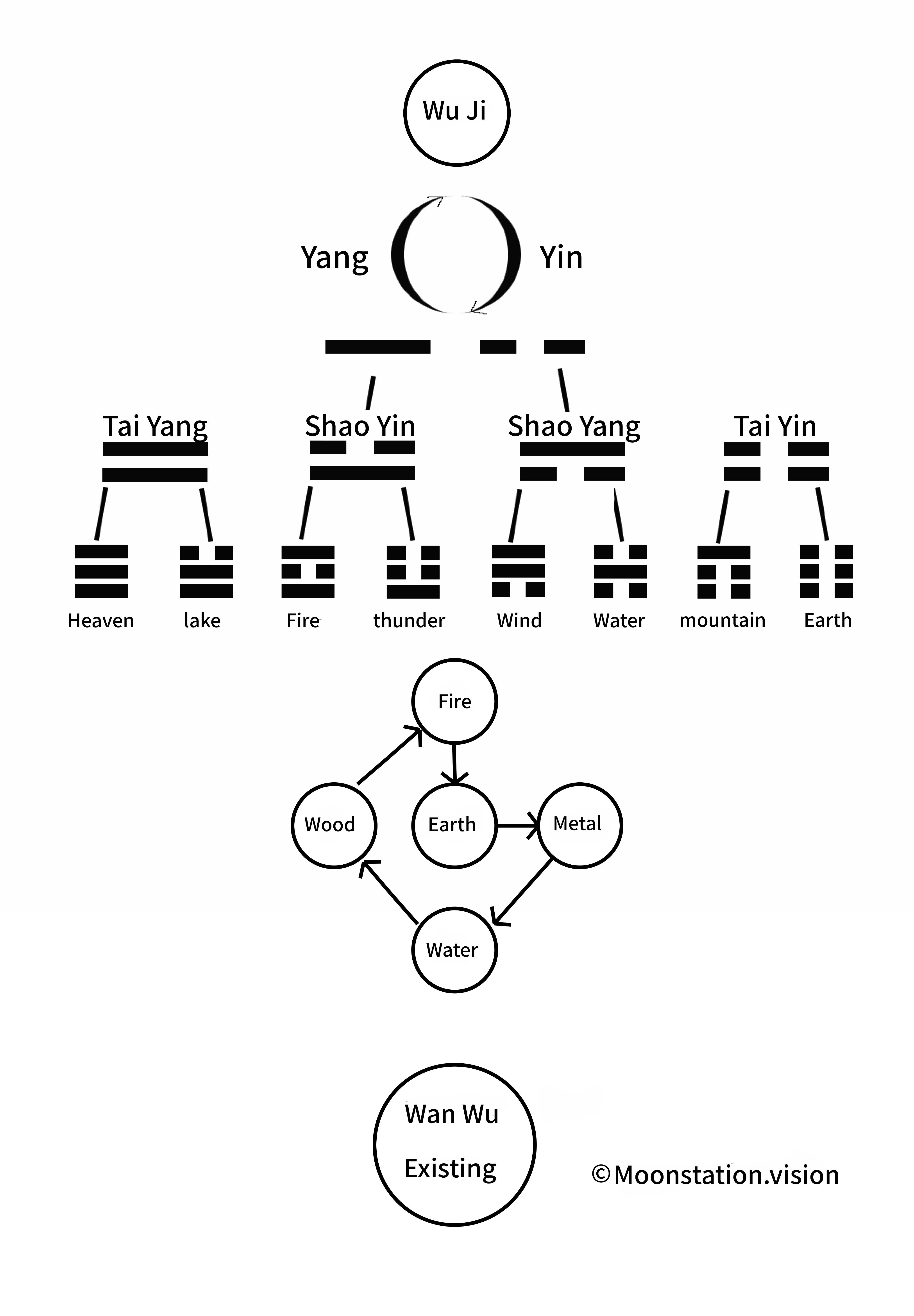
Shen is a direct expression of the soul originating in the cosmic mother energy: Wu Ji, the Great Void, that absolute potential in which Yin and Yang are united in perfection. This is the source of the universe, pure awareness not yet divided into form or definition. This awareness is neither emotion nor thought: it is void or the knowing beyond knowing. In this sense, Shen is not a "product" of the mind, but rather part of what is termed "the source of all things."
Shen carries with it the spark of the supreme spirit, a particle of pure consciousness descended into the world from the void. The purpose of that particle is to realize celestial potential within earthly existence: to embody a form, experience reality, undergo movement, emotion, connection, choice, and struggle. All of these are required so that the spirit may know itself through the mirrors of life. One can liken this to an idea taking form in physical reality through practical realization.
Even before birth, while the fetus is in the womb, the process of embodiment begins. In the third month of pregnancy, Shen enters the developing body, and a subtle coordination between spirit and body commences. Every building organ, muscle, nerve, or tissue becomes a vessel for the soul. This is a period during which Shen remains in its celestial quality, but with birth the next stage occurs: the transition from the Early Heaven chart to Later Heaven, from idea to realization, thus beginning the life journey in this world.
Shen is not a goal unto itself, but our true and sole essence. When it is balanced, a person is present, the Heart is open, consciousness is clear, and existence is saturated with meaning. One is capable of loving, understanding, expressing, feeling, directing, and evolving. Conversely, when Shen is unsettled, a person feels detached, unfocused, haunted by anxiety or emptiness, mixed with a sense of lacking clear direction and holding a loose inner connection to oneself, essentially living with the feeling of not knowing who one is.
And finally, one must remember: Shen is the root of all things. It is the longing, the hope, and the Heaven seeking integration. It embodies and clarifies itself to us through life itself, through self-knowledge and friction with life situations, hardships, obstacles, and hope. This is our soul, which is the only thing that knows the way, signaling to us and pointing toward it through the distractions of daily life.
Shen - Between Heaven and Earth
The central difference between the celestial level and the physical level is the difference between absolute potential and actual experience. While in the universe of void (Wu Ji) there exists pure logic, complete awareness, and absolute unity, one must understand that there is no emotion, intellect, or practical application there, hence no conflict, no karma or choice: there is only an idea world of possibilities. In contrast, in the existing physical world or realm of matter, there is body, time, space, and density.
Every experience in the world begins with Shen, and it is already an expression because it contains the choice to experience. In the next stage, the physical-corporeal, there is emotion, movement, difficulty, learning. There is deliberation because there is practical work and action in matter, constituting the connection between idea and realization. A connection between Heaven and Earth.
The connection between Heaven and Earth passes through this tension between void and fullness. This is a process we experience every moment. A continuous reincarnation of spirit in the body in various forms. Why? We came to learn, and therefore learning must be experienced from several directions. This is described in Chinese cosmology through the Eight Trigrams, the Five Elements, the Ten Stems, and the Twelve Branches. The Stem expresses celestial potential, and the Branch earthly realization. This is the connection between Yin and Yang, between upper and lower, between potential and reality.
As a pre-natal idea, Shen dwells in the Heart, seemingly protected and illuminated because it has not yet experienced. In the body of awareness there is no emotion, intellect, or mode of thought, hence no pain. In the world of spirit, the soul is eternal, and as it experiments in the world of the body, experience turns into emotional knowledge, enriching consciousness, for learning increases: a consciousness nourished by the way emotion and lessons have been absorbed into it.
Within each of us exists a divine spark, a particle of the whole seeking to experience itself. Each carries a unique idea brought to expression through choice, personality, and journey, and this is destiny.
At the moment of conception, the "descent into the world" occurs: Shen distances itself from the source, creating an experience of lack. A longing and sense of loneliness emerge, not due to a flaw, but because the entity knows that once it was part of the whole, and this is the fracture of missing unity. The entire journey of life is an attempt to return to that same connection, to that same source: through love, relationships, closeness, yearning, creation. The more Shen lives in the body, the more it identifies with it, and thus yearning also exists within the body, through emotion. It manifests through coping with pain, change, limitation, and lack. In this sense, life is not a test, but a game of experience. A game wherein Shen seeks to navigate, preserve, and discover its uniqueness. To open once more to that subtle path connecting us to the place from whence we came. Connection to the divine, to Wu Ji, occurs not through escape from existence, but through complete presence of selfhood within existence.
The Heart - Dwelling Place of Shen and Emperor of All Organs
The dwelling place of Shen is in the Heart: it is the Emperor. It is that which enables eternal connection with the source. When the Heart is open, clear, and maintains a healthy flow of Qi, all life experiences, emotional, sensory, and mental, become clear, joyous, and understood. Such a person will walk one's path not according to external dictations, but according to inner feeling.
Consciousness is not a fixed or finished thing. It is an emerging process of experiences, emotions, insights, and accumulated life experiences. This consciousness shapes itself, fills with meaning, and becomes living knowledge only within a material body. Though the Heart guards Shen, in life's experiences it can be distracted or diverted by wounds, unprocessed emotions, recurring thoughts, and a sense of detachment from essence. When this happens, Shen is injured and a person clings only to what is visible to the eye. One will believe the five senses while denying the broader, more subtle reality, that which resides behind the scenes of consciousness, in the fields where the subtle movement of Qi occurs.
We are all nourished by the same celestial energy, from the same source. The seven emotions (joy, fear, worry, grief, anger, anxiety, and overthinking) are not obstacles in themselves. On the contrary, they are essential to the journey. Yet they can also become an obstacle for the Heart, a fog obscuring the correct direction.
The intention of awareness is for Shen to be that which leads the way. Not the body, not fears, not automatic patterns. When human consciousness is guided by matter alone, imbalance is born, and diseases arise from the physical overwhelming the spiritual. Lack of emotional flow, fixation, unresolved emotion, and a rigid thought pattern: all of these can disrupt Qi movement in the Heart, unsettle Shen, and become the root of disease, spiritual blindness, and loss of path. Shen manifests in the eyes; thus in a balanced state the Heart shines. There is quiet, joy, presence, clarity. When there is internal restlessness, anxiety, confusion, sleep difficulties, or lack of focus, it is a sign that Shen is diverted or disconnected.
In extreme situations, we see this as mental disorders, but the process begins much earlier, in loss of internal control and the Heart's inability to shine and rejoice. One of the deep properties of Shen is that it governs the remaining spiritual aspects, Hun, Yi, Po, Zhi, enabling coordination among them. When harmony exists, all parts of the mind respond to the Heart and move in harmony. Each expresses a different movement of Qi, yet all are reflections of the same core.
HUN - The Ethereal Soul (魂)
The HUN, the "ethereal soul," is the spiritual aspect of the Liver (LIV), constituting an integral part of the mind's entirety in Chinese medicine. If Shen is the spark connecting us to Heaven and divine awareness, Hun is the spirit of vision and initiative. It is that which allows us to dream, plan, imagine, hope, create, and strive forward.
In cultural translation, it is sometimes termed the "wandering soul," as it is considered a Yang conscious force exiting the boundaries of the body during sleep. It is responsible for the realms of dreams, imagination, and the subconscious. Ancient texts speak of three Hun and seven Po, where the three parts of the Hun represent the higher spirit in man, that which strives to ascend and unite with Heaven after death.
Hun dwells in the Liver, requiring the anchoring of Liver Blood and Yin to stabilize and move correctly. "The Liver stores Blood, and Blood anchors the Hun": this means that without physical anchoring, the ethereal soul may float, wander, and get lost.
Hun carries a quality of celestial Yang Qi: moving upward, opening, initiating, expanding. In its action it complements the Po, the "corporeal soul" linked to the Lungs, which is Yin and responsible for connection to Earth. Together they create a movement of balance between Heaven and Earth: one pulling upward (Hun), the other downward (Po).
Yet while Shen connects to the mother energy (Wu Ji), to the element of the void and the absolute, Hun connects to the collective subconscious, to a broad information system operating beneath the surface, primarily in sleep, dreaming, and reverie. It echoes from Heaven yet is not one with the source, and is therefore considered a secondary celestial spirit, one mediating between supreme potential and earthly mental and conscious action.
During sleep, Hun is highly active. It scans, wanders, processes, releases, digests emotions, and connects a person to hidden parts of the soul. This is a process of connecting to deep information, to unconscious inner layers, and at times even to knowledge lacking logical explanation, because Hun operates in realms beyond waking consciousness. One could say that during sleep a person walks a path of awareness impossible during wakefulness, and Hun leads this path due to its connection with Blood.
The Connection with the Body and Blood
The quality of Hun's operation depends directly on the quality of Blood. The higher the quality of Liver Blood and Yin, the more anchored, calm, sharp, and directed Hun is. When Blood is weak, Hun wanders without an anchor, dispersing, bringing feelings of confusion, restlessness, difficulty in planning, difficulty in making decisions, or irritability and frustration against a backdrop of unfulfilled self-realization. Disturbing dreams or insomnia are classic expressions of an unanchored Hun.
On the physical level, wandering of Hun manifests also in symptoms related to the Liver: lateral headaches, vision problems (the Liver opens to the eyes), feelings of stagnation, or unexplained frustration. It is advisable to promote in treatment the strengthening of Liver Blood to "anchor the Hun," as well as creative expression, writing, movement, painting, or speaking, to allow a person to express oneself and generate emotional and conscious movement.
When Hun is balanced, a person feels connected to vision and internal direction. One possesses the ability to imagine the future, formulate goals, and take clear steps to realize them. One experiences inspiration, mental flexibility, and a sense of meaning, even when the path is challenging.
When there is an excess of Hun, the spirit wanders too much; ideas appear and disappear without the ability to realize them. This can be an escape into realms of illusion and lack of presence. Therefore, it is always important to bring this energy back to the ground.
PO - The Corporeal Soul (魄)
Po is termed in Chinese medicine the "corporeal soul," representing the spiritual aspect of the Lungs. It is the Yin of the mind, the earthly, concrete aspect, that which pulses in the physical body and dissipates with it at death. If Hun is the celestial ethereal soul, Po embodies the deep connection to Earth, matter, body, touch, smell, sound, breath, and survival itself.
Po dwells in the Lungs and acts through the system of immediate sensations and reflexive responses: responsible for primary instincts such as hunger, sleep, drive, crying, laughter, embodying the capacity for existence and direct physical response to the world. It drives breath, is responsible for physical expression, sensitivity to touch, intuitive survival, protection, and withdrawal during threat.
Po operates through the five senses, yet also beyond them: processing sensation and turning it into experience. It is the threshold between outside and inside, between what occurs in space and the body's ability to contain and react. Therefore, Po is also the regulating spirit: closing or opening the boundaries of the body, filtering, protecting, allowing, or blocking, depending on the state of Qi and emotional history.
Through its connection to the Lungs, Po is also responsible for mental survival, not merely through physical drives, but through the ability to cope with loss, grief, deep emotional pain, and the sense of existence. It is that which allows us to "release" grief, clear space for new movement, and return to breathing life. It connects also to the skin, which is the person's external boundary, reflecting the degree of ability to feel safe and distinct.
Balanced Po manifests in: deep breathing, vital physical sensation, ability to cry and release, healthy sensory enjoyment, listening to the body and its signals, ability to be here and now, in the body, in the moment.
Weak Po causes: weak respiration, chronic fatigue, difficulty in physical vitality, gloom, sense of emptiness, withdrawal, difficulty releasing grief, holding onto memories, skin problems, difficulties in feeling safe.
Excess Po manifests in: clinging to matter, over-indulgence of senses, addiction to immediate action, difficulty parting, letting go, releasing.
In the clinic we see expressions of Po deficiency in a picture of a person "detached from the body," unable to be present, alive, forgetting to eat, shallow breathing, a "numb" feeling in limbs, or difficulties with touch.
Po is that which generates the need for emotional and physical safety. It requires a defined environment, clear boundaries, permanence. It does not "seek inspiration" like Hun, but seeks definition, certainty, home. It knows that life is transient, and does not react well to uncertainty because it is responsible for survival; hence it mobilizes vast energy for regulation and control: creating a safe, familiar, stable, controlled space.
A survivalist worldview leads to emotional expressions of fear, anxiety, or trauma arising frequently from Po, not merely as a sense of external danger, but as a breach of an inner boundary. It needs Yang so as not to sink, be drawn inward, withdraw, and disconnect itself. It needs movement, warmth, and light to remain active.
Po has a deep connection also to the eyes and ears, the central receptive instruments of sensation. A decline in hearing, difficulty in vision, or loss of sensory sensitivity points to injury to Po. This is not merely physical, but also emotional: the person fails to feel reality, to identify where one begins and the other ends, because the ability to set boundaries weakens. Po strives for physical and mental survival, but also for touch, connection, and full presence. The ability to be in the body, to breathe, to feel, is an act of Po. And as long as balance exists with Hun, a delicate dance occurs between sensation and spirit, between survival and creation.
YI - Intellect, Thought, Intention (意)
Yi is the mental aspect of the spirit. It expresses thought, intention, memory, and attunement. It is responsible for the ability to process experiences and transform them into ordered, applied knowledge. Yi dwells in the Spleen, operating as the mental processing center of the body-mind: responsible for the process wherein something from outside passes through the senses, is processed in thought, added to emotion, and internalized into consciousness. The word "Yi" is composed of the characters for "Heart" (心) and "Sound/Language," teaching that thought is not a purely intellectual process, but an emotional one as well. It echoes from the Heart, taking form through inner listening. This is the connection between intellect and emotion, between idea and content; Yi translates what the eye sees and the inner self feels into insight.
While Shen in the Heart symbolizes high awareness, the spiritual spark, Yi expresses the capacity to think, process, and focus. It connects what exists and is visible to a network of understanding. It dives into what exists to break it down, categorize, sharpen, and comprehend.
When Yi is balanced, a person is quiet, focused, curious, capable of learning, internalizing, and drawing conclusions. When it is weak, a person becomes scattered, troubled, obsessive, inundated with thoughts, or alternatively staring, forgetful, drained. A person's ability to think clearly depends on the energy of the Spleen, enabling Yi to function. Just as the Spleen digests food and converts it into energy, so Yi digests information and converts it into knowledge.
Yi operates in stages: sensory intake (touch, sound, sight, taste, smell); impressions (initial impression, beginning of reaction); processing and logic (analysis, comparison, thought, judgment); emotional joining (is it pleasant? familiar? threatening? exciting?); conclusion (the experience becomes part of consciousness). Thus, information flows from the outside in, from the sensory world into the Heart. Yi is the bridge: helping us not only to understand, but also to internalize; thinking life through until it turns into conscious knowledge generating habits.
Yi is responsible for concrete learning: studying a profession, understanding instructions, remembering details, and memorizing. This is the knowledge nourishing function. But it also integrates with emotional learning: through the Heart, through accumulated experience. For example: parenting, partnership, trust, friendship, these are learned through time, sensation, pain, or joy. Shen and Hun bring these, but to process it all mentally and draw conclusions, to understand what operated, Yi is that which pours words into experience, and meaning into words, as it defines concepts.
When awareness is open (through SHEN), Yi also opens to ideas arriving "from above" through intuition, inspiration, inner urge.
When the Heart is quiet, and Shen is calm, Yi can function in harmony: digesting, thinking, remembering, and stabilizing.
Yi in Weakness or Excess
Excess Yi is excess thoughts: worry, over-analyzing, preoccupation with detail, shallow sleep, mental fatigue.
Weakness of Yi: difficulty in learning, forgetfulness, lack of concentration, lack of focus, thought passivity.
Treatment in this state includes not merely physical strengthening of Spleen Qi, but balancing thought and emotion, processing and understanding, moving from "I received information" to "knowing."
The thought of Yi is maintained by the ground (Earth); it requires stability, sequence, warmth. It needs the Heart's warmth to act. The Spleen operates well when nourished by the Heart (Fire nourishes Earth), and when there is joyful warmth, worry transforms into gentle attention and discernment. The more Yi operates from the Heart, the clearer and more lucid it becomes.
ZHI - Will, Aspiration, Perseverance (志)
Zhi is the deep seed of the will. It carries aspiration, perseverance, and the ability to move forward even when the path is unclear, driven by an inner urge. This is the place in the soul that knows the goal, even if it cannot always translate it into words. It is the source of inner strength taking an idea and guiding it over time until it turns into reality.
Zhi dwells in the Kidneys, in the Water element: the place where primordial potential resides. It is like an subterranean spring: the water is deep, carrying with it the root, existential memory, the Jing. From there the will emerges.
The character 志 is composed of "Heart" (心) and a component of "moving forward," teaching that the will is a Heart deciding where to turn.
When speaking of will, it is not a momentary drive or spontaneous wish ("I feel like" or "I fancy"), but a deep inner force, born of awareness, thought, emotion, solidifying into an internal knowing that is not always logical: a will that asks not "what is worthwhile for me," but "what is right for me."
When Zhi is balanced, a person is connected to oneself. One perseveres not out of compulsion, but out of knowing what must be done. One flows and follows inner movements that ultimately grant direction through sensation.
When Zhi is weak, unsettled, or suppressed, a sense of emptiness develops, along with inner fatigue, lack of motivation, difficulty holding intention over time. It does not always look like fear or avoidance; sometimes it is simply mental exhaustion.
On the other hand, excess Zhi, an unbridled Yang will, can bring compulsive ambition, a relentless race, exhausting both Heart and Kidneys, a state where the goal harms the journey because everything is done without attention to the path itself.
The connection between Zhi and Yi is important. Yi, belonging to the Spleen, represents intention, concentration, thought. It refines an idea and brings it to the Heart's approval. Zhi takes that raw idea and guides it forward.
True will always includes an emotional component. It is not merely "logical thought," but a quiet emotional maturation occurring within a person, sometimes taking years before seeking expression. In this sense, Zhi touches a very thin line between fulfillment and avoidance: a person may know what one wants yet avoid doing it. Not out of fear, but because one is unsure of knowing or being capable. One's will has not yet matured, and hence at times the will is not "weak," but simply awaiting maturation and the right time.
True will is not something that fades away. It does not depend on the opinion of others, nor is it transferred outward. It remains, even when you are alone.
People identified with the Water element Yin, for example, do not always know what they want. Not because they lack will, but because they have an issue understanding their boundaries, alongside a vast capacity to surrender, listen, and flow. They will ask the waitress what to order, not only because they cannot choose, but because they feel without always knowing how to express or pinpoint the situation in words. This is confusing: on one hand it can be a weakness of Yi (confusion, lack of focus), yet on the other hand it is a genuine capacity to be open and let the world decide for you.
When balance is absent, this can lead to lack of meaning, fatigue, chronic confusion. Will is not built, not realized, not executed. All of this relates to Water-Earth relationships, because thought (Yi) is unfocused, does not sink inward, and does not allow Zhi to solidify.
Zhi is not built by force. One cannot "demand a person to know will." But one can listen with a person to that quiet place within. Allowing emotion to surface and letting the will have its say. Not out of planning, but out of recognition. This is a place where treatment becomes a true journey, not guidance for strengthening motivation, but discovering what truly holds one from within. To which voice one is ready to listen. In other words: will is not the urge to act, but the courage to know where you are going even when there is no clear path.
Summary
The five spirits (Shen, Hun, Po, Yi, Zhi) are not mere theory; they are the map of the living human mind, a reflection of Heaven in a living, feeling, deliberating, creating, and falling body. Each operates as a layer of consciousness connected to an organ, an emotion, a movement, an element, together creating the unique texture of who we are.
Within them are memory and instinct (Po), imagination and creation (Hun), thought and direction (Yi), will and perseverance (Zhi), and broad consciousness (Shen): yet only when harmony exists among them does a person feel whole.
True treatment is not merely "balancing organs," but a renewed reconnection among the parts of the mind. The goal is not merely resolving a symptom, but reawakening vitality, the inner voice, the bridge between body and soul. When a person remembers who one truly is, not merely through the eyes of others but through the reflection of the Heart, the spirits unite, and consciousness dwells quietly in the body. "When the Heart is calm, Shen dwells in its home. And from there, everything begins."
The Seven Emotions
What Is an Emotion?
In Chinese medicine, emotion belongs to the Water element, and is mistakenly associated solely with fear. Why mistakenly? Because emotion is far broader than a fixed definition, containing within itself all human emotions, including those with which we are uncomfortable. It is worth noting that there are more emotions than the "7 emotions," but in the Chinese classics this is the source. Dealing with additional emotions will need to find discussion in another article (e.g., hatred, control, rebelliousness, procrastination, etc. All of these are also emotions).
Emotion is a complex linked to SHEN, while its action and belonging are that of the Water element. It flows and changes, moves, erupts, and recedes, operating independently and proving difficult to direct. It presents obstacles and difficulties, serving as a challenging factor. Its spring comes from the depth of things: speaking truth even when uncomfortable to the ear.
Emotion is a challenging mechanism because it clashes at times with rational thought patterns, and one can say this is one of man's central challenges: balancing intellect and emotion.
The seven emotions in Chinese medicine traditionally include: joy (喜), anger (怒), worry (忧), overthinking (思), grief (悲), fear (恐), and anxiety (惊). These emotions are defined as natural experiences inseparable from human life, and are not inherently negative. In a balanced state, appropriate emotional expression is part of proper Qi movement, expressing healthy adaptation to life events. Yet when an emotion becomes intense, overly sudden, prolonged, or inappropriate to the situation, it can disrupt the flow of Qi and harm the internal organs.
Fear
Fear constricts the movement of Qi and causes it to descend. This is a movement of internal contraction, at times reaching paralysis. It belongs to the Water element, touching the roots of the will, deep memory, and a person's inner affinity to oneself. Fear evokes an intense experience of helplessness, usually before something possessing a name, an event, an image, or an expectation; yet the distance between the event and the feeling within, between outside and inside, creates an empty space, a place where information is lacking, and thus the feeling is unsettled.
A prolonged feeling of fear harms Shen. It causes a continuous inward withdrawal, a detachment from interactions, encounters, and experiences that might touch again upon the sense of threat. Thus an internal lock is created, Qi constricts and preserves within itself, and no genuine emotional movement can occur. Consciousness cannot transform fear into a corrective emotional experience through outward movement into the Wood element (action-expression).
And in truth, fear, like any emotion, seeks to evoke movement. This is a call to action. But for this to happen, one must recognize the different forms in which it appears: fear of feeling: avoidance of direct emotional encounter. Fear of pain, confusion, overflow: this is fear of the Heart. Fear of experiencing: self-reluctance from experimentation. Fear of tasting, touching, opening, and experiencing: SHEN fear or soul fear. Fear of losing control: overly strong self-holding that locks Qi and prevents things from simply happening and flowing.
When fear (Water) meets no expression or possibility of action (Wood), it turns into paralysis. And when Shen loses tranquility and is threatened, a person's ability to settle within the situation is unsettled. The realization that Water is everywhere is also the realization that behind all things hides fear. Restoring movement to the fear factor is the key to release.
Anxiety
Unlike fear, whose origin is usually clear and defined, anxiety is a feeling of fear regarding what is about to occur, yet without knowing precisely what. It does not warn against a real external danger, but seeks to move within a fog of hidden, future threat that approaches without necessarily materializing. Anxiety is usually accompanied by a vague, elusive physical sensation whose source is unclear: accelerated heart rate, heaviness or restlessness in the abdomen, disrupted breathing, frequent urge to urinate, or complete freezing. Yet this is merely the outer shell of a deeper process, a conscious movement expanding outward uncontrollably.
Anxiety expands the field of attention. The senses heighten, attention scatters outward as if seeking to locate the threat, yet the more it searches, the more it becomes lost. Consciousness departs from its safe internal space, creating an experience of loss of control.
In other words: anxiety is an emotional and physical response to the intensity of unprocessed information. Something outside the person flows toward oneself, penetrating one's field, yet one fails to contain it. There is insufficient grounding, no system to filter. This can happen at a train station, in a crowded gathering, standing in line at the post office, or at a party. The object is not important, but rather the internal feeling of being overwhelmed, the scattering of Water and Fire, and the loss of center. The feeling that what transpires cannot be understood and processed, and the body tenses, threatening to collapse under the load of the experience.
Anxiety is directly related to an unbalanced state between Heart and Kidneys (Fire-Water). When the Heart remains without the grounding and depth of Water, a person feels scattered. And when Water is unstable or devoid of quiet, it pulls Fire inward and extinguishes the sense of life. Time and again, anxiety seeks only one thing: to be observed and defined, for definition itself narrows back the sense of breached boundaries, allowing movement to be restored.
Anger
Anger is an emotion moving Qi upward. It generates heat, arouses Yang, and brings about a breach of inner boundaries, one violating order, yet at times saving the soul due to the possibility of airing out the interior (the fears and apprehensions). It appears when something deep within us is no longer willing to remain silent (Wood), when things do not proceed as expected (Earth), when our boundary is violated (Metal), when there is no justice (Metal), when our path receives no place (Fire).
Anger belongs to the Wood element seeking to grow, burst forth, and expand; yet when this movement is blocked, Wood struggles to move life energy forward, generating stagnation and frustration, at which point anger surfaces, and it is not necessarily negative. It carries the possibility of releasing trapped emotions, exposing truth, and airing pain and fears. Yet when anger takes control, it burns.
In an energetic sense, anger blocks Liver Qi, affects the Heart (through the Generating Cycle: Wood creates Fire), unsettles the connection to Water (which is supposed to nourish Wood), and leads at times to a cycle of suffering wherein fear nourishes anger and anger exacerbates fear.
Anger is not an enemy: it is movement and drive. It seeks recognition. And when receiving recognition, it can transform into passion, creativity, an engine of change driving our actions in life.
Joy
Joy belongs to the Heart and the Fire element. It occurs when life energy flows in harmony, when the Heart is open, when a person momentarily touches the simple truth of existence, consenting to accept what transpires as it is. This is the sole emotion expressing a distinctly celestial frequency, a connection to an inner spark illuminating for a moment the world and inner existence. A sense of deep gratitude, a smile, laughter, expansion of the Heart, release of effort. Yet joy also has boundaries.
Excess joy, euphoria, disrupts balance. This is a state where the Heart becomes overly excited, speech becomes profuse and unnecessary, tempo accelerates, and there is a sense of elevation ungrounding a person. This excess can harm the function of SHEN, because the Heart is the Emperor, and when it goes out of balance, the entire entity is unsettled.
True joy, that which brings healing, occurs naturally, attentive to natural, cyclical ebbs and flows. A balanced person accepts what exists and what occurs, measuring the event not by "level of joy," but by the value of the experience. This frees existence from conditionings of mood or social role taken on as the center of attention. Hence, true joy stems not from centralism, but from integration within society and gratitude for what does exist. This encourages joy.
Worry
Worry is an accompanying expression of "overthinking," linked to the Earth element. The primary effect is on the Spleen, because excess thought weakens Spleen Qi, causing it to sink downward, encouraging the accumulation of dampness and phlegm in the body, mostly collecting in the Lungs.
Worry itself arises from the desire to understand or resolve a situation before its time has arrived. It seeks immediate clarity, certainty, or sense of security, often out of a sense of responsibility or belief that one must act or influence, even when the situation is not within one's control. In other words: a person worries over situations linked indirectly, not always respecting the free choice of those existing, living, or acting nearby. In most cases, burrowing into worry alongside recurring thoughts creates a loop devoid of solution, producing mental fatigue.
The link between excessive worry and the digestive and respiratory systems is clear: excess dampness, digestive difficulties, congestion, a feeling of heaviness, or shortness of breath; all of these reflect the heaviness of worry sitting upon the body and weighing down systems. It causes a person to wallow in the problem, deepening it until finding a solution, a solution arriving in many cases precisely when one releases or becomes indifferent to it.
Grief
Grief belongs to the Lungs and the Metal element. It is an emotion closing and constricting Lung Qi movement. When appearing in sudden separation or loss such as bereavement, it can create a sharp constriction of Lung Qi, at times collapsing Spleen Qi as well. The result can appear as depression, deep fatigue, emotional and physical exhaustion.
Yet grief does not always belong to the moment alone. At times it brings a deeper echo, the sum of all separations, losses, and moments when we were forced to release something precious. All these gather in inner memory, appearing as a wave of pain the mind is not always able or ready to contain.
Chronic grief, that accompanying a person over time, can turn into a fixed pattern of melancholy: a state where Lung Qi gradually weakens, and a person attempts to restore a sense of stability and security through habits, rituals, and repetition that over time express compulsive behavior. These create a sort of "artificial self-control," an attempt to hold tightly onto what exists so as not to experience again the loss of form and boundaries.
Overthinking
Overthinking belongs to the Spleen and the Earth element. This is not a distinct emotion like anger or joy, but rather a conscious state, a quiet yet pervasive pattern operating beneath the surface, daily affecting quality of life. Thought is a natural action of the mind, designed to process, understand, learn, and attune. Yet when thinking does not cease, when it is circular, exhausting, or returning repeatedly to the same questions, it no longer contributes to insight or knowledge, but drains strength.
Excess thought exhausts Spleen Qi. It weakens its function in digesting food, but no less in digesting life. The Spleen is responsible for our ability to nourish ourselves, physically and emotionally. When we are troubled, bothered, "chewing" repeatedly on the same issues without reaching a solution, we create internal dampness, lack of clarity, and conscious heaviness.
In the physical aspect, this can manifest in a sense of heaviness in the body, fatigue, digestive problems, cloudiness, or a frequent need for sweets. In the mental aspect, difficulty in letting go, a constant need to know, understand, control.
Overthinking usually stems from our need to hold onto something stable, a sense of security, certainty, clear direction. Yet paradoxically, the more we think out of worry or restlessness, the more Earth weakens.
True healing lies not in eliminating thought, but in creating spaces within it. Letting it settle by itself. Trusting that quiet knows far more than effort. Reminding ourselves that what is meant to be resolved will resolve even without us forcing it upon reality.
Body, emotion, and consciousness are intertwined like three layers (Heaven-Man-Earth). In Chinese medicine there is no true separation among them; they appear together, change together, and seek a balance suited to who we are, in this moment.
The true work is not to eliminate emotion, become addicted to control, or tame the mind, but to learn the movement of life within us. To honor each person's path, structure, tendency, wound, and search.
Healing is the capacity to balance the needs of body and mind and bring them into function within a harmonious system.